Introduction
Welcome to the final lesson of our course! Over the past several weeks, you have built a powerful foundation for excellent English pronunciation. You started by understanding the physical mechanics of speech, learned to produce every individual vowel and consonant in English, mastered the "music" of the language through word and sentence stress, and just last week, you practiced the shadowing technique to develop natural rhythm and intonation.
Today, we will bring all of these skills together. Our goal is to fulfill the final learning outcome of this course: to create a structured daily practice routine targeting your specific pronunciation challenges. This lesson will provide you with a clear, sustainable framework that you can use long after this course is over to continue improving and achieve your career goals. Consistency is the key to lasting improvement, and a well-designed routine will be your guide on the path to confident, clear English.

1. The Power of a Daily Routine
Think of pronunciation practice like physical exercise. A single workout is good, but consistent training is what builds strength, flexibility, and endurance. In the same way, daily pronunciation practice builds "muscle memory" in your tongue, lips, and jaw. This makes producing new English sounds feel automatic and effortless over time.
A consistent routine is especially helpful for you as you continue to adjust to your braces. Regular, gentle exercises can help your mouth adapt more quickly to the physical changes and reduce any tension. Let's start with a video that introduces this concept of a pronunciation "workout."
15 Minute Morning Pronunciation Practice for English Learners
In this clip from '15 Minute Morning Pronunciation Practice', Hadar Shemesh explains why a daily routine is so effective for building control over your articulation organs.
Watch the first minute of the video, from 00:00 to 01:00. Notice the comparison she makes between pronunciation practice and a physical workout.
This idea of a daily workout forms the core of our plan. We will structure your 30-minute practice session around three key pillars: a physical warm-up, focused practice on specific challenges, and application in realistic contexts.
2. The Three Pillars of Your Practice Routine
A balanced routine ensures you are not just drilling sounds in isolation but are also preparing your body for speech and integrating your skills into natural communication.
Pillar 1: The Physical Warm-Up (10-15 minutes)
Before you can practice sounds effectively, you need to warm up the tools you use to make them. This is crucial for improving your control and is also beneficial for releasing any jaw tension that might be associated with your braces.
The following video provides an excellent and complete warm-up routine.
15 Minute Morning Pronunciation Practice for English Learners
Let's continue with Hadar's '15 Minute Morning Pronunciation Practice' video. It contains a series of exercises to prepare your jaw, tongue, and lips for speaking.
Follow along with these exercises from 01:23 to 06:56. Jaw Massage (01:23 - 02:12): This is excellent for relaxing the muscles around your jaw, which can be tense with braces. Tongue Warm-up (02:12 - 05:43): These exercises will improve your tongue's agility and strength. Lip Warm-up (05:43 - 06:56): This helps you practice lip shapes needed for sounds like /w/ and /f/.
Making this warm-up a daily habit will significantly improve your physical ability to produce English sounds clearly.
Pillar 2: Focused Practice on Your Challenges (10-15 minutes)
After warming up, the next step is to target your specific pronunciation challenges. As a native Hindi speaker, there are common patterns that are useful to be aware of. The best way to practice is to focus on one specific challenge each week.
The following resources will help you identify these challenges and give you exercises to overcome them.
English for Urdu and Hindi Speakers: 10 Pronunciation Challenges
This article, 'English for Urdu and Hindi Speakers: 10 Pronunciation Challenges', provides a clear overview of common difficulties. It is an invaluable resource for identifying what to work on.
First, read the summary list under the headings from 'Challenge #1' to 'Challenge #10'. As you read, think about which of these you have noticed in your own speech. Then, click the link on the page to download the FREE workbook with audio recordings. This workbook will be the source of your focused practice drills.
Once you have downloaded the guide, you can structure your focused practice for the week. Here is the process:
- Identify a Weekly Goal: Choose one challenge from the guide to focus on for the entire week (e.g., distinguishing /v/ and /w/, or producing consonant clusters).
- Understand the Mechanics: Review the explanation for that sound in the guide or watch the relevant section in the accompanying video. For example, for the /v/ and /w/ sounds, understanding the difference in lip and teeth placement is key.
- Drill with Minimal Pairs: Use the word lists and audio in the downloaded guide to practice. Say the words out loud, paying close attention to the mouth movements. Record yourself and compare your pronunciation to the audio.
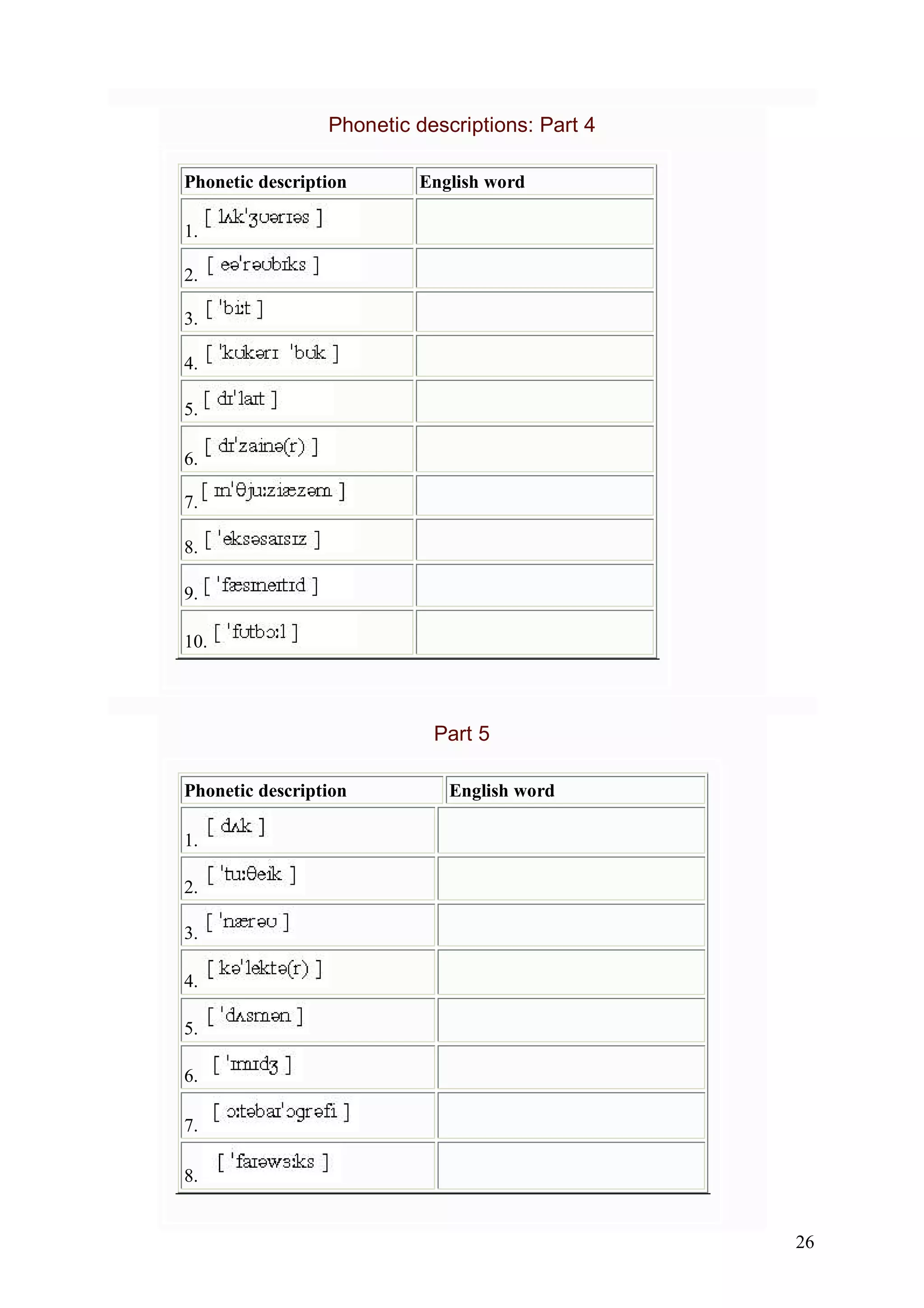
- Use Other Tools: You can also create your own exercises. For instance, you could find words with your target sound and write them out phonetically, like in the exercise below, to reinforce the connection between the symbol and the sound.
Pillar 3: Application and Integration (5-10 minutes)
The final part of your daily routine is to move from isolated words to connected speech. This is where you apply what you've practiced.
The best technique for this is shadowing, which you learned in our last lesson.
- Find a short audio or video clip (1-2 minutes) of a native speaker.
- Set your intention for the shadowing exercise to be the challenge you are focusing on that week. For example, if your focus is on the /θ/ sound ('think'), listen carefully for every time the speaker uses it and do your best to mimic it perfectly.
Another excellent application technique is simply reading out loud. This was also recommended as a way to adjust to speaking with braces.
Braces Speech: Proven Strategies for Clearer Pronunciation
This article, 'Braces Speech: Proven Strategies for Clearer Pronunciation', reinforces the value of daily practice.
Read the section 'Tips to Improve Braces Speech Adjustment'. Notice the recommendations like 'Read Out Loud Daily' and 'Repeat Difficult Words'. This is exactly what the application phase of your routine is for.
3. Your Personal Weekly Practice Plan
Now, let's put it all together into a sample weekly schedule. You can adapt this template to fit your needs.
| Day | Duration | Activity |
|---|---|---|
| Monday | 30 minutes | Plan the Week: 1. Physical Warm-up (10 min). 2. Choose ONE new challenge for the week from your Hindi-speaker guide (e.g., consonant clusters). 3. Study the concept and listen to the audio examples (20 min). |
| Tue-Thu | 30 minutes | Practice & Apply: 1. Physical Warm-up (10 min). 2. Drill the weekly challenge using word lists from the guide. Record yourself. (15 min). 3. Shadow a 2-min video, focusing on finding and imitating your target sound/feature (5 min). |
| Friday | 30 minutes | Review & Consolidate: 1. Physical Warm-up (10 min). 2. Read a short article out loud, trying to correctly use the sound you practiced all week. Record yourself. 3. Listen to your recording and evaluate your progress. (20 min). |
| Sat-Sun | Flexible | Listen Actively: Rest from speaking practice, but listen to English podcasts or watch movies. Try to notice the pronunciation features you have learned throughout this course. |
Conclusion
Congratulations on completing this course! You have dedicated yourself to mastering the details of English pronunciation, and you now have a comprehensive toolkit to continue your journey.
Key Takeaways:
- A structured daily routine is the most effective way to build lasting pronunciation skills.
- Your 30-minute routine should be built on three pillars: a physical warm-up, focused practice on specific challenges, and application through shadowing or reading aloud.
- Use the provided resources, especially the downloadable guide for Hindi speakers, to identify and target your personal challenges week by week.
- Consistency is more important than intensity. A little practice every day will lead to significant improvement over time.
You now possess all the knowledge and techniques needed to become a truly independent learner. By following this practice structure, you can continue to refine your speech, build your confidence, and move closer to your professional goals of succeeding in job interviews and working abroad. Keep practicing, stay curious, and you will achieve the clear, confident English you are aiming for. Well done