Welcome back. In our last lesson, we explored the divine necessity for prophethood and established the universal scope of Prophet Muhammad's (PBUH) mission. We saw through Quranic verses and Prophetic traditions that his message was not for a single tribe or era, but for all of humanity for all time.
Today's lesson is a direct and crucial consequence of that universality. We will address the learning outcome: Explain the doctrine of Finality of Prophethood (Khatm-e-Nabuwwat) with Quranic and Hadith evidence and analyze its theological and contemporary significance. This doctrine holds that Prophet Muhammad (PBUH) is the very last prophet, and the chain of divine revelation has been completed and sealed with him. Understanding this concept is not just an academic exercise; it is a fundamental tenet of Islamic faith, agreed upon by all mainstream schools of thought throughout history.
The Cornerstone of Finality: Quranic Evidence
The belief in the finality of prophethood, or Khatm-e-Nabuwwat, is anchored in an explicit verse of the Quran. This verse serves as the ultimate textual proof for this doctrine.
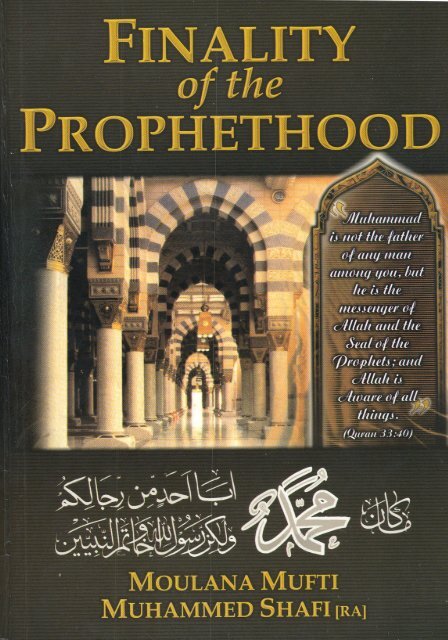
The verse states:
"Muhammad is not the father of any of your men, but he is the Messenger of Allah and the Seal of the Prophets (Khātam an-Nabiyyīn). And Allah is ever, of all things, Knowing." (Quran 33:40)
To fully grasp the weight of this verse, we must analyze its context and the linguistic meaning of the term Khātam an-Nabiyyīn. The late scholar Syed Abul A'la Mawdudi provides a masterful analysis of this.
Finality Of Prophethood - IIUM
In this excerpt from his renowned treatise, Mawdudi dismantles alternative interpretations and provides a rigorous linguistic and contextual analysis of the term "Khatam-al-Nabiyyin". This level of detail is precisely what is needed to construct a robust argument for your CSS exams.
Please begin by reading the section that explains the context of Surah Al-Ahzab, verse 40. Then, proceed to the sections titled "The Verdict of the Text of the Qur'an" and "The Dictionary Meaning of the Word 'Khatam-al-Nabiyyin'." Focus on how the context refutes interpretations of "seal" as a "stamp" for future prophets, and how Arabic lexicography confirms the meaning of finality and closure.
As you've just read, the analysis is conclusive on several fronts:
- Contextual Meaning: The verse was revealed to settle a social issue related to the Prophet's marriage to Zainab (RA), the divorced wife of his adopted son, Zaid (RA). By declaring him the final prophet, Allah established that if the Prophet (PBUH) did not abolish this pre-Islamic taboo, no prophet of comparable authority would ever come after him to do so. An interpretation of 'stamp' or 'most exalted' would make no sense in this context.
- Linguistic Meaning: The Arabic root Kh-T-M unequivocally relates to closing, sealing, finishing, and coming to an end. Khatam al-Qawm means the last person of the tribe. The word does not mean a stamp that authenticates something that comes after; it means a seal that closes and finalizes what is inside.
A more concise summary, tailored for exam preparation, reinforces these points.
The Finality of the Prophethood - Cssprepforum
This article from a CSS preparation forum clearly defines the concept for an exam answer.
Please read the brief section "What is the concept of the Finality of the Prophethood?". Note how it succinctly links the finality to the universality of the message.
The Unbroken Chain of Evidence: Hadith and Consensus (Ijma)
The Prophet (PBUH) himself left no ambiguity on this matter. He clarified his status as the final prophet on numerous occasions. The sheer volume and consistency of these traditions are overwhelming.
Finality Of Prophethood - IIUM
This part of Mawdudi's work compiles a powerful list of authentic Hadith that directly address the finality of prophethood.
Please study the section titled "The Observations of the Holy Prophet(PBUH) About the Finality of Prophethood." Pay attention to the different metaphors he used, such as the famous analogy of the "final brick in the edifice of prophethood," and his explicit warnings about "thirty imposters" who would claim prophethood after him.
This massive body of Hadith evidence led to one of the strongest forms of consensus (Ijma) in Islamic history.
-
Consensus of the Companions (Sahaba): Immediately after the Prophet's death, several false prophets arose, most notably Musaylima al-Kadhdhab ("the Liar"). Musaylima did not entirely reject Prophet Muhammad (PBUH); he claimed to be a partner in prophethood. The first Caliph, Hazrat Abu Bakr (RA), with the unanimous support of all the Companions, waged war against him. The followers of Musaylima were not treated as political rebels but as apostates, demonstrating that the Sahaba considered the claim to new prophethood after Muhammad (PBUH) as a departure from Islam itself.
-
Consensus of the Scholars (Ulema): From the first century after the Prophet (PBUH) until today, there has been an unbroken consensus among all major scholars and jurists—from Imam Abu Hanifa to Imam Ghazali to Shah Waliullah—that Muhammad (PBUH) is the final prophet and anyone who claims otherwise is outside the fold of Islam. This is not a sectarian issue; Sunni, Shia, and all other mainstream schools of thought are united on this creedal point.
Theological and Contemporary Significance
Why is this doctrine so fundamental? Its significance is both theological, related to the structure of the faith, and contemporary, related to the cohesion of the Muslim community.
Theological Significance:
- Perfection and Preservation of Deen: The finality of prophethood implies that the religion of Islam is complete. Allah says, "This day I have perfected for you your religion..." (Quran 5:3). A perfect and complete message needs no additions or successors.
- Protection from Corruption: It seals the sources of divine guidance—the Quran and Sunnah—from any new claims that could alter or abrogate them.
- Unity of the Ummah: By closing the door to new prophets, the doctrine provides a single, unchanging foundation for the global Muslim community (Ummah), binding them to one Prophet and one final revelation.
Contemporary Significance: A Case Study
The most significant contemporary challenge to this doctrine, particularly relevant in the context of Pakistan and the subcontinent, is the rise of the Ahmadiyya movement (also known as Qadianism) in the 19th century. Analyzing this movement provides a clear case study of why Khatm-e-Nabuwwat is considered a "red line" in Islamic theology.
The Finality of Prophethood | The Red Line of Tolerance pt. 2 | Isha Khatira | Shaykh Dr Yasir Qadhi
Shaykh Dr. Yasir Qadhi, in this lecture, provides a detailed historical and theological analysis of the Ahmadiyya movement. This will help you understand the nature of the challenge to the doctrine and the response from the mainstream Muslim world, which are crucial points for a CSS question on this topic.
Please watch the following segments carefully: First, the overview of the movement's founder, Mirza Ghulam Ahmad, and his gradual claims, from being a reformer to claiming prophethood from this point. Note his reinterpretation of Khatm-e-Nabuwwat as a "stamp" and his claim to be a "shadow" prophet here. Pay close attention to his controversial teachings, such as the abrogation of Jihad against the British, and the nature of his "revelations" in this section. Finally, observe the response from prominent Muslim figures like Allama Iqbal and the official declarations by the state of Pakistan and the Organisation of Islamic Cooperation (OIC) here.
The case study you just watched highlights the practical implications of the Finality of Prophethood. The consensus of the Ummah—from individual scholars like Allama Iqbal to pan-Islamic bodies like the OIC and the state of Pakistan (through its constitution)—has been to consider this movement as being outside the fold of Islam precisely because it violates this foundational doctrine. This is not a matter of politics or intolerance, but a direct application of a core theological principle established by the Quran, Sunnah, and 14 centuries of consensus. This distinction is vital for a nuanced exam answer.
It is also important to clarify that the second coming of Jesus (Prophet Isa - PBUH), which is foretold in authentic Hadith, does not contradict the finality of prophethood. The traditions specify that he will return not as a new prophet with a new law, but as a follower of Prophet Muhammad (PBUH), ruling by the Shariah of the Quran and Sunnah.
Conclusion
In this lesson, we have established that the doctrine of the Finality of Prophethood is an undeniable and non-negotiable principle of Islam. It is not an interpretation but an explicit declaration of the faith.
Key Takeaways:
- Core Doctrine: Khatm-e-Nabuwwat means Prophet Muhammad (PBUH) is the final prophet, and the institution of prophethood is sealed forever.
- Definitive Evidence: This belief is unequivocally established by the Quran (33:40), a vast number of authentic Hadiths, and the unanimous consensus (Ijma) of the Companions and all subsequent generations of scholars.
- Theological Importance: It signifies the perfection and preservation of Islam's divine message and serves as a guarantor of the unity of the Ummah.
- Contemporary Significance: It acts as a bulwark against schism and heresy. The unified stance of the Muslim world against movements like Qadianism, which challenge this finality, serves as a powerful modern-day example of its importance in preserving the integrity of the faith.
Having firmly established the universal and final nature of the Prophet's (PBUH) mission, we are now positioned to examine his transformative impact on society. In our next lesson, we will evaluate the Prophet (PBUH) as a Reformer in Makkah, analyzing the profound social, moral, and spiritual changes he initiated in the pre-Islamic Arabian landscape.