Welcome to the first lesson of our module on the Islamic Economic System. In our previous module, we concluded by examining how to apply Islamic judicial principles to reform modern legal systems, focusing on Pakistan. We now shift our focus from the state's legal framework to its economic philosophy. Your ability to articulate the foundations of Islamic economics is essential for the CSS exam, not just as a standalone topic, but as a basis for comparative analysis with other systems like capitalism and socialism.
Today's lesson addresses the learning outcome: Analyze the philosophy, objectives, and distinctive features of the Islamic economic system, grounding the analysis in Quranic principles and Prophetic traditions. We will explore the core worldview that shapes Islamic economics, define its ultimate goals, and identify the unique principles that set it apart from conventional economic models. This foundational knowledge will be the bedrock for the more detailed topics we'll cover in subsequent lessons.
1. The Guiding Philosophy: Economics as a Moral Discipline
Before diving into specific rules, it's crucial to understand the philosophy that underpins the entire Islamic economic system. Unlike conventional economics, which often treats economic activity as a separate, value-neutral domain, Islam integrates it fully with faith, law, and social duty.
The following resource provides a concise and clear definition of Islamic economics, distinguishing it from a mere focus on banking or charity.
Islamic Economics: Definitions, Principles, Key Concepts & Objectives
This article from AIMS Education introduces the holistic nature of Islamic economics. It establishes that economic life is inseparable from moral and spiritual responsibility.
Please read the first three paragraphs of the article, from the introduction, and then the subsection titled Definition and Scope. Focus on how the system aims for a goal that is much broader than material prosperity alone.
As the reading makes clear, Islamic economics is a Shariah-guided framework. This means that all economic actions—earning, spending, investing—are subject to moral evaluation. Two core philosophical concepts define this worldview:
a) The Ultimate Goal: Falah (Holistic Well-being)
Conventional economics often measures success through metrics like GDP growth, profit maximization, or utility. The ultimate goal of the Islamic economic system is Falah—a comprehensive term that encompasses well-being, success, and prosperity not only in this world but, crucially, in the Hereafter.
The following video clip explains that economic activity in Islam is a means to an end, not an end in itself, and highlights the accountability for wealth on the Day of Judgment.
What is Islamic Economic System? Key Principles, Features & Benefits | AIMS Education
This video from AIMS Education frames the importance of economics within the larger context of one's purpose in life.
Watch the segment from the beginning. Pay close attention to the Hadith mentioning the five questions on the Day of Judgment, two of which are directly related to wealth.
This focus on Falah fundamentally changes the nature of economic decision-making. An action that might maximize profit but causes social harm or spiritual degradation would be deemed a failure from the perspective of Falah.
b) The Principle of Trusteeship: Tawhid and Amanah
The second pillar of this philosophy is rooted in Tawhid (the Oneness of God). In Islamic thought, Allah is the true and ultimate owner of all resources. Human beings are merely His trustees or vicegerents (khalifah) on Earth, holding wealth as a trust (Amanah).
This principle is clearly stated in the Quran:
“Believe in Allah and His messenger, and spend of that whereof He hath made you trustees; and such of you as believe and spend (aright), theirs will be a great reward.” (Surah Al-Hadid, 57:7)
This concept of trusteeship has profound implications:
- It counters human arrogance: It reminds the wealthy that their fortune is a gift and a test from God, not purely the result of their own genius.
- It redefines ownership: Private property is respected, but it is not an absolute right. It is a responsibility that comes with duties towards God and society.
The lecturer in the next video provides an excellent explanation of this mindset of humility and responsibility that the concept of Divine provision is meant to instill.
A Fascinating Introduction to Economics in Islam with Jamal Harwood
In this video from Blogging Theology, Jamal Harwood discusses how the Quranic emphasis on Allah as the ultimate provider shapes the moral foundation of Islamic economics.
Please watch from the discussion of Surah Fatir. The speaker elaborates on how this creedal point engenders humility, generosity, and a sense of custodianship over wealth.
2. The Objectives of the Islamic Economic System
Flowing from this core philosophy are a set of clear objectives. These goals are not arbitrary but are derived from the Maqasid al-Shariah (the higher objectives of Islamic law), which seek to preserve and promote faith, life, intellect, lineage, and property. The economic system is a primary vehicle for achieving these societal goals.
Islamic Economics: Definitions, Principles, Key Concepts & Objectives
This section connects the economic goals directly to the Maqasid al-Shariah.
Please read the subsection Maqasid al Shariah and Economic Goals. As you read the bulleted list of objectives, consider how each one contributes to building a just and stable society.
Based on this, we can summarize the key objectives as follows:
-
Establishment of Socio-Economic Justice ('Adl): This is the paramount objective. The system aims to ensure fairness in all dealings, protect individuals from exploitation, and guarantee that everyone's basic needs are met. The state has a direct responsibility in this regard. The story of Caliph Umar (RA) discovering a woman pretending to cook for her hungry children is a powerful historical illustration of the state's role in ensuring this objective is met.
-
Equitable Distribution of Wealth: The system actively works to prevent the concentration of wealth in the hands of a few. The goal is not to enforce absolute equality of outcomes, but to ensure broad circulation and prevent hoarding. The Quran states this principle clearly:
"...so that it (wealth) may not merely circulate between the rich among you." (Surah Al-Hashr, 59:7)
Mechanisms like Zakat and the laws of inheritance are designed specifically to achieve this objective. -
Guaranteeing Individual Freedom within a Moral Framework: Islam encourages private enterprise, work, and earning a livelihood. However, this freedom is not absolute. It is bound by the ethical limits of Halal (lawful) and Haram (unlawful) to ensure that economic pursuits do not lead to social or moral corruption.
-
Eradication of Poverty: Islam treats poverty not as an inevitability but as a problem to be solved decisively. The state is obligated to ensure that the basic needs of every citizen—food, clothing, and shelter, as well as education and healthcare—are fulfilled, regardless of their faith.
The seriousness with which Islam addresses poverty is powerfully captured in a statement attributed to Caliphs Umar (RA) and Ali (RA): "If poverty were a man, I would kill it." The following video clip provides further evidence of this deep-rooted commitment.
A Fascinating Introduction to Economics in Islam with Jamal Harwood
Jamal Harwood highlights Islam's uncompromising stance on poverty eradication, citing Hadith that link a believer's faith to their concern for their neighbor's well-being.
Watch the segment from the prophet sallallahu alaihi wasallam. Note how the Prophet (PBUH) connects the act of letting a neighbor go hungry directly to the quality of one's own belief.
3. Distinctive Features and Principles
To achieve its philosophy and objectives, the Islamic economic system employs several distinctive principles and mechanisms. These are not merely suggestions but are legally binding rules derived from the Quran and Sunnah.
The following infographic provides an excellent high-level comparison between the Islamic and conventional economic models across key dimensions. We will use it to structure our analysis of the system's unique features.
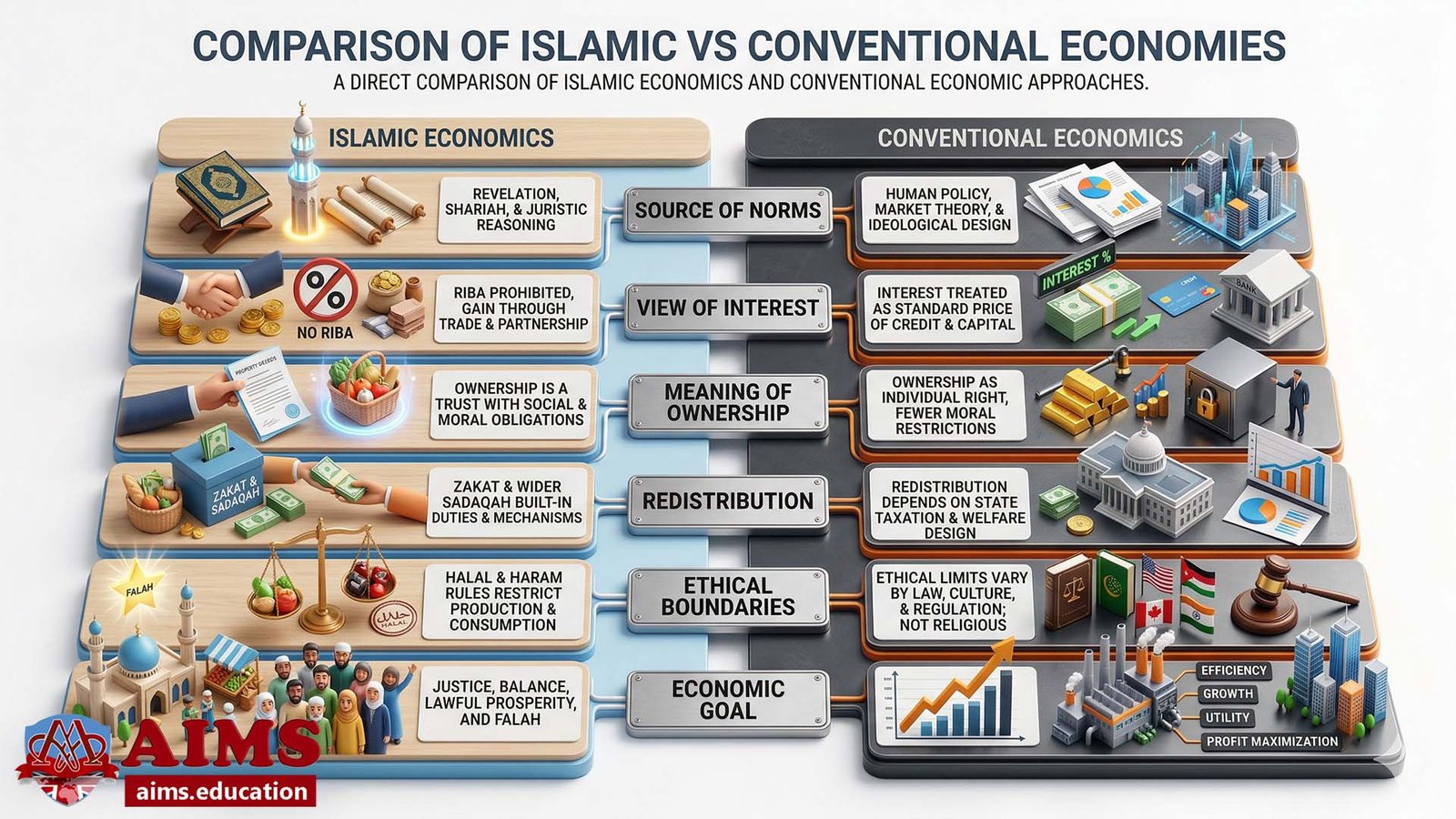
Let's break down these distinctive features with supporting evidence.
[PDF] Principles of Islamic Economics In The Light Of the Holy Quran and ...
This academic paper provides further detail on the foundational principles and characteristics of the Islamic economic system, with numerous references to Quran and Hadith.
Please review the following sections in this paper: The subsection Right of Property on page 48. The two principles listed under Basic Principles on page 51. The list of characteristics under the heading "Few features/characteristics..." starting on page 51. Focus on points 1, 2, 5, 6, and 7.
Drawing from the infographic and the readings, we can identify the following core features:
-
Source of Norms (Revelation): As the infographic shows, the rules are derived from the Quran and Sunnah, not from human-devised ideologies, market theories, or political expediency. This provides the system with a stable, divine anchor.
-
Prohibition of Riba (Interest): This is perhaps the most well-known feature. Riba refers to any predetermined, guaranteed increase on a loan. It is unequivocally forbidden.
“...Allah has permitted trade and has forbidden Riba...” (Surah Al-Baqarah, 2:275)
The rationale is that Riba allows wealth to grow without any productive effort or risk-sharing, leading to the exploitation of the needy and the concentration of wealth. Lawful profit from genuine trade and partnership is, however, strongly encouraged. -
Prohibition of Gharar (Excessive Uncertainty) and Maysir (Gambling): The system requires transparency and clarity in contracts. Transactions involving major ambiguity or speculation that amounts to gambling are prohibited to protect all parties from exploitation and disputes.
-
Obligatory Redistribution through Zakat: Unlike optional charity, Zakat is an obligatory annual levy on the wealth of affluent Muslims. It is a legally established right of the poor and a mechanism for purifying the wealth of the giver. It serves as a powerful, built-in tool for wealth circulation and social security.
-
Emphasis on Wealth Circulation and Prohibition of Hoarding: Wealth is meant to be a dynamic force in the economy, not idle. Hoarding wealth is condemned in the strongest terms.
“And those who hoard up gold and silver and do not spend it in the Way of Allah, announce to them a painful torment.” (Surah At-Tawbah, 9:34)
The obligation of Zakat itself acts as a strong disincentive to hoard, as idle wealth diminishes by 2.5% each year, encouraging its investment in productive enterprises. -
Clear Ethical Boundaries (Halal and Haram): The economy is not a free-for-all. There are clear prohibitions on producing, trading, or investing in goods and services considered harmful or immoral, such as alcohol, pork, and gambling. This ensures that economic growth does not come at the cost of social and moral well-being.
Conclusion
In this lesson, we have laid the groundwork for understanding the Islamic economic system. We have moved beyond superficial definitions to analyze its deep philosophical and moral foundations.
Key Takeaways:
- Guiding Philosophy: The Islamic economic system is a moral discipline guided by Shariah, with the ultimate goal of achieving Falah (holistic well-being). It is built upon the creedal concept of Tawhid, where Allah is the true owner and humans are His trustees (Amanah).
- Core Objectives: The system aims to establish socio-economic justice ('Adl), ensure the equitable circulation of wealth, eradicate poverty, and allow individual economic freedom within a clear moral framework.
- Distinctive Features: The system is defined by principles derived from revelation, including the absolute prohibition of Riba (interest) and Gharar (uncertainty), the obligatory nature of Zakat for redistribution, a strong injunction against hoarding, and clear ethical boundaries based on Halal and Haram.
Now that you have a firm grasp of these foundational concepts, you are prepared to engage in the comparative analysis required for the CSS exams. In our next lesson, we will do just that, as we delve into the learning outcome: Compare the Islamic economic system with Capitalism and Socialism, focusing on ownership, wealth distribution, and the role of the state.