Greetings. In our last lesson, we examined how Hazrat Abu Bakr (RA) consolidated the nascent Islamic state by preserving its divine constitution through the compilation of the Quran and establishing its economic foundation with the Baitul Maal. He secured the state's survival and provided the essential pillars upon which his successor could build.
Today, we transition from foundation to architecture. If Hazrat Abu Bakr (RA) was the consolidator, Hazrat Umar ibn al-Khattab (RA) was the master architect of the Islamic state's administrative machinery. His ten-year caliphate (634-644 CE) was a period of unprecedented expansion, but more importantly, it was an era of profound institutional innovation. Our objective is to analyze the administrative reforms of Hazrat Umar (RA), focusing on the Majlis-e-Shura and provincial governance system, and evaluating them through modern public administration principles. This analysis is critical for your CSS preparation, as it moves beyond historical narrative to the practical science of statecraft, a frequent area of examination.
1. From Community to Empire: The Challenge of Governance
Hazrat Umar (RA) inherited a state rapidly transforming into a vast, multicultural empire. The challenge was immense: how to govern territories stretching from Persia to Egypt, incorporating diverse populations, while remaining faithful to the Islamic principles of justice (Adl), consultation (Shura), and accountability. His response was not ad-hoc; it was a systematic and visionary program of institution-building.
UMAR IBN AL-KHATTAB: THE MAN BEHIND WESTERN POLITICAL IDEALS
The video "UMAR IBN AL-KHATTAB: THE MAN BEHIND WESTERN POLITICAL IDEALS" provides an excellent overview of this transition. It frames his caliphate as the pivotal moment when a young religious community was transformed into an organized state with lasting institutions.
Please watch the first part of the video, from the beginning to 02:59. Pay close attention to how his leadership is described as establishing "accountable government, equitable law, social welfare, and moral statecraft." Note the establishment of structured institutions called Diwans (state departments) and how these were seen as the "infrastructure to sustain justice at scale."
As the video illustrates, Hazrat Umar's (RA) genius lay in creating a formal state bureaucracy capable of managing a large-scale empire. Let's dissect two of his most significant administrative structures: the Majlis-e-Shura and the provincial system.
2. The Majlis-e-Shura: Institutionalizing Consultative Governance
The principle of Shura, or consultation, is a cornerstone of Islamic governance, mandated by the Quran:
"...And consult them in the matter. Then, when you have taken a decision, put your trust in Allah..." (Surah Aal-e-Imran, 3:159)
While the Prophet (PBUH) and Hazrat Abu Bakr (RA) practiced consultation, Hazrat Umar (RA) was the one who gave it a formal institutional shape through the Majlis-e-Shura (Consultative Assembly). This was not a modern elected parliament, but a body of the most knowledgeable and trusted companions, which operated on two levels:
- Majlis-e-Aam (General Assembly): Comprising a wider group of Muslims in Madinah, convened for matters of utmost national importance, such as announcing a major policy or during a crisis.
- Majlis-e-Khas (Council of Advisors): This was the real engine of governance. It consisted of the most senior companions from the Muhajirun and Ansar, who met regularly with the Caliph to deliberate on all major state affairs, including legislation, appointment of governors, fiscal policy, and military strategy.
This body acted as a cabinet and a proto-parliament. No major decision was taken unilaterally. This formalization ensured that governance was based on collective wisdom rather than the singular opinion of the ruler, thereby enhancing the legitimacy and quality of decisions.
Evaluation through Modern Principles:
- Participatory Governance: The Majlis-e-Shura is a clear historical precedent for participatory and deliberative governance, a central tenet of modern democratic theory. It ensured that the community's leadership was involved in statecraft.
- Policy Formulation & Think-Tank: It functioned as a strategic think-tank, allowing for robust debate and analysis before policies were enacted. This process minimized error and aligned state actions with the public interest (maslaha).
- Strengthening Legitimacy: As the article "Islamic Political System Under Khilafat-I-Rashid'" notes, this "consultative approach allowed for diverse perspectives and minimised the risks of unilateral decisions, underscoring Islam’s value for inclusive governance."
3. The Provincial Governance System: Balancing Decentralization and Control
To effectively manage a sprawling empire, Hazrat Umar (RA) established a sophisticated system of provincial administration. He divided the empire into provinces (e.g., Kufa, Basra, Syria, Egypt) and implemented a structure built on a brilliant system of checks and balances, a concept highly relevant to your study of Pakistan's own administrative history.
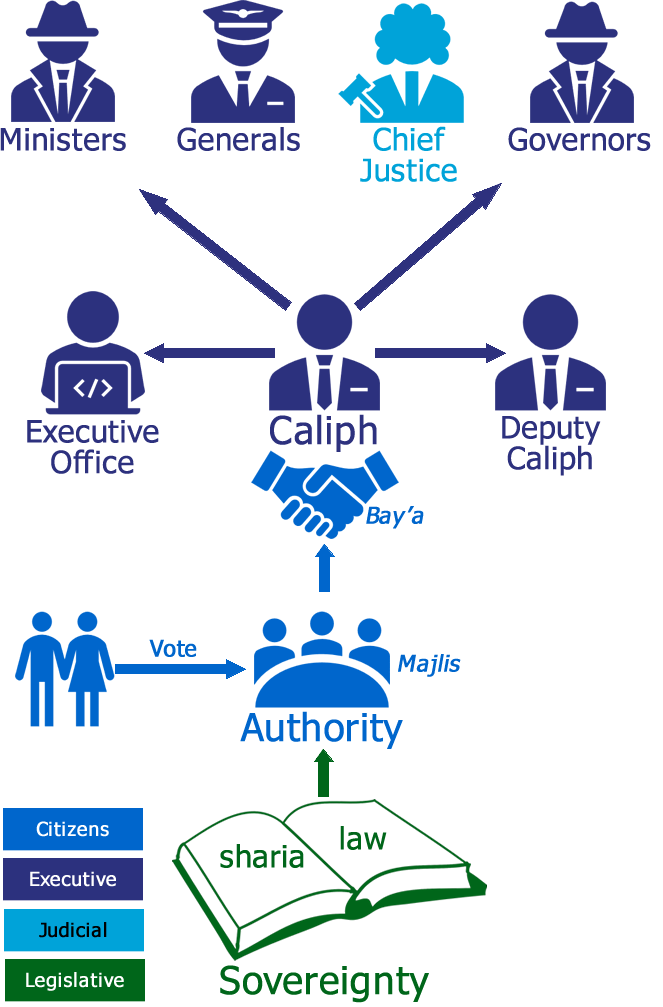
The structure for each province was as follows:
- Wali (Governor): The chief executive and military commander of the province.
- Qadi (Judge): Crucially, the Qadi was appointed directly by the Caliph and was independent of the Wali. His sole responsibility was judicial matters.
- Sahib-e-Baitul Maal (Finance Officer): Also appointed by and reporting directly to the Caliph in Madinah, this official was responsible for the provincial treasury, collecting taxes, and managing expenditures.
- Katib-ud-Diwan (Chief Secretary): Responsible for maintaining all official records.
This structure was a masterstroke of administrative design. By separating executive, judicial, and financial authorities, Hazrat Umar (RA) prevented the concentration of absolute power in the hands of any single provincial governor, thereby minimizing the risk of rebellion or tyranny.
The Epistles of Hazrat Umar (RA) and Hazrat Ali (RA) to Public ...
This article highlights the administrative philosophy of Hazrat Umar (RA) and the moral framework he established for his officials.
First, read the short introduction on "Pragmatic Governance" to understand his overall approach. Then, jump to the section "The Moral Framework for Governance." Read the subsections on Merit-Based Appointments and Consultation (Shura). This will clarify the principles that guided his selection of governors and his decision-making process.
4. Mechanisms of Accountability: The Steel Frame of Governance
A structure is only as good as its enforcement. Hazrat Umar (RA) enforced this system with rigorous accountability mechanisms that are strikingly modern.
- Asset Declaration: When appointing a governor, the Caliph would document the official's total wealth. At the end of their tenure, their assets were audited. Any unexplained increase was confiscated and deposited into the Baitul Maal. This is one of history's first known anti-corruption policies based on asset declaration.
- Annual Hajj Assembly: All governors were required to attend the annual pilgrimage (Hajj) in Makkah. This served as an annual performance review. Here, in an open forum, any citizen from any part of the empire could lodge a complaint directly against a governor in the presence of the Caliph.
- Written Instructions (Epistles): Governors received detailed written instructions outlining their powers, responsibilities, and code of conduct. The famous letter to Abu Musa al-Ashari, the governor of Basra, is a timeless manual on judicial ethics and administrative justice.
- Rule of Law: The law was supreme, and no one was above it. There are numerous accounts of Hazrat Umar (RA) himself appearing in court before a Qadi to answer a claim made by an ordinary citizen, reinforcing the principle that the ruler is subject to the same laws as the ruled.
UMAR IBN AL-KHATTAB: THE MAN BEHIND WESTERN POLITICAL IDEALS
The documentary we watched earlier elaborates on these powerful accountability measures.
Now, watch the segment from 3:00 to 4:31. This section explains how he created an independent judiciary by separating judges from governors, a concept that mirrors modern separation of powers. It also details the groundbreaking anti-corruption policy of auditing governors' assets.
5. Evaluation Through the Lens of Modern Public Administration
When we evaluate Hazrat Umar's (RA) reforms using the vocabulary of modern public administration, the parallels are remarkable. His system anticipated many principles that were formally articulated in the West centuries later.
- Separation of Powers: The division of authority between the Wali (executive) and the Qadi (judiciary) is a clear, practical application of the principle of separating powers to ensure checks and balances and prevent abuse of authority.
- Rule of Law: His insistence that everyone, including himself, was subject to the law is the very definition of the Rule of Law, as opposed to the arbitrary Rule of Man.
- Accountability and Transparency: The annual assembly at Hajj, the open-door policy for complaints, and the auditing of assets are powerful tools of public accountability and administrative transparency, which are central to modern concepts of "good governance."
- Meritocracy: The principle of appointing officials based on competence and integrity (taqwa), rather than kinship or status, is the foundation of a modern, professional civil service.
- Weberian Bureaucracy: While anachronistic, his administration displays key characteristics of what sociologist Max Weber would later call a "rational-legal" bureaucracy: a clear hierarchy, division of labor, a system of written rules, and professional, salaried officials.
Islamic Political System Under Khilafat-I-Rashid' - Cssprepforum
This article reinforces the modernity of Hazrat Umar's (RA) reforms.
Read the section beginning with "ground-breaking administrative reforms" to see a summary of his key projects, including the provincial system. Then, read the "Critical Analysis" section, which explicitly connects his principles to modern concepts like transparency, meritocracy, and social cohesion.
Conclusion
Hazrat Umar's (RA) administrative reforms were not just a reaction to the needs of a growing empire; they were a proactive and systematic implementation of Islamic principles of governance. He created a durable and sophisticated state structure that was both decentralized enough to be efficient and centralized enough to be just and accountable.
Key Takeaways:
- Majlis-e-Shura: Hazrat Umar (RA) institutionalized the Quranic principle of consultation, creating a formal advisory council that served as a check on executive power and ensured collective decision-making.
- Provincial Governance: He designed an advanced provincial system based on the separation of executive, judicial, and financial powers, establishing a robust system of checks and balances.
- Modern Accountability: He implemented strikingly modern accountability tools, including asset declaration, public forums for grievances, and the supremacy of the rule of law.
- Precursor to Modern Administration: His reforms embody core principles of modern public administration, such as separation of powers, meritocracy, accountability, and a welfare-oriented state, making his caliphate a timeless case study in effective and ethical governance.
In our next lesson, we will delve deeper into Hazrat Umar's (RA) legacy by examining his equally revolutionary judicial and welfare reforms. We will analyze how he formalized the judiciary as an independent institution and further institutionalized the Baitul Maal into a comprehensive social welfare system.