Welcome to our fourth lesson. In our previous session, we explored the profound philosophical and spiritual dimensions of Tawheed, establishing it as the bedrock of Islamic faith. We analyzed its three core pillars—Rububiyyah, Asma was-Sifat, and Uluhiyyah—and understood it as a liberating force for the individual soul. Today, we will build directly on that foundation, moving from the personal to the public sphere.
This lesson focuses on the learning outcome: Analyze the socio-political implications of Tawheed on society and governance, citing Quranic verses and scholarly opinions. We will investigate how the singular belief in the Oneness of God translates into a comprehensive blueprint for a just, equitable, and accountable socio-political order. This is a critical topic for the CSS/PMS exams, as it forms the ideological core of Islamic governance and social justice.
From Divine Sovereignty to Human Equality
The most revolutionary socio-political implication of Tawheed is the concept of Hakimiyyah, or the absolute sovereignty of God. If Allah is the sole, ultimate Sovereign, then no human being—no king, priest, aristocrat, or assembly—can claim absolute authority over others. All human authority is delegated, temporary, and subservient to Divine Law. This principle serves as the ultimate check on tyranny and absolutism.
As Sayyid Abul A'la Mawdudi argued, this makes any claim of absolute human sovereignty a form of shirk (polytheism) in the political domain. The ruler is not a master but a vicegerent (Khalifah) and a trustee (Ameen), tasked with implementing God's will.
This vertical relationship of all humanity to a single Sovereign has a direct and inescapable horizontal consequence: the fundamental equality of all human beings. Since all people are equally subjects of the One God, no one can claim inherent superiority based on race, lineage, wealth, or nationality. The only criterion for value in the sight of God is righteousness (Taqwa).
The Quran makes this point with unparalleled clarity:
"O mankind, indeed We have created you from male and female and made you peoples and tribes that you may know one another. Indeed, the most noble of you in the sight of Allah is the most righteous of you. Indeed, Allah is Knowing and Acquainted." (Surah Al-Hujurat, 49:13)
This verse demolishes all man-made hierarchies. The Prophet Muhammad (PBUH) cemented this principle in his Farewell Sermon, a landmark declaration of human equality:
"An Arab has no superiority over a non-Arab nor a non-Arab has any superiority over an Arab; a white has no superiority over a black nor a black has any superiority over a white; except by piety and good action." (Sahih Muslim)
This egalitarian imperative is not merely a moral suggestion; it is the logical and theological endpoint of believing in One God.
Tawhid's Egalitarian Imperative: Dismantling Hierarchies… | The Grand Review
This article, written specifically for CSS/PMS aspirants, provides a robust analysis of how Tawheed serves as an engine for social justice. It connects the theological concept directly to its socio-political outcomes.
Begin by reading the Introduction to grasp the contemporary relevance of this topic. Then, move to the next section, "The Classical Foundation," and read it carefully. Pay close attention to how the author links Tawheed to equality using Quranic verses, Hadith, and the insights of classical and modern scholars like Mawdudi and Khurshid Ahmad.
The Structure of a Tawhid-Based Polity
The principles of Divine Sovereignty and human equality form the foundation upon which the entire structure of an Islamic political system is built. This structure is characterized by several key operational mechanisms.
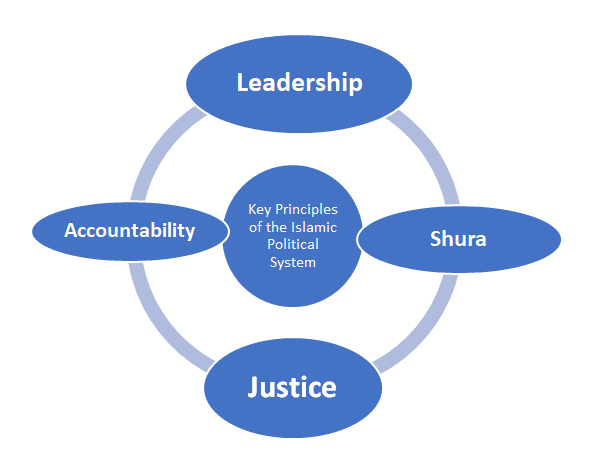
Let's explore these principles in detail.
-
Rule of Law: Since sovereignty belongs to God, His law (Shariah) is supreme. The ruler is not the source of the law but its chief enforcer. This establishes the principle that no one is above the law. The famous declaration of the first Caliph, Hazrat Abu Bakr (RA), upon assuming office, captures this perfectly: "Obey me as long as I obey Allah and His Messenger; but if I disobey them, you owe me no obedience."
-
Justice (
Adl) and Equality (Musawah): A society that acknowledges God as the ultimate Sovereign must strive to establish His justice on Earth. The Quran commands believers to "judge between people with justice" (Surah An-Nisa, 4:58). This justice must be universal, applied equally to all, regardless of status, as demonstrated by the Prophet (PBUH) when he stated that he would apply the law even to his own daughter, Fatimah (RA). -
Accountability: The ruler in an Islamic state has a dual accountability: vertical (to God, as a trustee) and horizontal (to the people, who have the right and duty to hold him accountable). Hazrat Umar's (RA) famous statement, "If a dog dies of hunger on the banks of the Euphrates, I will be held accountable for it," exemplifies the profound sense of personal responsibility this vertical accountability fosters. Horizontal accountability was institutionalized through public access to the ruler and the right to question their decisions.
-
Consultation (
Shura): The Quran praises the believers whose "affairs are conducted by consultation among themselves" (Surah Ash-Shura, 42:38). Since no human holds absolute authority, it is imperative for the leader to seek counsel from the community or its representatives on matters not explicitly decided by the Quran and Sunnah.
This article provides an excellent analysis of the core mechanisms of Islamic governance, grounding them in the concept of Tawheed.
Please read the following sections: Start with "The Foundations of Governance" to understand the direct link between Tawheed and the political structure. Continue with the subsections on Divine Sovereignty, Justice and Equality, and Accountability and Transparency. These sections provide Quranic evidence and historical examples from the Pious Caliphate that are invaluable for exam answers.
Tawheed's Imprint on Society
The implications of Tawheed extend beyond the formal structures of government to shape the very fabric of society.
- Unity and Brotherhood (
Ummah): By negating all other sources of loyalty, Tawheed creates a new, transcendent bond based on shared faith. This establishes the Ummah, a global community that supersedes tribal, racial, and national divisions. As the Quran urges: "And hold firmly to the rope of Allah all together and do not become divided." (Surah Al-Imran, 3:103). This creates a powerful force for social cohesion. - Freedom and Bravery: A true believer in Tawheed fears only Allah. This belief liberates the human spirit from the fear of creation—fear of tyrants, fear of poverty, fear of death. This liberation fosters immense courage and conviction, creating individuals and societies that are resilient and principled.
- Establishment of Social Justice: The consciousness that Allah is All-Knowing and All-Seeing, and that everyone is accountable to Him, fosters a deep-seated sense of social justice. Individuals are motivated to fulfill the rights of others—in family, in business, in neighborhood relations—not out of fear of state power, but out of a higher sense of duty to God. This internal moral compass is the most effective guarantor of a just society.
Lecture # 103 : Tauheed and its impact on individual and social life.
This lecture (in Urdu) provides a clear breakdown of the impact of Tawheed on both individual and social life, which is a common exam question.
Watch the segment on the impact on individual life, noting how traits like accountability, fearlessness (bravery), and modesty are cultivated. Then, watch the section on the impact on society, which explains how these individual traits aggregate to create a society defined by equality, unity, peace, and social justice.
Application to Governance in Pakistan
As a student of Pakistan Studies, you are well-positioned to analyze the application of these principles in the Pakistani context. Pakistan's identity as an "Islamic Republic" is constitutionally rooted in the principle of Divine Sovereignty.
- The Objectives Resolution, now a substantive part of the Constitution (Article 2A), begins by declaring: "Whereas sovereignty over the entire universe belongs to Almighty Allah alone, and the authority to be exercised by the people of Pakistan within the limits prescribed by Him is a sacred trust." This is a direct constitutional expression of Hakimiyyah.
- Article 2 declares Islam as the state religion.
- Articles 227-231 (the Islamic Provisions) mandate that all laws must be brought into conformity with the injunctions of the Quran and Sunnah.
These provisions create a constitutional framework for governance based on Tawhidic principles. However, the critical task for a civil servant is to analyze the gap between these ideals and the reality. The persistence of feudal power structures, class disparity, ethnic prejudice, and corruption represents a fundamental challenge to the egalitarian and just society envisioned by Tawheed.
Tawhid's Egalitarian Imperative: Dismantling Hierarchies… | The Grand Review
This final reading from the article connects our theoretical discussion directly to the Pakistani state.
Please read the section titled "Application to Governance: Islam in Pakistan's State Architecture." It critically examines how Pakistan's constitutional framework is informed by Tawheed and analyzes the challenges in applying these principles to issues of class disparity, ethnic discrimination, and economic inequality.
Conclusion
In this lesson, we have moved from Tawheed as a personal creed to Tawheed as a socio-political manifesto. We have established that the belief in One God is not a passive doctrine but a revolutionary force that reshapes society and governance from the ground up.
Key Takeaways:
- Sovereignty and Equality: Tawheed establishes the absolute sovereignty of God (Hakimiyyah), which in turn necessitates the fundamental equality of all human beings.
- Foundations of Governance: A Tawhid-based political system is built on the principles of the Rule of Law, universal Justice (
Adl), dual Accountability (to God and the people), and Consultation (Shura). - Societal Transformation: This belief fosters a cohesive society built on the universal brotherhood of the Ummah, liberates individuals from fear, and embeds a deep commitment to social justice.
- Contemporary Relevance: The principles derived from Tawheed provide a powerful framework for analyzing and critiquing modern governance, particularly in states like Pakistan that are constitutionally committed to Islamic injunctions.
Our analysis has highlighted the core principles of Islamic political theory. In the next lesson, we will place these ideas in a comparative context. We will compare and contrast Islamic political theory with Western democratic systems, identifying crucial areas of convergence and divergence. This will further sharpen your analytical skills for the comparative questions often asked in CSS/PMS exams.