Welcome to the first lesson of your customized course on Islamiat for the CSS and PMS examinations. Our goal in this initial session is to build a strong foundation by analyzing the sources of Islamic knowledge. Understanding the nature and authority of the Quran, Sunnah, Ijma, and Qiyas is not merely an academic exercise; it is the bedrock upon which all subsequent topics in Islamic law, governance, and ethics are built. For your exams, a deep, analytical grasp of these sources is essential for formulating well-reasoned arguments on contemporary issues.
Today, we will dissect the hierarchy of these sources, distinguishing between the divine primary texts and the secondary tools of human reasoning. We will explore how jurists derive rulings, the challenges of interpretation they face, and the mechanisms that give Islamic jurisprudence its intellectual rigor and dynamism.
The Architecture of Islamic Law
At the heart of Islamic jurisprudence, or Usul al-Fiqh, lies a structured hierarchy of sources from which laws and ethical guidelines are derived. These are traditionally categorized into primary and secondary sources.

- Primary Sources: These are the foundational, divinely revealed texts that constitute the ultimate authority. They are the Quran and the Sunnah of the Prophet Muhammad (PBUH).
- Secondary Sources: These are methodologies developed by scholars to derive rulings for new situations not explicitly addressed in the primary texts. The two most widely accepted secondary sources are Ijma (scholarly consensus) and Qiyas (analogical reasoning).
Think of this as an architect using a blueprint (the primary sources) and specialized tools (the secondary sources) to construct a complete and functional building. The blueprint is fixed, but the tools allow for its application to diverse terrains and modern requirements.
The Primary Sources: Revelation and Prophetic Example
The primary sources are the textual foundation of Islam, considered divine in origin and therefore holding the highest level of authority.
1. The Quran: The Unquestionable Foundation
The Quran is the literal word of Allah, revealed to the Prophet Muhammad (PBUH) over 23 years. Its authority is absolute. However, possessing the text is one thing; deriving law from it is another. This is where a crucial juristic distinction comes into play: the difference between a text's authenticity and the clarity of its meaning.
- Definitive in Authenticity (Qat'i al-Thubut): The text of the Quran has been transmitted through a process of tawatur—a massive, unbroken chain of narrators at every generation—making its authenticity definitive and beyond doubt.
- Definitive vs. Speculative in Meaning (Qat'i al-Dalalah vs. Zanni al-Dalalah): While the text is certain, the meaning of every verse is not always singular or unambiguous.
- Qat'i al-Dalalah (Definitive): These are verses with a clear, specific, and single meaning. The verses on inheritance shares (e.g., Quran 4:11) are a classic example. "One-half" means precisely that.
- Zanni al-Dalalah (Speculative): These are verses open to interpretation and scholarly reasoning (Ijtihad). For example, Quran 2:228 states that a divorced woman must wait for three quru'. While the number "three" is definitive, the word quru' is speculative, with some scholars interpreting it as menstrual cycles and others as clean periods between cycles.
For a deeper understanding of these concepts, let's turn to a couple of resources.
[PDF] the relevance of qiyas (analogical deduction) - Kashim Ibrahim Library
This paper provides a clear, structured overview of the sources. We will first focus on its explanation of the Quran.
Please read the section on The Qur’an (The Qur'an), followed by the subsections on its Contents and Characteristics. Pay close attention to the discussion on definitive (Qat'i) and speculative (Zanni) texts, as this concept is fundamental to understanding the entire field of Islamic jurisprudence.
[PDF] Persuasion and Authority in Islamic Law - eScholarship.org
This academic article offers a more advanced analysis of how legal arguments are constructed. It reinforces the Qat'i/Zanni distinction with excellent examples.
In the section titled "III. LOGOS", read the first few paragraphs discussing the distinction between definitive and probable textual implications. This will solidify your understanding of how jurists approach the sacred text with intellectual humility and rigor.
2. The Sunnah: The Prophetic Elaboration
The Sunnah refers to the model of the Prophet (PBUH)—his sayings (qawl), actions (fi'l), and tacit approvals (taqrir). It is transmitted through narrations known as Hadith. Its authority stems directly from the Quran, which repeatedly commands believers to obey the Prophet (e.g., Quran 4:59, 59:7).
The Sunnah serves three primary functions in relation to the Quran:
- Confirmation: It reiterates and reinforces rulings already present in the Quran.
- Clarification: It explains and provides details for general injunctions in the Quran. For example, the Quran commands prayer (Salat), but the Sunnah specifies the methods, timings, and number of units (rak'at).
- Initiation: It establishes rulings on matters not mentioned in the Quran. This category, known as Sunnah al-Mu'assisah (founding Sunnah), is also considered binding. An example is the prohibition of marrying a woman and her paternal or maternal aunt simultaneously.
Like the Quran, the authority of the Sunnah depends on both its authenticity and meaning. The science of Hadith criticism ('Ilm al-Rijal) was developed to meticulously assess the authenticity of narrations, classifying them as Sahih (Authentic), Hasan (Good), or Da'if (Weak). The most authentic Hadith are those transmitted via tawatur, which are very few, followed by widely-known (mashhur) and solitary (ahad) narrations. This classification determines the legal weight a particular Hadith carries.
[PDF] the relevance of qiyas (analogical deduction) - Kashim Ibrahim Library
Now, let's explore the second primary source in the same document.
Please read the section on The Sunnah (The Sunnah), focusing on its legal authority (Hujjiyyah), and its role as a source of law, particularly the three ways it relates to the Quran (as a Source of Islamic Law).
The Secondary Sources: Reasoned Extension of Law
When a new issue arises that is not explicitly addressed in the Quran or Sunnah, scholars turn to secondary sources. These are not new revelations but are structured, rational processes grounded in the primary texts.
3. Ijma (Consensus)
Ijma is the unanimous agreement of the qualified jurists (mujtahids) of a particular era on a point of law after the death of the Prophet (PBUH). Its authority is derived from prophetic traditions, most famously, "My community will never agree upon an error."
Ijma serves a powerful function: it elevates a speculative ruling (zanni) to the level of certainty (qat'i). When scholars, after examining all evidence, collectively agree on an interpretation, that interpretation becomes binding. The consensus on the compilation of the Quran into a single volume (mushaf) during the caliphate of Hazrat Abu Bakr (RA) is a prime example of a foundational Ijma.
For your CSS exam preparation, understanding the nuances of Ijma is very important. Let's watch a video lecture specifically designed for this purpose.
Sources of Islamic Law - Ijma | CSS Islamic Studies by Nearpeer
This video by "CSS Online with Nearpeer" breaks down the concept of Ijma for CSS candidates. It clarifies its definition, types, and authority.
Please watch from the introduction, paying attention to the technical definition and linguistic root of Ijma. Then, focus on the formal definition provided and the explanation of its types, particularly the binding consensus of the Companions.
4. Qiyas (Analogical Reasoning)
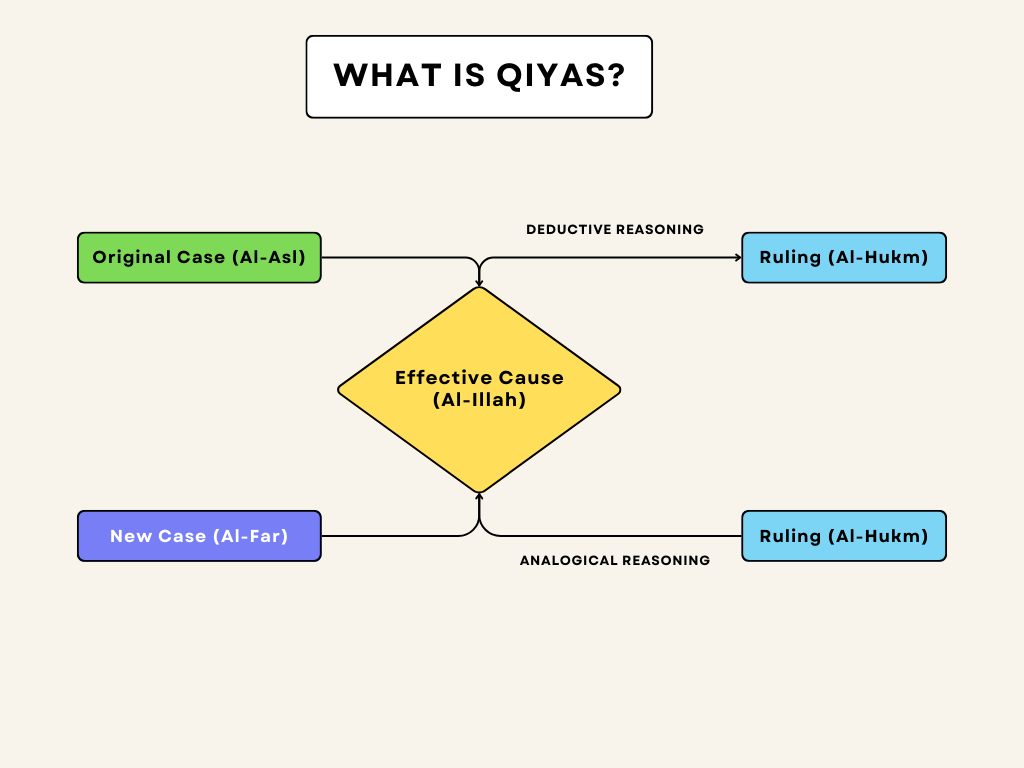
Qiyas is the most significant method of legal reasoning used to address new issues. It is the extension of a legal ruling from an original case (asl) found in the primary texts to a new, parallel case (far') because both share the same underlying effective cause ('illah).
The process requires four essential components:
- Asl: The original case with a ruling in the Quran or Sunnah (e.g., wine).
- Far': The new case requiring a ruling (e.g., cocaine or heroin).
- Hukm: The original ruling (e.g., prohibition).
- 'Illah: The effective cause that the two cases share (e.g., intoxication).
Since the 'illah for prohibiting wine is its intoxicating property, Qiyas allows jurists to extend the prohibition to all other substances that cause intoxication.
Qiyas is an indispensable tool for keeping Islamic law relevant and applicable across time and space. However, because it relies on the jurist's intellectual effort to identify the 'illah, it is an interpretive process and its conclusions are generally considered speculative (zanni), unless a compelling Qiyas (qiyas jali) commands widespread agreement.
[PDF] the relevance of qiyas (analogical deduction) - Kashim Ibrahim Library
This paper provides a thorough examination of the arguments surrounding Qiyas.
Start with the definition of Qiyas in Chapter 1. Then, jump to Chapter 4 and read the sections on the justifications from the Quran and the justifications from the Sunnah. Finally, read the short Summary on Qiyas and the Observations in Chapter 5 to see practical examples of its modern application.
Advanced Reasoning and the Objectives of Law
Beyond these four sources, jurists like Imam Abu Hanifa and Imam Malik developed further principles to ensure that legal rulings produce just and beneficial outcomes. These principles, such as Istihsan (juristic preference) and Maslaha Mursala (consideration of public interest), are tools used to refine the application of Qiyas, ensuring the law always aligns with its higher objectives (Maqasid al-Shari'ah), such as the preservation of faith, life, intellect, lineage, and property.
Principles on Islamic Jurisprudence: Qiyas
This video provides an excellent overview of these advanced reasoning principles and connects them to the overall goals of Islamic law.
Watch from this section, where the speaker explains Imam Abu Hanifa's principle of Istihsan ("seeking beauty") and Imam Malik's principle of Maslaha ("human welfare"). This discussion highlights the sophisticated and purpose-driven nature of Islamic jurisprudence. Then, watch the segment on custom ('Urf), as it shows how Islamic law adapts to different cultural contexts.
Conclusion
Today we have established a clear framework for understanding the sources of Islamic law. You now have an analytical toolkit to dissect how religious authority is structured and how divine law is interpreted and applied in a systematic, rational manner.
Key Takeaways:
- Hierarchy of Sources: Islamic law is derived from primary (Quran, Sunnah) and secondary (Ijma, Qiyas) sources.
- Divine Text and Human Interpretation: The primary texts are divine, but their application requires human reasoning (Ijtihad). The distinction between definitive (qat'i) and speculative (zanni) texts is central to this process.
- Authority and Function: The Quran is the ultimate authority. The Sunnah confirms, clarifies, and legislates. Ijma provides certainty by consolidating scholarly opinion. Qiyas provides dynamism by extending existing laws to new problems through analogy.
- Purpose-Driven Law: Advanced principles like Istihsan and Maslaha ensure that legal rulings serve the higher objectives (Maqasid) of justice and public welfare.
In our next lesson, we will build on this foundation to explore the distinction between 'Deen' (a complete way of life) and 'Religion' (a set of rituals). We will analyze why Islam, with its comprehensive sources of guidance, is considered a complete code that governs all aspects of human existence.