Welcome to our third lesson. In our previous session, we explored the qualities that distinguish effective coaches, focusing on the blend of Professional, Interpersonal, and Intrapersonal knowledge, and the goal of fostering the "Four C's" in players. We established that great coaching goes far beyond tactics and is rooted in who the coach is as a person.
This lesson builds directly on that foundation, focusing specifically on the idea of Intrapersonal Knowledge—the practice of self-awareness. We will use this to tackle a cornerstone of your development: defining your personal coaching philosophy. This philosophy will become your "why," the compass that guides every decision you make, from designing a drill to managing a difficult moment in a match. By the end of this lesson, you will have a clear framework to define a personal coaching philosophy based on your own values, goals, and your chosen age group of teenagers and adults.
What is a Coaching Philosophy?
Many coaches, when asked about their philosophy, immediately jump to formations and playing styles. While those are important, they represent the playing philosophy—the "what." A true coaching philosophy is deeper; it's the "how" and the "why." It defines the environment you create and the values that guide your interactions with players.
The distinction is critical. As one coaching educator memorably put it, "Players don't care how much you know until they know how much you care." Your coaching philosophy is about caring for the person first, then the player.
Implementing a Coaching Philosophy in Football
To start, let's hear from the Coach Reese YouTube channel. This video, "Implementing a Coaching Philosophy in Football," does an excellent job of separating the coaching philosophy from the playing philosophy.
Watch the first part of the video, which covers this key distinction and the importance of focusing on the human being behind the athlete. Pay close attention to the two types of philosophy and the powerful quote he shares from his coaching course.
Your coaching philosophy, therefore, is not a set of tactics but a set of principles. It's the operating system that runs in the background, ensuring your actions are consistent, authentic, and purposeful. This is similar to how design principles in product design guide every feature decision, ensuring the final product is coherent and user-centric. A clear philosophy makes your difficult decisions simpler and provides a foundation for every interaction.
Why It Matters: Setting Expectations and Guiding Decisions
Defining your philosophy isn't just an academic exercise. It has immediate practical benefits. When you clearly know what you stand for, you can communicate it to your players (and their parents, where applicable), setting clear expectations from day one. This alignment prevents misunderstandings about playing time, behavioral standards, and the team's overall goals.
A strong philosophy acts as a reference point in the heat of the moment, helping you make choices that are true to your values, even under pressure.
How to Pick Your Soccer Coaching Philosophy
The "Understand Soccer" channel provides excellent, concrete examples of how a pre-defined philosophy makes coaching easier.
Watch the section from the beginning of the season that explains the power of setting expectations early. Then, see how this plays out in two different scenarios: one involving playing time and another concerning an ethical choice, from making decisions.
As you saw, having a philosophy removes ambiguity and helps you navigate the complex social and ethical challenges of coaching.
The Building Blocks of Your Philosophy
Now, let's begin the work of defining your own philosophy. It's a process of self-reflection that involves examining your core beliefs, motivations, and past experiences. A helpful way to structure this is to think in terms of four key areas.

To guide you through this process, we will use a set of questions from the official US Youth Soccer coaching manual. While it's geared toward "youth," the questions are universal and perfectly applicable to coaching teenagers and adults.
[PDF] The Official US Youth Soccer Coaching Manual
This manual contains a specific section designed to help coaches formalize their philosophy. We will use it as a structured guide for your self-reflection.
On page 57, find Chapter 9, and read the section titled Philosophy of Coaching. As you read the questions under the headings 1. Beliefs, 2. Motivation, and 3. Experiences, take a moment to pause and consider your own answers. You don't need a perfect, final statement yet. Just start capturing your initial thoughts.
This exercise is the heart of today's lesson. Take your time with these questions. Your answers will form the raw material for your personal coaching philosophy statement.
- Your Beliefs are your "why." Why do you coach? What is success? Is it winning trophies, developing players' character, fostering a lifelong love for the game, or something else?
- Your Motivation is your personal drive. What do you enjoy about coaching? What challenges you?
- Your Experiences as a player and in life shape your perspective. What did past coaches do that you want to emulate or avoid?
- Your Methods (the fourth bubble in the mind map) will be covered in later lessons, but they flow directly from these first three components. For example, if you believe in holistic development, your methods will include character-building activities, not just tactical drills.
From Values to Actionable Principles
Once you have reflected on those big-picture questions, the next step is to translate your abstract values into concrete, actionable principles. For instance, if one of your core values is "player development," what does that actually look like in practice?
The "Responsible Coaching" framework provides some excellent examples of such principles.
[PDF] The Official US Youth Soccer Coaching Manual
Let's return to the US Youth Soccer manual and look at some well-defined principles you might choose to adopt or adapt.
In Chapter 15, "The Importance of Responsible Coaching," read about two key concepts. First, read the section Coaching for Mastery on page 94, which introduces the ELM (Effort, Learning, Mistakes are OK) approach. Second, read about Filling Emotional Tanks on page 96, which describes the "Magic Ratio" of praise to criticism.
These concepts—the ELM Tree of Mastery and Filling Emotional Tanks—are not just vague ideas. They are specific strategies that bring a philosophy centered on development and positivity to life. Adopting principles like these makes your philosophy tangible and measurable.
Living Your Philosophy: From Paper to the Pitch
A philosophy is useless if it only exists on paper. Its true power is realized when it consistently guides your actions, especially when it's difficult. This is where your philosophy is truly tested. A coach who lives by their values builds a culture of trust and integrity.
The diagram below shows how a high-level philosophy cascades down into every single action a coach takes.
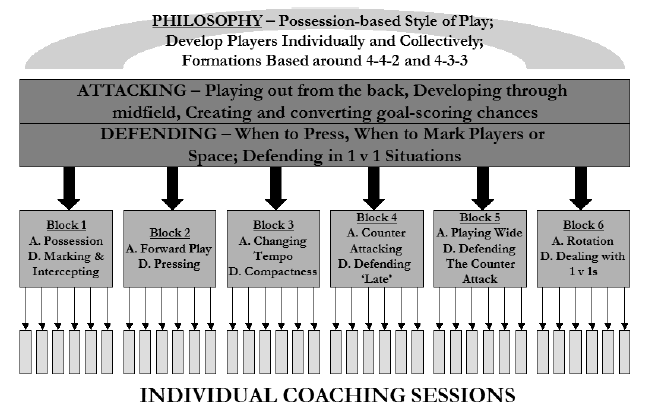
To see what this looks like at the highest level of the game, let's revisit the Coach Reese video for two powerful examples of a manager standing by his principles, no matter the cost.
Implementing a Coaching Philosophy in Football
This part of the video illustrates how a manager's personal background shapes their philosophy and, crucially, how they must live by it to create a strong culture.
Watch from the manager's vision to understand where a philosophy comes from. Then, watch the critical section on implementation, where he discusses the examples of Guendouzi and Aubameyang at Arsenal from it's really quite simple.
These examples perfectly illustrate the point. A philosophy only has power when it is applied consistently to everyone, from the youngest player to the team captain. It requires courage and conviction.
Finally, remember that your philosophy is not static. It should be a living document that evolves as you gain more experience and encounter new contexts.
How to develop your coaching philosophy | England Football Learning
The article from England Football Learning provides some final, practical advice on documenting and evolving your philosophy.
Please read the last two points of the article: Write your philosophy down, but live it every day, and Don't be afraid to tweak.
Conclusion
In this lesson, we have laid the groundwork for you to build the most important tool in your coaching toolkit: your personal philosophy. This is the bedrock upon which you will build your team culture, your training sessions, and your relationships with players.
Key Takeaways:
- A coaching philosophy is your "why"—the set of values and beliefs that guide your actions and create the team environment. It is distinct from a playing philosophy, which is about tactics.
- It is built on self-reflection about your beliefs, motivations, and experiences.
- A clear philosophy helps you make consistent decisions and set clear expectations for your players.
- To be effective, abstract values must be translated into actionable principles (like the ELM model).
- Your philosophy must be lived consistently to build a strong culture. It is a living document that should evolve with you.
In our next lesson, we will address a non-negotiable part of any coaching philosophy: ethical responsibilities and safety considerations. These principles ensure that the environment you create is not only effective for development but also fundamentally safe and respectful for every participant.