Welcome to the final lesson of our module on scaling laws and emergent capabilities. In our previous session, we explored the fascinating and sometimes unpredictable world of emergent abilities, where quantitative increases in model scale lead to surprising qualitative leaps in performance. We saw how models suddenly learn to perform complex tasks and even adopt new reasoning strategies like chain-of-thought, which were completely absent in their smaller predecessors.
Today, we will take a deep dive into what is arguably the most significant emergent ability of all: in-context learning (ICL). This is the remarkable capability of a model to perform a new task simply by being shown a few examples in its input prompt, all without any modification to its underlying parameters. We will precisely define what ICL is, confirm its status as an emergent phenomenon, and draw a sharp distinction between this transient, inference-time learning and the permanent knowledge acquisition of traditional fine-tuning.
Defining In-Context Learning
At its core, in-context learning represents a paradigm shift from the traditional machine learning workflow. In standard supervised learning, a model learns a task by being trained on a large dataset, which involves iteratively updating its weights using an optimization algorithm like gradient descent. The "learning" is a slow process that results in a new, fine-tuned model.
In-context learning, by contrast, is a form of rapid, inference-time adaptation. The model learns a task's format or pattern from a few demonstration examples (input -> output pairs) provided directly within the context window of a single prompt. It then applies this learned pattern to a new query, all within one forward pass of the network.
To solidify this definition, let's turn to a helpful article that surveys various perspectives on ICL.
A Review of In-Context Learning Hypotheses for ...
This post from LessWrong provides a clear and concise introduction to in-context learning, compiling definitions from several key research papers.
Please read the introduction section. As you read, focus on the core distinction highlighted by all the definitions: ICL happens without changing the model's parameters or weights.
As the article emphasizes, the "learning" in ICL is mysterious because it happens without the explicit training or fine-tuning we associate with machine learning. The model's weights remain frozen, yet its behavior adapts to the context it's given. This ability is not programmed; it is an emergent property that arises from training very large models on vast and diverse text corpora.
ICL as an Emergent Capability
Just like the arithmetic and reasoning tasks we examined in the previous lesson, the ability to perform in-context learning effectively is itself emergent. Smaller models, when presented with few-shot prompts, often fail to grasp the underlying task and may even perform worse than with a simple zero-shot prompt. It is only when models cross a certain threshold of scale that they become adept at this kind of rapid pattern recognition.
The Stanford CS25 lecture we referenced previously provides a perfect illustration of this. The concept of "few-shot prompting" discussed in the video is a prime example of in-context learning.
Stanford CS25: V2 I Emergent Abilities and Scaling in LLMs
This lecture by Jason Wei, a key researcher in this area, explains few-shot prompting and visually demonstrates its emergent nature.
First, watch the segment from few-shot prompting. This section defines the technique and shows the characteristic "hockey stick" performance curve, where accuracy remains near-random for smaller models and then sharply increases with scale. This is the visual signature of an emergent ability. After that, you might find it useful to briefly re-watch the segment on Chain-of-Thought prompting from concrete examples with ICL in mind. CoT is a sophisticated form of ICL where the "examples" provided in the context include intermediate reasoning steps, teaching the model not just the task, but how to reason about it.
The evidence is clear: the capacity for a model to learn from context is not a gradually improving skill. It is a capability that switches on at a critical scale, solidifying its status as a true emergent phenomenon.
The Fundamental Distinction: ICL vs. Fine-Tuning
Now we arrive at the central point of this lesson: differentiating in-context learning from the more traditional process of fine-tuning. While both are methods for adapting a pre-trained model to a specific task, they operate on fundamentally different principles.
The following diagram provides a high-level overview of the two distinct pathways.
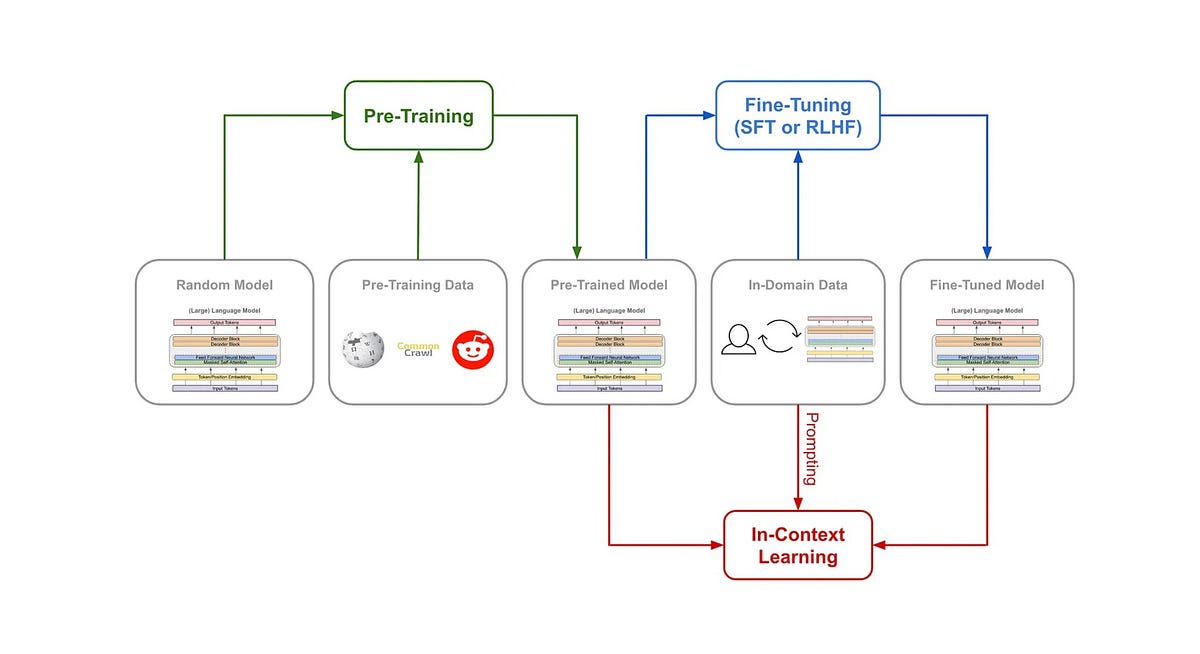
Let's break down the differences formally.
Fine-Tuning: Learning by Weight Updates
Fine-tuning involves continued training of a pre-trained model on a smaller, task-specific dataset. The goal is to adjust the model's internal parameters to make it an expert on that particular task.
- Mechanism: Backpropagation and gradient descent.
- Effect on Parameters: The model's weights are permanently modified.
- Result: A new, specialized model is created.
- Computational Cost: Requires a training phase, which can be resource-intensive (though less so than pre-training).
For a more rigorous definition, let's examine a research paper that formally describes the fine-tuning process.
The Power of In-Context Learning Over Fine-Tuning
This paper from EMNLP 2024 provides clear, formal definitions of both fine-tuning and ICL, making it an excellent resource for a direct comparison.
First, read the two paragraphs in the introduction that define the methods, starting from this section. Then, for a mathematical perspective, study the section titled Fine-tuning (that section). Pay close attention to Equation (3), which is the standard gradient descent update rule.
As Equation (3) in the paper shows, fine-tuning is an explicit optimization process. The parameters at step are a function of the parameters at step and the gradient of the loss:
This update rule is the mathematical signature of learning being encoded into the model's weights.
In-Context Learning: Learning without Weight Updates
ICL, as we've established, happens entirely within a single forward pass during inference.
- Mechanism: A single forward pass of the Transformer architecture.
- Effect on Parameters: The model's weights remain frozen and are not updated.
- Result: The model's behavior is temporarily adapted for a single query. The "learning" is transient.
- Computational Cost: All costs are incurred at inference time. While each inference call is more expensive due to longer prompts, there is no separate training phase.
The same paper also provides a formal definition of ICL.
The Power of In-Context Learning Over Fine-Tuning
Continuing with the same paper, this section succinctly defines ICL.
Read the section titled In-Context Learning (that section). Notice the explicit statement that "ICL happens in inference-stage without explicit re-training".
In summary, the most critical distinction is this: fine-tuning changes the model, while in-context learning changes the model's input. Fine-tuning results in permanent, generalized knowledge, whereas ICL leads to transient, contextual adaptation.
The Deeper Connection: Is ICL Implicit Fine-Tuning?
The distinction between permanent weight updates and transient context seems clear. However, recent research has uncovered a fascinating and deeper connection, blurring this line from a theoretical standpoint. The leading hypothesis is that in-context learning is functionally equivalent to performing a temporary fine-tuning step within the forward pass itself.
This idea suggests that the Transformer's attention mechanism processes the in-context examples and computes updates that are applied to the model's activations. This modification of activations achieves the same functional outcome as if the weights themselves had been temporarily updated. This is often called a "ghost weight update."
The following video provides an excellent, detailed explanation of this theory, which unifies ICL and fine-tuning under a common mathematical framework.
NEW: Why AI In-Context Learning Works (Explained)
This Discover AI video walks through recent research from Google and Oxford that provides a mathematical proof for how ICL can be seen as a form of fine-tuning. This is a conceptually dense but highly rewarding watch.
Please watch this video carefully, from the beginning to the end. The presenter breaks down a complex topic into several key ideas: The Core Claim (intro and core idea): ICL is mathematically equivalent to fine-tuning. The prompt effectively creates a deltaW (a weight update) for a single forward pass. The Ghost Update (ghost weight update): The attention mechanism instructs the MLP layers to rewrite their logic, creating a virtual set of weights that exist only for that specific query. The Mathematical Equivalence (the math): This is the crucial part. The video shows how adding an attention output vector A to the input x in the activation space (W * (x + A)) is mathematically identical to updating the weight matrix W in the weight space ((W + ΔW) * x). The update ΔW is shown to be a simple rank-one matrix. Clarifications (clarifications): The video clarifies that this is a functional not operational equivalence, and defines ICL as a "transient, rank-one, online stochastic gradient descent performed on the forward pass."
This perspective is revolutionary. It suggests that during pre-training, the model doesn't just learn about language; it learns a general-purpose learning algorithm (approximating gradient descent) that it can then execute within its own forward pass at inference time. What appears to be simple pattern matching from the outside is, from a mathematical perspective, a sophisticated optimization process.
Conclusion
This lesson has focused on in-context learning, a powerful emergent capability that fundamentally changes how we interact with and adapt language models. We have moved from a simple surface-level distinction to a deep, mathematical unification.
Here are the key takeaways:
- ICL Defined: In-context learning is an emergent ability of large models to learn new tasks at inference time from examples provided in a prompt, without any weight updates.
- The Core Distinction: Fine-tuning involves permanent parameter updates via backpropagation, creating a new model. ICL is a transient adaptation via a single forward pass, leaving the model's parameters unchanged.
- The Deeper Connection: From a theoretical standpoint, ICL can be understood as implicit fine-tuning. The forward pass is mathematically equivalent to applying a temporary, low-rank update to the model's weights, effectively simulating one step of gradient descent.
- A New Perspective on Learning: This suggests that LLMs are not just knowledge repositories but also meta-learners that have learned how to learn within a single inference step.
This concludes our module on scaling laws and emergent capabilities. We have seen how quantitative scale leads to both predictable improvements and surprising new behaviors. In our next module, "Advanced Architectural Innovations," we will explore some of the key architectural components, like Rotary Positional Embeddings (RoPE) and Mixture of Experts (MoE), that have enabled models to scale to the massive sizes where these incredible abilities emerge.