Hello! Welcome to your next lesson.
In our last session, we established a crucial foundation: you learned what a niche is and precisely why focusing on one is the most effective strategy for a new affiliate marketer. We discussed how it reduces competition, builds trust, and leads to a more loyal and profitable audience.
Now that you understand the "what" and the "why," it's time to explore the "how." Specifically, how do you distinguish a promising niche from one that's a dead end? This lesson will equip you with the knowledge to do just that.
Your learning outcome today is to identify the characteristics of a profitable niche, focusing on three key pillars: audience demand, evergreen potential, and competition level. Mastering this will enable you to evaluate niche ideas systematically, dramatically increasing your chances of building a successful affiliate business from the start.
The Anatomy of a Profitable Niche
A profitable niche isn't just a topic you're passionate about; it's a topic that has the right business characteristics. Think of it as a three-legged stool. If any one of these legs is weak, the whole thing becomes unstable.
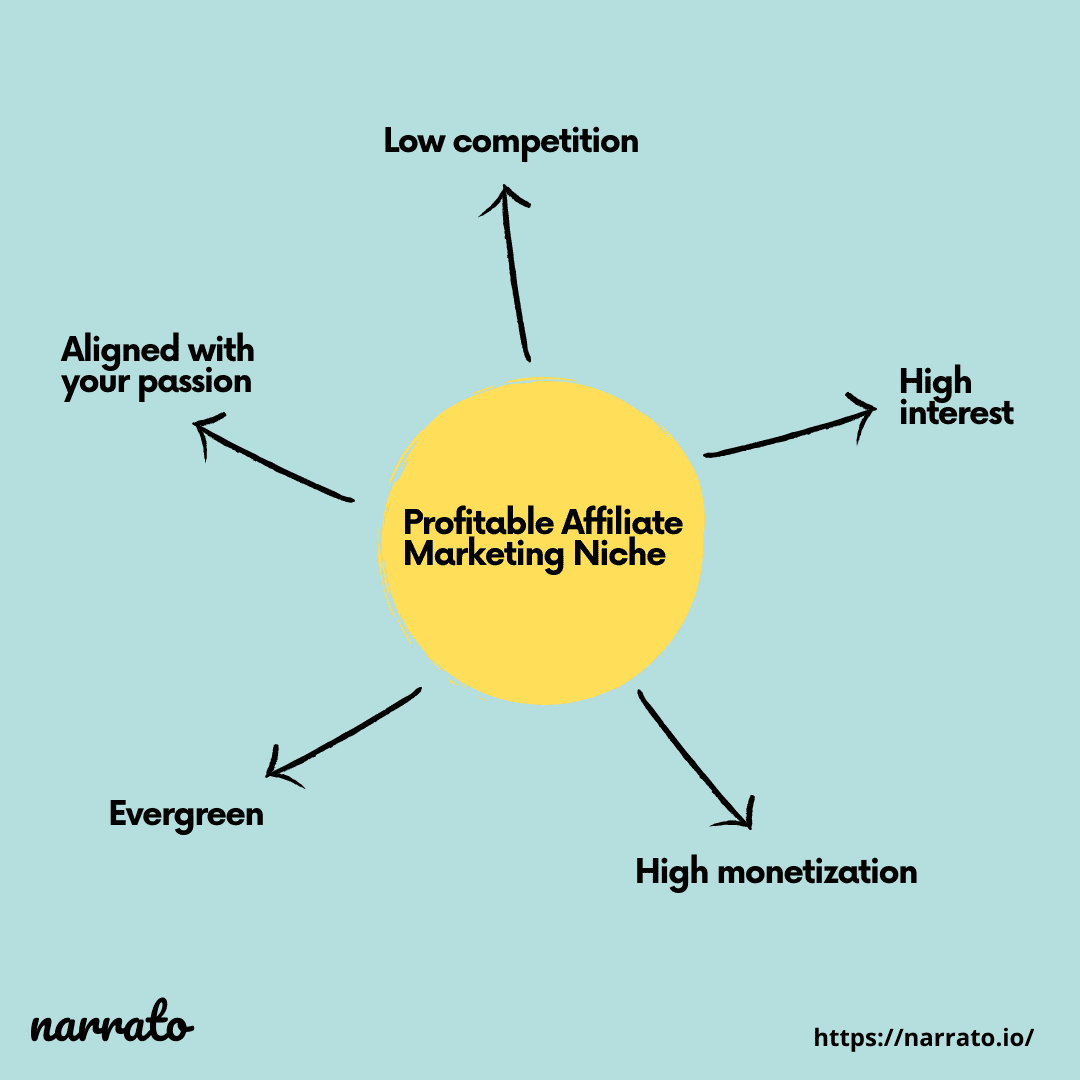
Let's break down these essential characteristics one by one.
1. Audience Demand & Buyer Intent
This is the most fundamental characteristic. You need to enter a market where a significant number of people are actively looking for information and, crucially, are willing to spend money on solutions.
This involves two components:
- Search Volume: Are people actually searching online for terms related to this niche?
- Buyer Intent: Are their searches purely for information, or are they looking to make a purchase?
A niche can have high interest but low buyer intent, which is a trap for new affiliates. To hear an expert explain this critical distinction, watch the following clip.
How to Find a Profitable Niche for Affiliate Marketing
Affiliate marketer Matt Diggity shares a personal story that perfectly illustrates the problem of choosing a niche with no 'buyer intent.'
Watch the segment from 02:38 to 03:32. Pay close attention to his experience with the 'yoga travel' niche and why it failed despite having search volume.
As he explains, people were looking for information, not products. Your goal is to find niches where people are actively seeking solutions they can buy, often referred to as "commercial" or "transactional" intent. The big three categories he mentions—Health, Wealth, and Relationships—are famous for having strong buyer intent because they address deep, persistent human problems.
2. Evergreen Potential
The second pillar is longevity. An "evergreen" niche is one that remains relevant and in demand year after year. It's not based on a fleeting trend or fad.
Top Profitable Niches for Affiliate Marketing in 2026 | Affilorama
The article 'Top Profitable Niches for Affiliate Marketing' from Affilorama gives a clear definition of evergreen niches versus trend niches.
Read the section titled 'Types of Niches in Affiliate Marketing'. Focus on understanding the difference between an 'Evergreen Niche' and a 'Trend Niche' and the pros and cons of each.
For your first affiliate site, aiming for an evergreen niche is the most stable, long-term strategy. While chasing trends can be profitable, it's a high-risk game that requires you to move very quickly. Building a business around a topic like "personal finance" or "dog training" provides a foundation that won't disappear in six months.
You must be careful to distinguish between a long-term trend and a short-lived fad.
How to Find a Profitable Niche for Affiliate Marketing
Let's return to Matt Diggity's video, where he discusses the importance of checking a niche's popularity over time and the danger of fads.
Watch from 07:32 to 08:32. He explains how to use Google Trends to check a niche's trajectory and gives examples of fads, like specific diets.
The key takeaway is to look for niches with stable or growing interest over the long term. A downward trend is a clear warning sign.
3. Competition Level (The "Goldilocks" Principle)
Competition can be tricky. You might think the ideal niche is one with zero competitors, but that's rarely the case.
- Too little competition often means there's no money to be made. If no one else is trying to sell to that audience, it's a major red flag.
- Too much competition means you'll be up against massive, established authority sites that are nearly impossible for a beginner to outrank.
You are looking for a "just right" level of competition. There should be other affiliate sites proving the market is profitable, but not so many giant players that you can't carve out your own space.
How to Find a Profitable Niche for Affiliate Marketing
Matt Diggity explains this 'Goldilocks' principle perfectly, covering both sides of the competition coin.
Watch the two short segments from 04:06 to 05:14. First, he'll explain why 'no competitors at all' is a problem. Then, he'll discuss what to do when a niche is 'too competitive.'
Having a few competitors is a good thing. It validates the niche and gives you a blueprint for what works. You can analyze their websites to understand what kind of content resonates with the audience and what products they are successfully promoting.
How to Evaluate a Niche in Practice
You now know the what—the three pillars of a profitable niche. But how do you actually measure these characteristics for a niche idea you have?
The following video provides a fantastic, step-by-step demonstration of this evaluation process. While it uses a paid tool called Semrush, the principles and the type of data you're looking for are universal. In our next lesson, we will focus on free tools to do this research. For now, focus on understanding the process.
How to Find the Best Niche for Affiliate Marketing (5 Simple Steps)
This practical walkthrough from Metics Media shows you how to use data to evaluate your niche ideas against the criteria we've just discussed.
Watch these three segments to see the process in action: Evaluating Evergreen Potential (02:21 - 04:50): See how Google Trends is used to analyze a topic's interest over 1 and 5 years. Notice the different trend patterns he identifies (upward, downward, flat, cyclical). Evaluating Demand & Competition (06:52 - 09:20): Observe how he uses a tool to find the 'monthly search volume' (Audience Demand) and 'Keyword Difficulty' or KD% (Competition Level). Evaluating Profitability (11:39 - 14:20): Watch how he researches actual affiliate programs to determine commission rates and earning potential. This is a crucial final check.
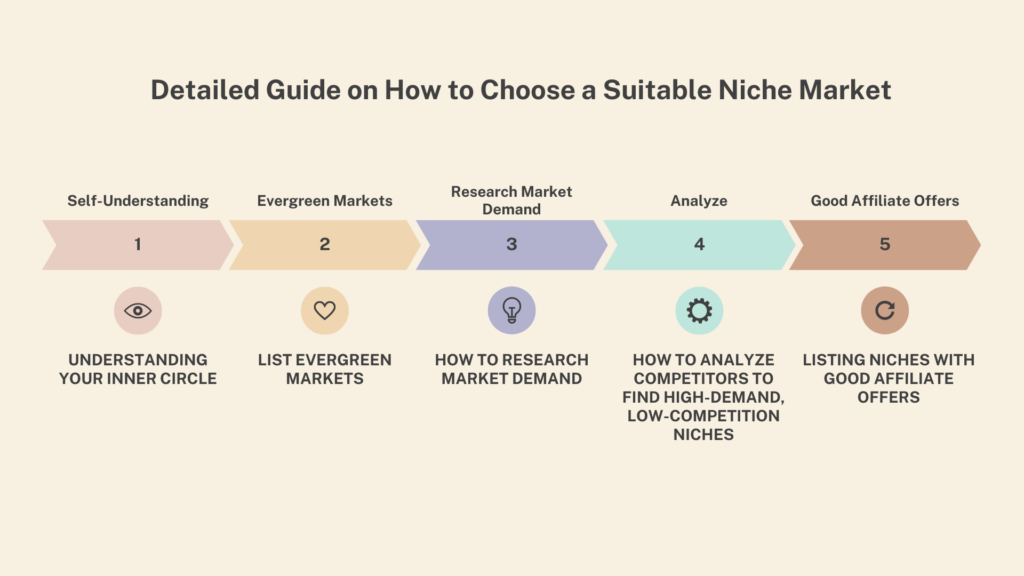
This process of gathering data on trends, search volume, competition, and monetization potential is how you move from a vague idea to a validated, profitable niche. This infographic provides a nice summary of the entire workflow.
Conclusion
You've just learned the essential framework for evaluating any niche idea. Instead of guessing, you now have a set of criteria to guide your decision-making.
Here are your key takeaways:
- A profitable niche must have sufficient Audience Demand, which includes both search volume and clear Buyer Intent.
- It should have Evergreen Potential, meaning it addresses a long-term need and shows stable or growing interest over time, rather than being a short-lived fad.
- The Competition Level should be "just right"—enough to prove the market is viable, but not so high that you're competing against unbeatable industry giants.
- The evaluation process involves using tools to look at trend data, search volume, keyword difficulty, and the availability of strong affiliate programs.
Preview of the next lesson:
Theory is great, but practice is better. In the next lesson, we'll roll up our sleeves and put this into action. You will learn how to use free tools, such as Google Trends and online forums, to research the demand in a potential niche. This will be your first hands-on step toward finding your perfect niche.