Hello! In our last lesson, we established the blueprint for a solid pitch shot setup, focusing on the key variables of stance width, weight distribution, and ball position. You learned how to create a stable foundation designed to produce a high, soft trajectory by promoting a clean strike and utilizing the club's loft and bounce.
Today, we build directly on that foundation. With a consistent setup, the next challenge is controlling how far the ball travels. This lesson addresses one of the most crucial skills in the short game: explaining how to control pitch shot distance by systematically varying the length of your backswing, rather than falling into the common trap of decelerating through the ball. We will transform pitching from guesswork into a calibrated, repeatable process.
The Problem: The Instinct to "Ease Up" and the Danger of Deceleration
When faced with a shot that doesn't require a full swing, a beginner's natural instinct is often to take their normal backswing and then consciously slow down or "ease up" on the downswing to reduce power. While logical on the surface, this is one of the most destructive habits in golf, leading to a fault called deceleration.
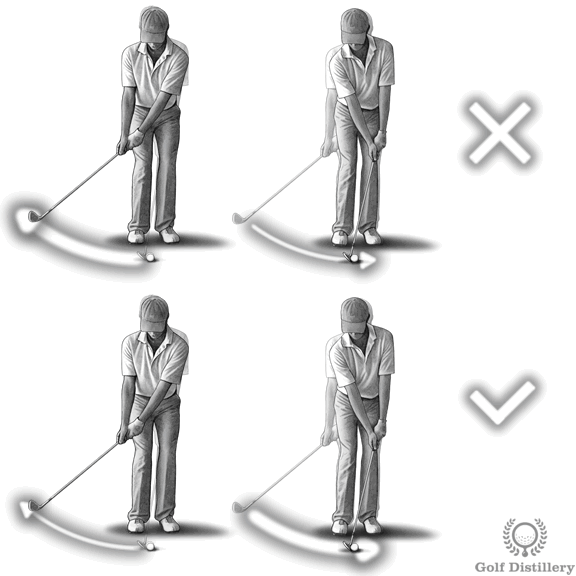
Deceleration is the reduction of clubhead speed before or at the point of impact. Instead of the club accelerating smoothly through the ball, the golfer's hands and arms tense up and apply the brakes. This action disrupts the natural arc of the swing, changes the club's loft and bounce presentation at impact, and makes consistent contact nearly impossible. The result is often a poorly struck shot—either "thinned" (hit on the equator of the ball, sending it screaming across the green) or "fatted" (hitting the ground first, with the ball going almost nowhere).
This image illustrates the difference between a swing that decelerates and one that correctly accelerates through impact.
To understand the "why" behind this problem, it's helpful to read about the physics and psychology at play.
Deceleration in the Golf Swing: The Simple Cure - The Left Rough
This article from The Left Rough provides an excellent breakdown of what deceleration is and why it happens, particularly in the short game.
First, read the introductory sections to understand the definitions of acceleration and deceleration, and why deceleration before impact is a major issue. Focus on the explanation from the definitions to the end of that paragraph. Next, jump to the section "Why Deceleration Happens?" and pay close attention to the part on why backswing length is a key factor. This directly addresses the scenario where a player swings too far back and then tries to "save" the shot by slowing down, leading to a poor result.
As the article explains, deceleration happens when doubt creeps in. You take too long a backswing for the shot you want to hit, realize it mid-swing, and your brain subconsciously tells your muscles to slow down. This breaks your rhythm and ruins the shot. The key takeaway is that manipulating swing speed is an unreliable and often counterproductive way to control distance.
The Solution: A Systematic Approach to Distance Control
If changing swing speed is the wrong variable to manipulate, what is the right one? The answer, agreed upon by virtually all top instructors, is backswing length.
The correct method for controlling pitch shot distance is to maintain a consistent rhythm and tempo—always accelerating through the ball—but to vary how far back you take the club. A shorter backswing will naturally produce a shorter shot, while a longer backswing will produce a longer one, all while the tempo of the swing remains the same.
This approach offers several advantages, especially for an analytical mind:
- It's repeatable: A body movement (swing length) is far easier to replicate under pressure than a nebulous feeling of "power" or "speed."
- It's systematic: It turns distance control into a system with defined inputs (backswing length) and predictable outputs (carry distance).
- It builds trust: Once you know how far the ball goes with a certain swing length, you can commit to the shot without the doubt that causes deceleration.
This consensus is strongly supported by teaching professionals who work with golfers of all levels.
This roundtable article from Backswing.com gathers opinions from numerous PGA professionals on this exact topic. Their collective wisdom is very clear.
Read the following three short expert opinions: Start with Erik Barzeski's answer, which begins "You're not John Daly." He strongly advocates for focusing on swing length. Next, read Nathan Morris's take, which starts "I hate to say it..." He explains why a system of preset swing lengths is more beneficial for players who don't practice every day. Finally, read Zachary Abels's comment, starting "I strongly feel deceleration is the number one issue..." He directly connects the problem of deceleration with the solution of using proper swing length.
The Clock System: A Framework for Your Swing
To make this systematic approach practical, golfers use a mental model called the "Clock System." Imagine you are standing in the center of a giant clock face, with your head at 12:00 and the ball at 6:00. The position of your hands at the top of the backswing corresponds to a time on the clock.

By practicing swings to different "times"—for example, an 8:00, 9:00, or 10:00 backswing—you can create a set of stock yardages for each of your wedges. A short, 8:00 swing might produce a 30-yard shot, a 9:00 swing might go 45 yards, and a 10:00 swing might go 60 yards. The key is that for each of these swings, the rhythm and acceleration through the ball remain constant. You are simply changing the length of the wind-up.
Calibrating Your Personal Distances
The beauty of this system is that it's unique to you. Your "9 o'clock" shot won't go the same distance as a tour pro's, and that's perfectly fine. The goal is not to hit a specific number, but to find out what your numbers are and then trust them. This process is called calibration.
Short-game guru Dave Pelz is a huge proponent of this method. Watch this video where he explains and demonstrates the core principle.
Wedge Week: Dave Pelz swing tips for distance control | Golf Channel
In this Golf Channel clip, Dave Pelz demonstrates how varying backswing length—not swing speed—is the key to consistent wedge distances.
Watch from the beginning of his demonstration. Pay close attention to his emphasis on a consistent "rhythm" and his warning that trying to consciously control how "hard" you hit the ball is a recipe for failure under pressure.
Now that you've seen the principle, let's watch a coach take a student through the actual process of calibration. This will show you exactly how you can do this yourself on the practice range.
How to dial in your Wedge Distances [wedge clock system]
This video from Cordie Walker GolfWell shows the practical application of the clock system to "dial in" a specific yardage.
Watch the segment from where the student begins hitting shots. The coach asks him to repeat the same "three-quarter length swing" multiple times. Notice how they aren't aiming for a pre-determined distance; they are hitting the shot and then using a rangefinder to discover what the consistent distance is (it turns out to be about 87-90 yards). Then, watch the coach's explanation from the summary discussion. He explains that once you have this "benchmark" or "stock" 90-yard shot, you can then make small adjustments to hit a shot that's 85 yards (a little less swing) or 95 yards (a little more). This is the essence of a calibrated system.
Conclusion
You now have a complete understanding of the professional-level method for controlling pitch shot distance. It is not about a mysterious "feel" for speed, but about a reliable, repeatable system based on a single, controllable variable: backswing length. By committing to a consistent tempo and acceleration through the ball, you eliminate the primary cause of poor wedge shots—deceleration.
Key Takeaways:
- The Problem: Trying to control distance by changing swing speed leads to deceleration, tension, and inconsistent strikes.
- The Solution: Control distance by varying the length of your backswing while maintaining a consistent rhythm and tempo.
- The Framework: Use the "Clock System" (e.g., 8:00, 9:00, 10:00 backswings) as a mental guide for creating different swing lengths.
- The Process: The goal is to calibrate your own personal distances for each clock position with each wedge, so you can trust your system on the course.
In our next lesson, we will dedicate our time to a practical drill. You will perform the Clock Drill, systematically working through the 8, 9, and 10 o'clock positions to begin building your very own distance-control chart.