Welcome back. In the last lesson, we completed our deep dive into putting by focusing on distance control with the ladder drill. You learned to approach this not just as a repetitive task, but as a systematic calibration exercise—building a reliable internal model that maps stroke length to distance, much like building a predictive model from clean data.
Now, we take a step back from the putting surface into the surrounding area to begin our module on the short game. When you miss the green on your approach, you'll rely on two fundamental types of shots to get the ball close to the hole: the chip and the pitch. Mastering your short game is the fastest way to lower your scores, and it starts with a clear understanding of your options. This lesson is dedicated to distinguishing between a chip shot and a pitch shot, focusing on the key variables of trajectory, carry, and roll. This forms the conceptual foundation for all the short game techniques we will cover next.
The Core Distinction: Air Time vs. Ground Time
At the most fundamental level, the difference between a chip and a pitch comes down to a simple ratio: how much time the ball spends in the air versus how much time it spends rolling on the ground.
- A chip shot is a low-trajectory shot that is designed to get the ball onto the green as quickly as possible and let it roll out toward the hole like a putt. It prioritizes ground time over air time.
- A pitch shot is a high-trajectory shot that spends more time in the air, allowing it to fly over obstacles (like bunkers or rough) and land softly on the green with minimal roll. It prioritizes air time over ground time.
The two images below illustrate this core difference perfectly.
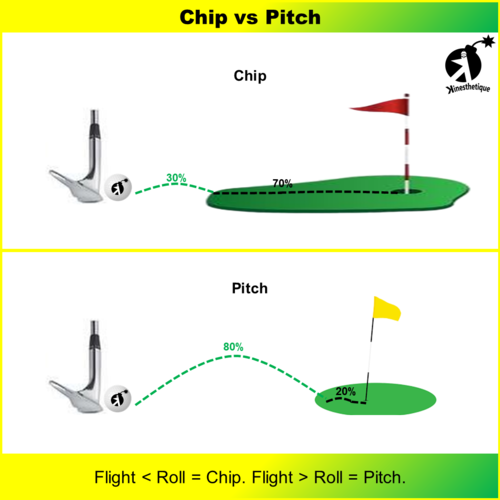

Think of this as a strategic decision based on the parameters of the situation. When you have a clear runway of green between you and the hole, the chip shot is the simpler, lower-risk option. When you must navigate an obstacle or stop the ball quickly on a small target area, you must use the higher-risk, higher-skill pitch shot.
This short video from ChrisRyanGolf offers a clear and concise explanation of this air-time vs. ground-time concept.
CHIP V's PITCH - Whats the difference and when to use them
The instructor, Chris Ryan, defines the shots based on how much they carry versus how much they roll.
First, watch his definition of a chip shot, where he emphasizes its short carry and that it will "spend more time rolling on the ground than it will be flying through the air." Then, contrast this with his definition of a pitch shot, which has "more time through the air, less time on the ground."
A Quantitative Look: The Physics of the Shot
Your background in data and analytics gives you a unique advantage in understanding golf technique. We can move beyond conceptual definitions and define these shots using precise, measurable data, just as you would define key performance indicators. The golf technology company Trackman, which produces launch monitors that measure ball and club data, provides a quantitative framework for this.
The Chip Shot Code: Mastering Short Game Precision - Trackman
This article from Trackman delves into the data that defines a chip shot. It provides the kind of hard numbers that underpin the "feel" of these shots.
Read the section What do we mean by the term ‘chip shot’?. Pay close attention to the specific thresholds provided for landing angle and spin rate that define a chip shot and how they contrast with the landing angle required for a pitch shot.
As the article explains, the "chip shot" isn't just a vague idea; it's a shot with specific physical properties that promote roll:
- Landing Angle: Below 37 degrees. This shallow angle of descent means the ball's forward momentum is preserved upon landing, causing it to roll out.
- Spin Rate: Below 3750 RPM. Lower spin reduces the ball's tendency to "grab" or check up on the green.
In contrast, a pitch shot, designed to stop quickly, requires a landing angle of over 45 degrees. This steep descent drives the ball downward into the green, dissipating forward energy and maximizing stopping power, often aided by a higher spin rate.
Thinking in these terms—shallow vs. steep landing angle—is the technical "why" behind the visual difference you see in the ball's trajectory and subsequent roll.
Visualizing the Technique: Seeing the Difference in Action
The different ball flights of a chip and a pitch are a direct result of different techniques. While we will break down these techniques in detail in upcoming lessons, it's useful to see them in action now to connect the swing motion to the outcome.
Watch legendary tour player and short-game guru Brad Faxon demonstrate both shots. Your goal here is not to memorize the mechanics, but to observe the general differences in the size and character of the swing.
Chip Shot vs. Pitch Shot with Brad Faxon | Golf Tips | Titleist
In this video from Titleist, Brad Faxon provides a masterclass on the differences between chipping and pitching.
First, watch his explanation and demonstration of the chip shot. Notice how small and controlled the motion is. He uses the fantastic phrase "minimum air, maximum ground" to describe the goal. Next, watch his demonstration of the pitch shot. Observe how the swing is visibly longer and involves more body motion to create a higher, softer shot. Finally, listen to his summary of the differences in setup and motion. This provides a great preview of what we'll be working on.
Summary Framework
To consolidate your understanding, here is a table summarizing the key distinctions between a chip and a pitch shot. You can use this as a mental checklist when you're on the course deciding which shot to play.
| Characteristic | Chip Shot | Pitch Shot |
|---|---|---|
| Trajectory | Low | High |
| Air vs. Ground | Less air time, more ground time (roll) | More air time, less ground time (roll) |
| Landing Angle | Shallow (< 37°) | Steep (> 45°) |
| Primary Goal | Get the ball rolling on the green like a putt | Fly over obstacles and land softly |
| Typical Situation | No obstacles, plenty of green to work with | Obstacles (bunkers, rough), small landing area |
| Swing Motion | Smaller, more compact, like a putting stroke | Larger, more body rotation, more wrist action |
Conclusion
In this lesson, we established the critical distinction between the two families of short-game shots. You learned that the difference is not arbitrary but is defined by the shot's purpose and its resulting physical characteristics: trajectory, carry, and roll.
Key Takeaways:
- A chip shot flies low and rolls out significantly. Think "minimum air, maximum ground." It is the preferred shot when you have a clear path to the hole.
- A pitch shot flies high and lands softly with minimal roll. It is used to carry the ball over obstacles or to stop it quickly.
- From a data perspective, a chip has a shallow landing angle (<37°), while a pitch has a steep one (>45°), which is the primary driver of the difference in roll.
- The choice between chipping and pitching is your first strategic decision when you are around the green.
Now that you can clearly differentiate between what these shots are, our next lesson will begin to explore how to execute them. We will start with the simpler of the two: the chip shot. You will learn the correct setup—including stance width, weight distribution, and ball position—to produce that low, predictable, rolling shot.