Welcome back. Over the last several lessons, we have meticulously built your setup from the ground up: selecting a grip, establishing posture, positioning the ball, and, most recently, aligning yourself to the target. You now have a complete blueprint for a technically sound address position. However, the quality of your setup can be instantly undone by a single, often overlooked variable: tension.
This lesson focuses on that variable by exploring grip pressure. Think of your hands as the critical interface between your body and the club; how you hold it dictates how freely the club can move. This is a dedicated practice session designed to help you perform the grip pressure check drill and develop a consistent, reliable feel. Our goal is not just to understand the theory but to calibrate your hands to find the "Goldilocks" pressure—not too tight, not too loose, but just right for generating speed and control.
The Problem with Pressure
In any system, applying the wrong amount of force leads to suboptimal outcomes. The golf swing is no different. Holding the club is a delicate balance. Too much pressure creates tension in the hands, wrists, and forearms. This tension acts like a governor on an engine, restricting your ability to hinge your wrists naturally, which is a key source of clubhead speed. It also makes it difficult to rotate the clubface, often leaving it open at impact and causing the dreaded slice.
Conversely, too little pressure leads to a lack of control. The club can shift in your hands during the swing, leading to an inconsistent clubface angle at impact and unpredictable shots.
The coaches at Meandmygolf provide a quick explanation of why the majority of amateur golfers, who tend to slice the ball, hold the club far too tightly.
GOLF SWING GRIP PRESSURE DRILL
This video segment explains the direct consequences of gripping the club too tightly, linking it to restricted movement and common shot faults.
Watch the initial part of the video where the instructors discuss the impact of grip pressure on clubface rotation, wrist set, and power. Notice the connection they make between a tight grip and a slice.
The goal is to find a pressure that allows you to control the club without restricting the athletic motion of the swing. The HackMotion article "Grip Pressure in Golf" summarizes this balance well.
Grip Pressure in Golf: How It Affects Swing & Wrist Action
This article's summary provides a clear, concise overview of the core principles of grip pressure.
Please read the introductory section and the four bullet points under the heading Grip Pressure in Golf (Key Takeaways). This will reinforce the key concepts of control versus restriction.
A Framework for Feel: The 1-10 Scale
Grip pressure is subjective, which can make it difficult to learn and repeat. To bring an analytical framework to this feeling, it's helpful to use a 1-to-10 scale.
- A 1 is holding the club so loosely it's about to fall out of your hands.
- A 10 is a "white-knuckle" death grip, squeezing as hard as you can.
Neither extreme is functional. The ideal pressure for most shots lies somewhere in the middle. The Foy Golf Academy provides an excellent breakdown of this scale.
Grip Pressure 1–10 Scale: How Tight Is Too Tight?
This article introduces a simple but effective mental model for calibrating your grip pressure.
Read the section The 1–10 Grip Pressure Scale Explained. Focus on understanding the feel of a 1, a 10, and the target range of 4 to 6.
Your goal is to find what a 4, 5, or 6 feels like to you—secure enough to control the club, but light enough to allow your wrists to hinge freely and the clubhead to release.
Practical Drills for Consistent Grip Feel
Now, let's move to the practical application. The following drills are designed to help you find and replicate your ideal grip pressure.
Drill 1: The Toothpaste Test (Conceptual Drill)
The most famous analogy for grip pressure involves a tube of toothpaste. Imagine you are holding an open tube of toothpaste. Your goal is to hold it firmly enough that it won't slip, but not so tightly that you squeeze the paste out. This is the exact feeling you want with a golf club.
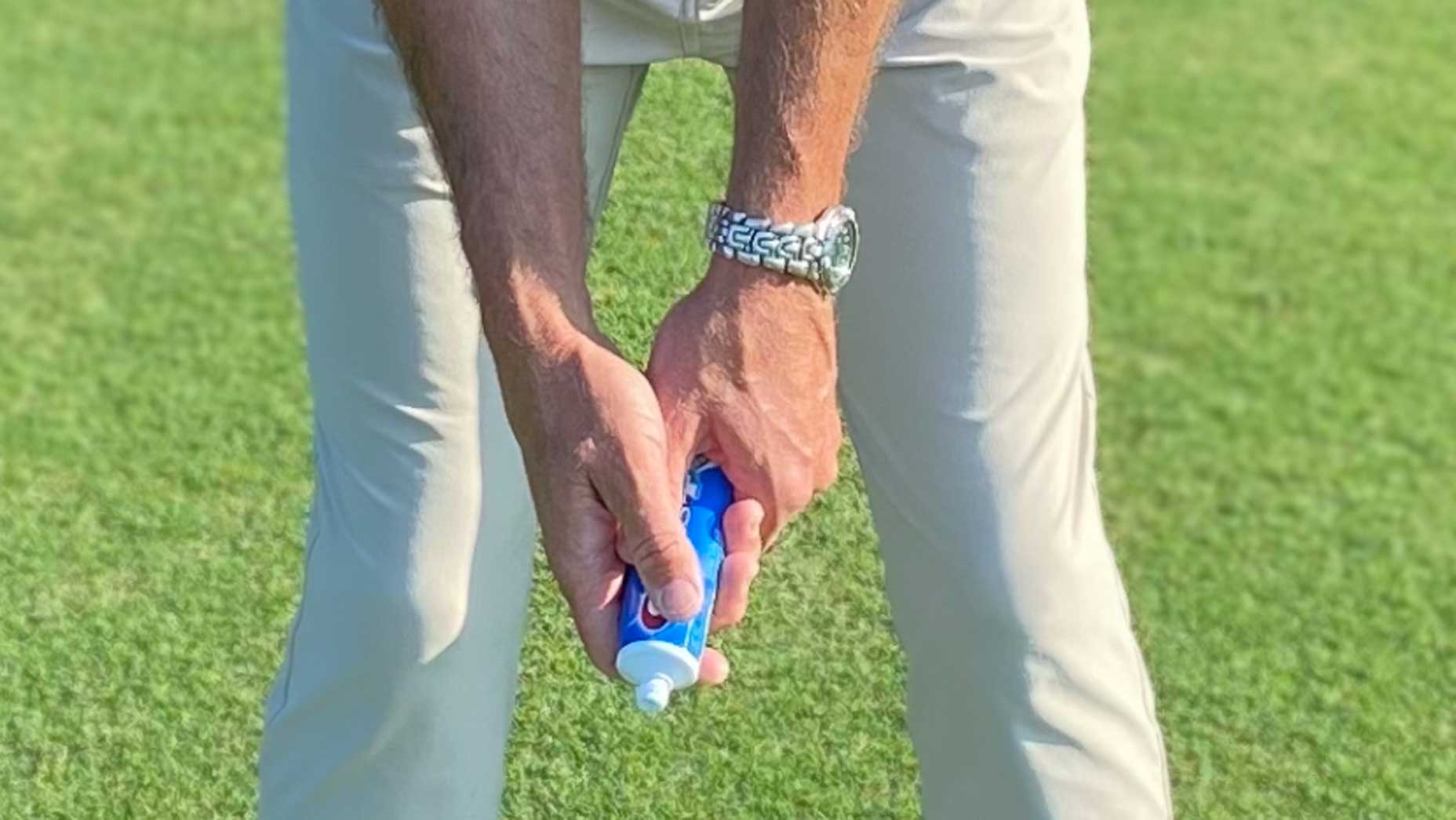
This is a mental check more than a physical drill, but it provides a powerful and memorable image for the sensation you're seeking.
Drill 2: The Tom Watson Drop Drill (Finding Your Threshold)
Golf legend Tom Watson offers a fantastic drill for finding the minimum pressure required to hold the club. This gives you a baseline for "light enough."
The BEST Golf Grip Lesson on YouTube | The Legend Tom Watson
In this clip, one of the greatest players of all time provides his personal drill for establishing the correct grip pressure.
Watch the segment from Tom Watson's demonstration. Follow his steps precisely: Hold the club vertically and let it slip through your hands. Re-grip it properly. Reduce pressure until the club almost begins to drop again. Bring the club to horizontal and feel where the pressure is in your fingers. This pressure is your baseline—as light as you can go while maintaining control.
Drill 3: The Club Weight Drill (Feeling the Head)
A key indicator of correct grip pressure is your ability to feel the weight of the clubhead. If your grip is too tight, you will only feel the handle. This drill, also demonstrated in the Meandmygolf video, helps you tune into the clubhead.
GOLF SWING GRIP PRESSURE DRILL
This segment demonstrates a simple, effective way to find a pressure that allows you to feel the clubhead.
Watch the drill explained from feeling the weight of the club. Hold the club up in front of you and relax your hands until you can clearly sense the heaviness of the clubhead. This sensation of "supporting" the club, rather than "gripping" it, is what you want to maintain.
Integrating Grip Pressure into Your Routine
Finding the right feel is one thing; making it automatic is another. You must consciously check and set your grip pressure before every shot in practice.
A simple and effective method is the waggle test. After you've taken your grip, make a few small, back-and-forth movements with the club. If your wrists are stiff and the motion is jerky, you're too tight. If the club feels sloppy and disconnected, you're too loose. It should feel smooth and rhythmic, with the clubhead moving freely.
You can then build this into your pre-shot routine. As shown in the Meandmygolf video, you can perform the club weight check behind the ball, walk into your setup maintaining that light feel, and use a waggle as a final check before starting your swing.
For a more structured practice approach, you can use the Pressure Ramp Drill.
Grip Pressure 1–10 Scale: How Tight Is Too Tight?
This article offers several drills, including a systematic way to find your "too tight" threshold.
In the section "Drills to Train Proper Grip Pressure," find and read the description of the Pressure Ramp Drill. On the range, hit a series of short shots, starting at a pressure you perceive as a 3/10 and gradually increasing. This systematic approach will help you clearly identify the point at which tension begins to restrict your swing.
Conclusion
You have now completed your first dedicated practice lesson, focusing on one of the most vital "feel" elements in golf. Mastering grip pressure is a continuous process of calibration, but with these drills, you have the tools to find and maintain it.
Here are your key takeaways:
- The goal is control without tension. Your grip should be firm enough to secure the club but light enough to allow your wrists to hinge and release freely.
- Use the 1-10 scale as a mental guide. Aim for a pressure of 4-6 out of 10 for most shots.
- Practice the drills to develop feel. Use the Tom Watson drill to find your baseline, the club weight drill to feel the head, and the waggle to check for tension.
- Make it part of your routine. Consciously set your pressure before every shot until it becomes second nature. Remember the cue: "Secure, not squeezed."
In the next lesson, we will have our second and final practice drill for this module. You will learn how to set up an alignment station on the practice range, which will allow you to bring together everything we've learned about grip, posture, ball position, and alignment into one cohesive and repeatable setup routine.