Welcome back. In our previous lessons, we developed a systematic approach to reading greens, culminating in using the "fall line" to predict a putt's break. Now, we shift our focus from reading the line to mastering the most crucial skill for scoring: controlling distance, especially on long putts.
Today's lesson is about lag putting strategy. For a player with your background in data and investment management, this concept should feel intuitive. Lag putting is not about maximizing returns by trying to sink a low-probability 40-foot putt; it's about risk management. The goal is to minimize the probability of a catastrophic failure—the three-putt—by ensuring your first putt leaves you with a high-probability second putt. We will analyze the data, define the strategy, and provide the technical framework to execute it.
The Problem, Defined by Data
First, let's establish why a strategic shift is necessary. The desire to make every putt is natural, but from a data perspective, it's an inefficient strategy for long putts. The probability of success is simply too low, even for the best players in the world.
How to Eliminate the Dreaded 3-Putt. Part 1
This article from Galvin Green provides excellent statistical context for the three-putt problem. It frames the issue in terms of probability, which will help us define a more effective strategy.
Read the section titled Statistics Tell the Tale. Pay close attention to the chart comparing a 15-handicap golfer to a Tour Pro and the table showing the average distance of the second putt by handicap.
The data you just reviewed is clear:
- A 15-handicap golfer makes fewer than 30% of putts from just 8 feet.
- The average second putt for that same golfer is 7.6 feet.
This creates a negative feedback loop. A poor first putt leaves a difficult second putt, which is frequently missed, leading to a three-putt. Your primary goal on any putt over about 20 feet is not to make it, but to improve a key performance indicator (KPI): proximity to the hole after the first putt.
Look at the following image, which visualizes this KPI across different skill levels.

The entire strategy of lag putting is built around shrinking that circle.
The Strategic Solution: The "Finish Zone"
If the hole is no longer the primary target, what is? The answer is a "finish zone"—an imaginary circle around the hole. By making this zone your target, you reframe the task from a high-pressure, low-probability shot into a manageable, repeatable skill.
How to Lag Putt | The Easy Way To ELIMINATE 3-Putts
This video from The Savvy Caddie explains this mental shift perfectly. It provides a "reality check" using PGA Tour data and introduces the concept of the finish zone.
Watch the first two minutes of the video, from the introduction through the explanation of the finish zone.
As the video makes clear, the goal is to consistently finish inside a three-foot circle. This not only almost guarantees a two-putt but also removes the outcome-oriented anxiety that leads to poor strokes. When you aren't trying to force the ball into the hole, your tempo and speed control naturally improve.
The Technical Solution: Calibrating Distance Control
Great strategy requires solid execution. In lag putting, execution is all about distance control, which is a product of two variables: stroke length and tempo. The most effective way to become consistent is to keep your tempo the same on all putts and vary only the length of your stroke.
This is not a mystical "feel" that some players have and others don't. It is a mechanical process that can be calibrated, practiced, and mastered. The following video presents a brilliant, systematic method for doing this. Think of it as building a personal data model for your putting stroke.
1 Easy Way to Master Your Putting Distance Control & No More 3 Putts
This video from Smartline Putting demonstrates a mechanical, repeatable way to control putting distance. It rejects the vague advice to "just feel it" and instead offers a structured system.
Watch the video from the beginning, paying close attention to these key segments: The two key components: stroke length and tempo. Calibrating a 5-foot putt using a ruler and equal backswing/follow-through. Translating this to your body by using your feet as reference points. Calibrating a 10-foot putt and seeing how it relates to your stance. Adjusting the system for uphill or downhill putts.
The process shown in the video is methodical and repeatable:
- Isolate Variables: Keep your putting tempo constant, like a metronome. The only thing that changes is the length of your backswing and follow-through.
- Establish a Baseline: Use a yardstick or measuring tape on a practice green to find the exact stroke length needed to roll the ball a specific distance (e.g., 10 feet). Ensure your backswing and follow-through are symmetrical.
- Create Personal Reference Points: Translate that measured stroke length to your body. For example, a 10-foot putt might mean a stroke that goes from the outside of your back foot to the outside of your front foot.
- Build Your Database: Repeat this calibration for 20, 30, and 40 feet. You are essentially building a lookup table:
Distance -> Stroke Length. - Adjust for Conditions: Once you have a reliable baseline for flat putts, you can make intelligent adjustments. A 30-foot uphill putt might require the stroke length you calibrated for 35 feet. A fast, downhill 30-footer might only need your 25-foot stroke.
This approach transforms distance control from a guess into an engineered process.
Practical Application: Lag Putting Drills
As per your preference for practical application, here are two essential drills to build your lag putting skill.
Drill 1: The Distance Ladder Drill
This drill directly builds the "database" we just discussed. It's a core exercise for calibrating distance control and is one of the required drills for this module.
Lag Putting: The Secret to Eliminating Three-Putts Forever
This article provides a clear description of the classic ladder drill.
In the section "Systematic Practice Drills for Lag Putting Mastery," read the description of this drill.
To perform the drill:
- On a large practice green, place markers (or tees) at 10, 20, 30, and 40 feet from a starting spot.
- Hit 5 balls to the 10-foot target. Your goal is to get them all within your "finish zone" (a 3-foot circle). Use the stroke length you calibrated for 10 feet.
- Once successful, retrieve the balls and hit 5 balls to the 20-foot target, adjusting your stroke length accordingly.
- Continue this process up the ladder to 30 and 40 feet. Focus on a consistent tempo and a smooth, accelerating stroke.
Drill 2: The Lag Putting Game
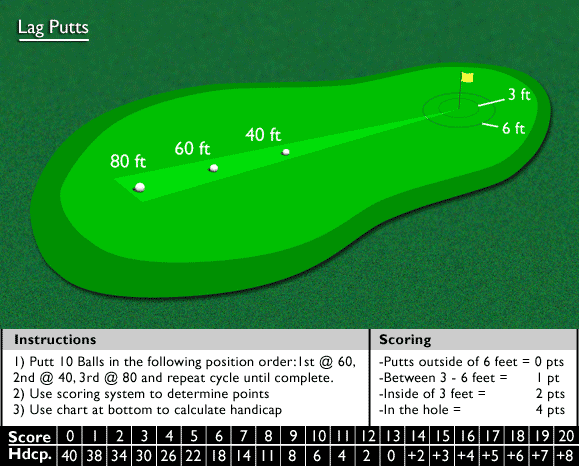
This drill makes the "finish zone" tangible and adds a scoring element to simulate pressure. The image below illustrates a version of this drill.
To perform the drill:
- From a distance of 30-40 feet, create a 6-foot diameter circle (3-foot radius) around the hole using tees. This is your primary target. You can also create a 3-foot inner circle for bonus points.
- Putt 10 balls from various locations at that distance.
- Score yourself:
- 4 points: Ball goes in the hole.
- 2 points: Ball finishes inside the 3-foot circle.
- 1 point: Ball finishes inside the 6-foot circle but outside the 3-foot circle.
- 0 points: Ball finishes outside the 6-foot circle.
- Your goal is to score as many points as possible. Track your score over time. This turns abstract practice into a measurable task focused on improving your proximity KPI.
Conclusion
Mastering lag putting is a strategic imperative for lowering your scores. It requires a fundamental shift in mindset, from an aggressive, high-risk "make everything" approach to a disciplined, data-driven, risk-management strategy.
Key Takeaways:
- The Goal is Proximity, Not Perfection: On long putts, your objective is to get the ball into a 3-foot "finish zone" around the hole to guarantee a simple second putt.
- Distance Control is a System: Effective distance control comes from a consistent tempo and a variable stroke length. This is a mechanical skill that can be calibrated and practiced, not an innate "feel."
- Calibrate Your Stroke: Use a systematic process to build a personal data model that maps specific stroke lengths to specific distances.
- Practice with Purpose: Use drills like the Ladder Drill and scored games to simulate on-course challenges and measure your improvement.
In our next lesson, we'll turn our attention back to shorter putts. Having mastered distance, we will work on ensuring your stroke starts the ball perfectly on line every time by practicing the gate drill, which is designed to train a straight, repeatable stroke path.