Welcome back. In our last lesson, we explored the power of visualization, establishing it as a critical component of your pre-shot routine. We learned how translating your strategic plan into a vivid mental image provides a clear blueprint for your athletic brain to execute.
Today, we will broaden our focus from a single step in the routine to the overarching mindset that governs consistent performance. The learning outcome is to distinguish between process-oriented and outcome-oriented thinking and explain why process focus improves performance. We will examine why the most successful performers in any field, from business to athletics, concentrate on the systems they control, rather than the results they desire. For someone with your background in analyzing and building systems, this framework of focusing on controllable inputs to improve outputs should be a very intuitive and powerful concept.
The Two Mindsets: Process vs. Outcome
On the golf course, every shot presents a choice in focus. You can fixate on the outcome—where the ball ends up—or you can commit to the process—the series of actions you take to produce the shot.
- Outcome-Oriented Thinking is being preoccupied with the result: "I need to make this putt," "Don't hit it in the water," "I have to shoot a good score today."
- Process-Oriented Thinking is being absorbed in the execution of controllable actions: "My process is to see the line, take a confident practice stroke, and commit to the target."
This distinction is fundamental to the mental game. The following article from Golf State of Mind provides a concise definition of these two concepts.
To Enhance Performance Turn Outcome To Process in Golf -
This article clearly defines the core terms we'll be discussing and provides excellent examples.
Read the first parts of the article to solidify your understanding of the key terms. Focus on these two sections: Under the heading "Process in Golf vs Outcome in Golf," read the definitions for outcome and process. In the next section, "Golf Outcomes and Processes," review the lists of outcome examples and process examples.
As the article highlights, your process includes elements like your pre-shot routine, course management strategy, and how you read a putt. Outcomes are the results: your score, your tournament standing, or whether a single shot lands in the fairway.
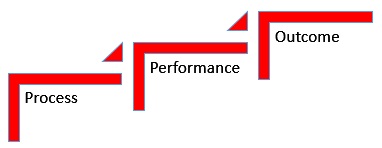
The relationship can be visualized as a set of stairs. The foundation is a solid process. Executing that process leads to better performance (e.g., more solid strikes, better distance control), and consistent performance ultimately produces the outcomes you desire.
Why Outcome-Focus Sabotages Performance
Thinking about outcomes feels natural; after all, we play to shoot a good score. However, focusing on an outcome that has not yet occurred introduces uncertainty, which triggers a counterproductive mental and physical response.
This video provides a vivid illustration of the "outcome-based golfer" and the emotional turmoil that accompanies this mindset.
Golf Psychology Tips - Understanding Process v Outcome , Golf Mental Game Lesson, Part 1
Watch this segment to see a dramatization of outcome-focused thinking and its negative consequences.
Watch from the beginning to this section. Notice how the golfer's internal monologue is filled with "don't" commands and score calculations. The presenter accurately describes this as an "emotional roller coaster" that breeds a lack of confidence, anger, and nervousness.
As you saw, focusing on an uncertain future result does the following:
- Triggers a Threat Response: Your brain perceives the uncertainty of the outcome (e.g., the possibility of hitting it out of bounds) as a threat. This engages your sympathetic nervous system—the "fight or flight" response—leading to increased heart rate, muscle tension, and shallow breathing. These are the physical enemies of a fluid, athletic golf swing.
- Creates Emotional Volatility: Good shots lead to elation and unrealistic expectations. Bad shots lead to anger and frustration that bleeds into subsequent holes. Your confidence becomes entirely dependent on external results you don't fully control.
- Shifts Focus Away from the Task: When you're calculating your score or worrying about a hazard, your attention is not on the present task of executing the shot. This is the mental equivalent of a data processing pipeline failing because the operator is too busy worrying about the final report to monitor the active transformation steps.
The key insight is that you do not have 100% control over the outcome. A perfect shot can get a bad bounce. A sudden gust of wind can move the ball. By attaching your emotional state to something you don't fully control, you set yourself up for failure.
The Power of a Process Focus
Now let's contrast this with the process-oriented mindset. By shifting your focus to the process, you direct your attention to what is 100% within your control.
This article explains why this shift is so powerful for creating a state of mind conducive to peak performance.
Stick To The Process to Play Your Best Golf
This article digs into the "why" behind prioritizing your process.
Read the section under the heading "Why make process your priority?". Pay attention to the distinction between focusing on uncertainty (outcomes) versus focusing on certainty (your intended tasks).
Focusing on your process—your routine, your visualization, your commitment—achieves the opposite of outcome-focus:
- Promotes Calm and Certainty: You know you can execute your pre-shot routine. You know you can commit to a target. Focusing on these certainties keeps you in the present moment and your nervous system calm. This allows your "athletic brain," which we discussed in the last lesson, to perform without interference.
- Builds Stable Confidence: Your confidence is now derived from your ability to execute your process, shot after shot. This is an internal, stable source of self-trust that isn't shaken by a single bad result.
- Redefines "Winning": You can "win" every single shot by successfully executing your process, regardless of where the ball lands. This re-frames success from an uncontrollable outcome to a controllable action.
Think of an outcome as feedback, not a final judgment. In your work, if a data model produces an incorrect forecast, you don't get angry at the number; you audit the data pipeline, check the assumptions, and refine the model—you fix the process. Golf is the same. A sliced drive is simply feedback that some part of your process—be it alignment, swing path, or commitment—needs review.
A Practical Framework for Process Focus: The 10-Point Commitment Score
To make this shift tangible, you need a way to measure your success in focusing on the process. The "Visualize, Feel, Let Go" routine, with its 3-3-4 scoring system, is a perfect tool for this. It turns a vague concept into a quantifiable metric.
This Simple 3-Step Routine Will Fix Your Mental Game (Forever)
This video introduces a brilliant and practical method for scoring your commitment to the process on every shot.
First, watch the explanation of the 3-3-4 scoring system. The goal is always to score a 10 out of 10 on the process, which is the only thing you can control. Next, watch the crucial discussion about separating the result from the process. This segment explains how to accept outcomes and learn from your level of commitment, not just the result.
The 3-3-4 system provides a clear scorecard for your mental game:
- Visualize (3 points): How clearly did you see the shot shape, trajectory, and landing spot?
- Feel (3 points): How well did your rehearsal swing match the feeling of the shot you visualized?
- Let Go (4 points): How completely did you trust your swing and commit to the target without trying to steer or control the result?
Your goal for every shot, from a tap-in putt to a pressure-packed drive, is to score a 10. If you hit a perfect drive but you were thinking about mechanics and only scored a 6 on your process, it was not a successful shot mentally. Conversely, if you fully committed (a 10/10 process score) but the ball catches the edge of a bunker, you can walk to the next shot with full confidence, knowing you did everything within your control.
Conclusion
In this lesson, we have drawn a critical distinction between focusing on the process and obsessing over the outcome. You have seen that an outcome-oriented mindset leads to an emotional roller coaster and physical tension, while a process-oriented mindset fosters calmness, consistency, and a stable foundation of confidence.
Your background in system analysis makes you uniquely equipped to embrace this mindset. By treating your golf game as a system where you control the inputs (your process) and use the outputs (shot results) as diagnostic feedback, you can build a robust and resilient mental game.
Key Takeaways:
- Outcome-oriented thinking focuses on results you don't fully control, creating anxiety and tension.
- Process-oriented thinking focuses on controllable actions, promoting a calm, present-moment awareness.
- The goal is not to ignore outcomes, but to reframe them as feedback on your process.
- You can "win" every shot by scoring a 10/10 on your commitment to the process (Visualize, Feel, Let Go).
In our next lesson, we will build directly on this foundation as we learn to describe strategies for managing pressure and nerves during a round. A steadfast commitment to your process is the single greatest tool for handling pressure, and we will explore how to maintain that focus when the stakes are high.