Welcome back. In our last lesson, we broke down the fundamental purpose and components of a pre-shot routine, establishing the "Think, Rehearse, Engage" framework. We discussed how this structured process helps replace mental chaos with clarity and confidence, drawing a parallel to the reliable outcomes of a well-designed ETL pipeline.
Today, we transition from theory to practice. Your learning outcome is to design a personal pre-shot routine for a full swing and a putt. This lesson is about creating your own personal algorithm for shot execution—a repeatable workflow that you can trust on every shot, especially under pressure. We will build two distinct routines, one for your long game and one for your work on the greens, giving you a consistent mental blueprint for the entire game.
Designing Your Full Swing Routine
A great routine is both structured and personal. It needs to include the key components we've discussed—analysis, visualization, rehearsal, and execution—but it must also fit your natural rhythm and timing. Think of it as customizing a standardized software module to fit a specific business need. The core logic is there, but you define the specific parameters.
A simple blueprint can provide a useful starting point.
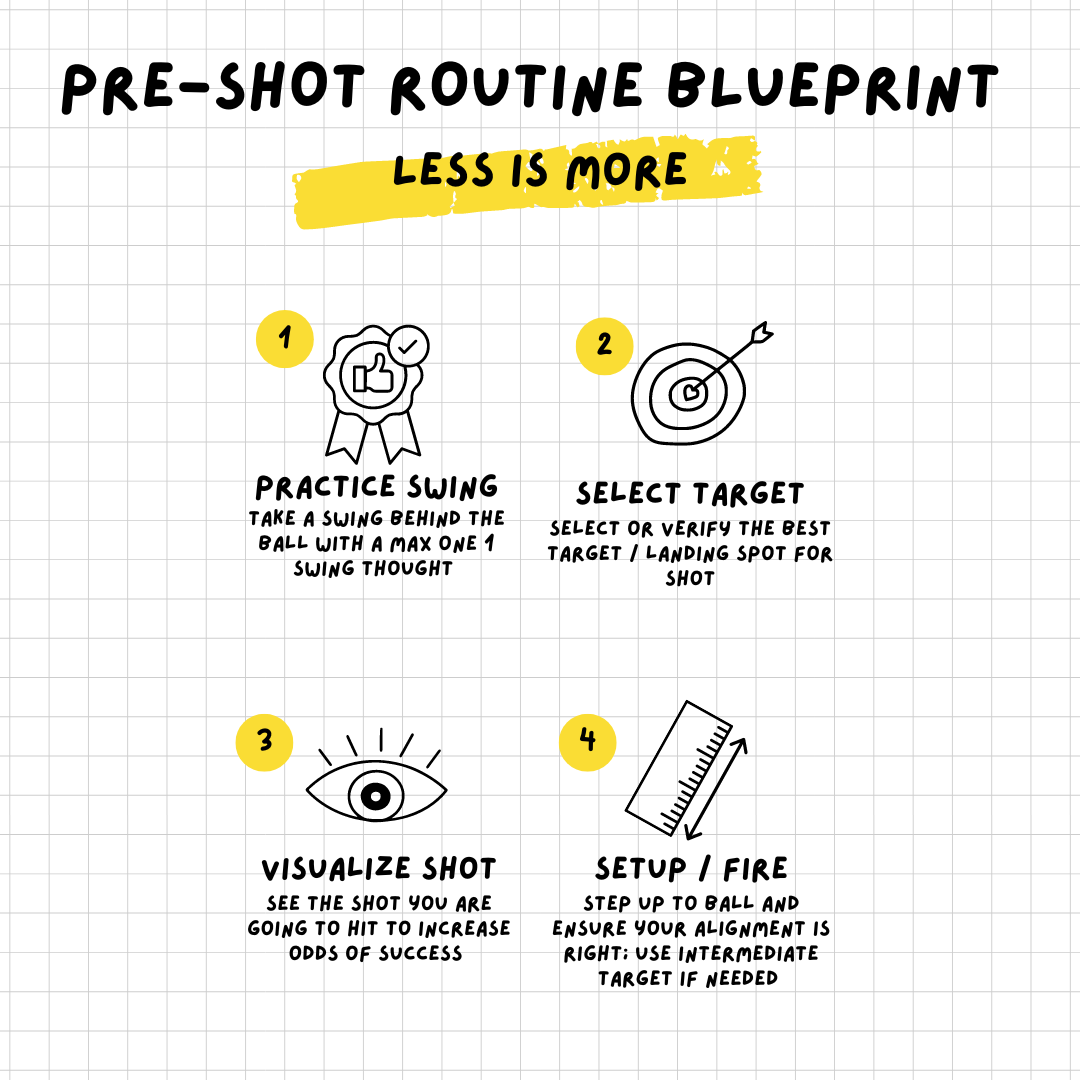
Using the "Think Box / Play Box" model from our last lesson, we can structure the design of your routine into three distinct phases.

Phase 1: The Think Box (Analysis)
This happens behind the ball, where you do all your conscious data gathering and decision-making.
- Assess Conditions: Analyze the lie, distance, wind, and hazards.
- Select Club: Make a definitive choice based on your assessment.
- Pick a Specific Target: Select the smallest possible target, not a general area.
- Commit: The moment you pull the club from the bag should signify that the analysis is complete. There is no more second-guessing.
Phase 2: The Feel Box (Rehearsal)
You’ve made your plan. Now, step to the side of the ball to translate that plan into a feeling.
- Visualize the Shot: With your target in mind, see the entire ball flight—the trajectory, the shape, the landing, and the roll. Make this mental picture as vivid as possible.
- Make Practice Swings: The goal here is not to work on swing mechanics. It is to feel the tempo and rhythm required for the shot you just visualized. One or two smooth swings are usually sufficient. Try to limit yourself to a single, positive swing thought (e.g., "smooth tempo" or "full turn").
Phase 3: The Play Box (Execution)
This is the final phase. Thinking is over. It's time to trust your preparation and execute.
- Approach and Align: Walk in from behind the ball. Pick an intermediate target a few feet in front of your ball and aim your clubface squarely at it.
- Build Your Stance: Set your feet, hips, and shoulders parallel to the line established by your clubface and intermediate target.
- Final Look & Trigger: Take one last, brief look at your ultimate target to connect your setup to your intention. Have a simple, consistent trigger to start your swing—like looking back to the ball.
- Let Go: Execute the swing within a couple of seconds of your final look. Do not linger. Trust the process and let your body perform the athletic motion it rehearsed.
A Practical Framework: Visualize, Feel, Let Go
The following video provides an excellent, practical demonstration of this process and introduces a powerful concept for a data-driven mind: a way to score your routine. This shifts the goal from the outcome (where the ball went) to the process (how well you executed your routine).
This Simple 3-Step Routine Will Fix Your Mental Game (Forever)
Watch this video from Cordie Walker GolfWell, "This Simple 3-Step Routine Will Fix Your Mental Game (Forever)." It masterfully simplifies the routine into three steps and introduces a brilliant scoring system.
Watch the introduction to the 3-step routine. See the application of the Visualize and Feel steps for a driver shot. Notice the emphasis on detailed visualization and confident, committed practice swings. Watch the same process applied to an iron shot. Pay close attention to how the coach challenges the player to commit fully despite self-doubt. Finally, understand the 3-3-4 scoring method. This is your new Key Performance Indicator (KPI) for the mental game.
The 3-3-4 scoring system (Visualize=3, Feel=3, Let Go=4) gives you a target of 10 for every shot. This is the only thing you are in control of. A "10" means you committed to your process, regardless of whether the ball went in the hole or into a bunker. This framework is invaluable for building mental discipline.
Designing Your Putting Routine
While the core principles are the same, the focus of a putting routine is more on line, speed, and feel. The stakes feel different, so the routine must be just as robust.
This article from GolfWRX provides a fantastic, detailed structure for a putting routine.
The Ultimate Putting Program (Part 5): The Pre-Shot Routine – GolfWRX
This article outlines a five-step process specifically for putting, which we will use as the foundation for your personal putting routine.
Please read through the five steps presented in the article: Assess the Situation: This covers data gathering on the green. Visualize The Shot: Note the quote from Jack Nicklaus. Feel The Shot: Pay attention to the tip about looking at the target during practice strokes. Execute The Shot: The key is to avoid hesitation. Accept The Outcome: This aligns perfectly with our process-oriented goal.
Based on this, we can establish a template for your putting routine. Notice the emphasis on looking at the target during practice strokes to calibrate distance, and the final step of accepting the outcome.
Your Personal Routine Blueprint
Now it's time to build your own routines. Copy the templates below and fill them out. Be specific. There are no right or wrong answers, only what is consistent and comfortable for you. The goal is to create a script that you can rehearse until it becomes second nature.
My Full Swing Routine
-
Phase 1: Think Box (Behind the ball)
- Steps: Assess lie, wind, distance -> Select club -> Pick specific target (e.g., left edge of a specific bunker).
- My trigger to commit and move on is:
_________________________(e.g., pulling the club from the bag).
-
Phase 2: Feel Box (Side of the ball)
- Visualization: I will see the ball's trajectory, shape, and landing spot.
- Practice Swings: I will take
___(1 or 2?) practice swing(s), focusing on feeling_________________________(e.g., a smooth tempo). - My single swing thought is:
_________________________
-
Phase 3: Play Box (Over the ball)
- Setup: I will pick an intermediate target, aim my clubface, then build my stance.
- My trigger to start the swing is:
_________________________(e.g., one last look at the target, then back to the ball). - My goal is to execute within 2-3 seconds of this trigger.
- My score for this shot (using the 3-3-4 method) is:
___ / 10.
My Putting Routine
-
Phase 1: Assess & Visualize (Behind the ball)
- Steps: Read the green from behind the ball and behind the hole -> Determine the exact line and speed -> Pick a specific spot to roll the ball over.
- Visualization: I will see the ball tracing the entire path into the hole.
-
Phase 2: Rehearse & Feel (Side of the ball)
- Practice Strokes: I will take
___practice strokes while looking at the hole to dial in the speed. - My focus is on feeling the
_________________________(e.g., length of the stroke).
- Practice Strokes: I will take
-
Phase 3: Execute & Accept (Over the ball)
- Setup: I will aim my putter face at my start line, then take my stance.
- Trigger: I will take one final look at the line/hole, look back at the ball, and go.
- Acceptance: I will assess my performance based on my commitment to the routine, not the result.
Practice these routines at home (as suggested in the comments of the GolfWRX article) or on the range. The goal is to make them so automatic that you don't have to think about them, allowing you to perform freely when it matters.
Conclusion
You now have the framework to build the two most important processes for golfing consistency: your full swing and putting routines. By personalizing these "algorithms," you create a reliable buffer against mental interference and pressure. Remember, the goal is not to achieve a perfect outcome on every shot, but to achieve a perfect process.
Key Takeaways:
- A personal pre-shot routine is a structured workflow that translates analysis into athletic execution.
- The "Think-Feel-Play" model provides a logical sequence: analyze and decide behind the ball, rehearse and visualize to the side, and execute without thought over the ball.
- The putting routine follows the same principles but with a greater focus on reading the green and feeling for distance.
- Use a scoring system like the 3-3-4 method to measure your commitment to the process, which is the only variable you can truly control.
In our next lesson, we will delve deeper into a critical component of your new routine: shot visualization. We'll explore how to use this powerful mental tool to build unwavering confidence and commitment before you even address the ball.