Welcome back. In our previous lesson, we constructed a systematic "post-shot routine" to serve as an error-handling protocol, ensuring that one poor outcome doesn't corrupt your entire round. We established that focusing on a controllable process is the key to mental resilience.
Today, we complete this mental framework by turning our attention back to the pre-shot routine. Having already designed its components, our goal now is to make it second nature. This lesson focuses on the practical application of that design, directly addressing the learning outcome: to rehearse the designed pre-shot routine on the practice range, executing it before every shot to build consistency. We will move from a conscious checklist to an ingrained, automatic process that becomes the unshakable foundation of every swing you make.
From Manual Script to Automated Process
In your work with data systems, you know the difference between a process that requires manual execution of every step and one that is automated. The automated process is faster, more reliable, and less prone to human error. This is precisely the goal for your pre-shot routine. Elite golfers are not consciously ticking boxes; their routine has become so ingrained that it runs on "auto-pilot," freeing their mind to focus on the target and the feel of the shot.
The following article from Titleist explains this state of "relaxed focus" and why consistency in the routine, down to the second, is a hallmark of the world's best players.
Pre-Shot Routine: How to Consistently Set Up Your Golf Shot - Titleist
This short introduction explains the "why" behind diligent routine practice. It frames the routine as a trainable skill for achieving an optimal mental state.
As you read this introductory section, focus on the idea of the routine as a form of "pre-shot choreography" that puts the player on auto-pilot, and the crucial point that it is a trainable skill that requires committed repetition.
Your objective is to transform your personally designed routine from a deliberate, conscious sequence into an automatic, reliable anchor. The way to achieve this is through purposeful practice.
The Drill: The Pre-Shot Routine Builder
A common mistake, especially for beginners, is to practice without a clear objective—simply hitting one ball after another. This is the equivalent of running code without a debugger or performance profiler; you're creating activity, but not necessarily improvement.
Best Golf Drills For Beginners At The Range | MyGolfSpy
The article "Best Golf Drills For Beginners At The Range" by MyGolfSpy opens by highlighting this exact issue.
Please read the section titled "The mistake that’s keeping you terrible." This section sets the stage for why structured drills are far more effective than mindless ball-beating.
To embed your routine, you must practice it with the same intention you plan to use on the course. This brings us to the core drill for this lesson.
The Pre-Shot Routine Builder Drill:
The drill itself is simple in description but demanding in execution. For a set number of balls during your practice session, you will execute your full pre-shot routine before every single shot. No shortcuts.
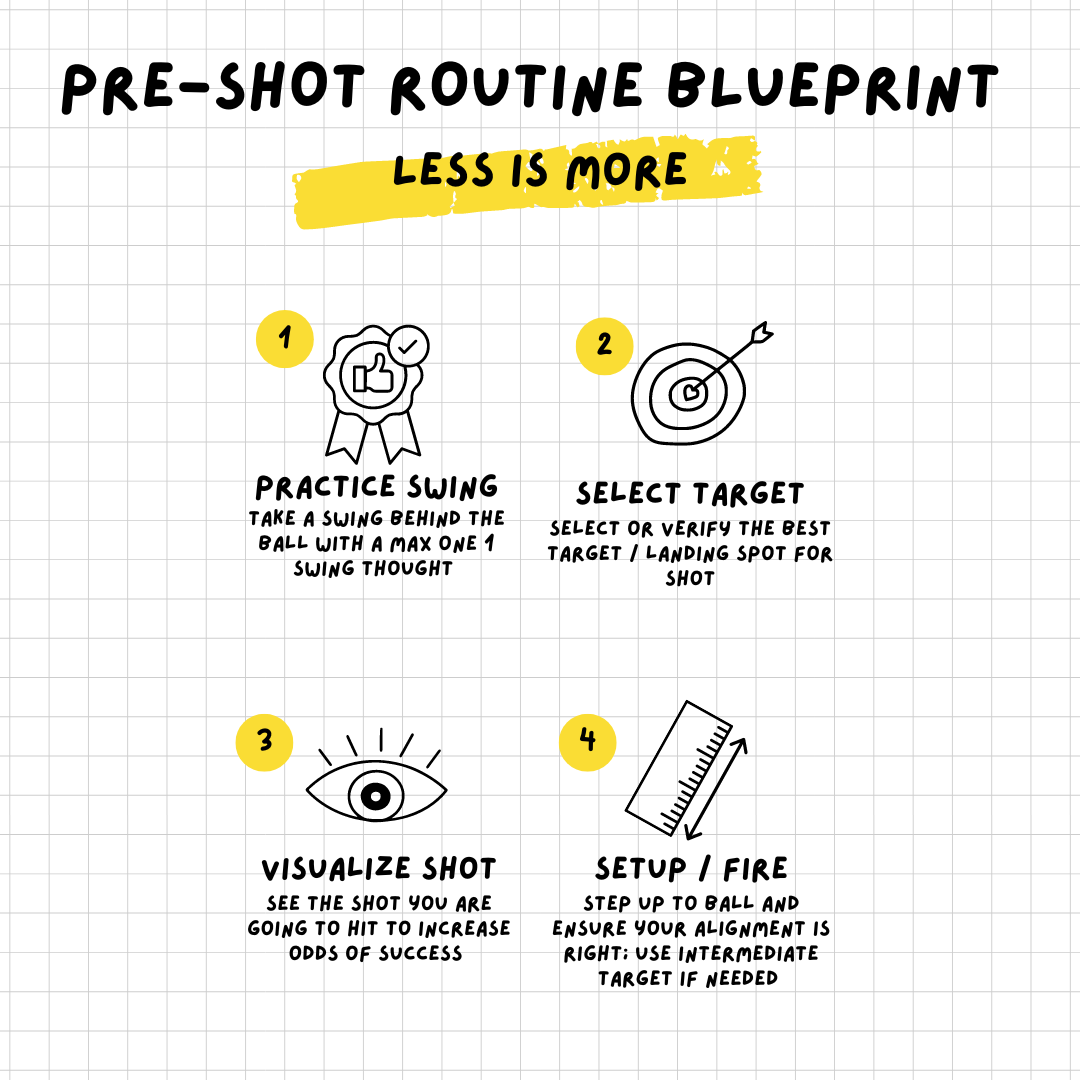
The MyGolfSpy article outlines this drill perfectly.
Best Golf Drills For Beginners At The Range | MyGolfSpy
This article provides the specific instructions for our main practice drill.
Now, read the short section titled "Drill #8: The pre-shot routine builder." The instruction is absolute: "Every single ball gets the same routine."
This discipline—treating every range ball like a crucial shot on the course—is what builds the habit. It connects the analytical "Think Box" phase (behind the ball) with the athletic "Play Box" phase (over the ball) into one seamless flow.
A Model for High-Quality Execution
To help you visualize what a well-executed routine looks like, the following video provides a detailed breakdown. The goal is not to copy this specific routine, but to observe the quality, deliberation, and flow of the process.
THE PERFECT PRE-SHOT ROUTINE FOR MORE CONSISTENCY
This video by Kerrod Gray Golf provides an excellent model. It contrasts common amateur mistakes with a professional-quality routine.
First, watch the introduction and the demonstration of common errors. Notice the lack of a plan, poor alignment checks, and static, indecisive posture. Next, watch the step-by-step breakdown from this point. Pay close attention to these key details: Taking the practice swing next to the ball to feel the turf interaction. Stepping behind the ball to select an intermediate target. Setting the grip before walking in. Setting the clubface first, then building the stance around it. Finally, watch the full-speed demonstration and listen to the advice on being intentional. This is what the routine looks like when it flows together.
Adding a Quantitative Layer: Time Your Routine
Given your background in data analysis, you'll appreciate that what can be measured can be managed. A powerful way to build rhythm and consistency into your routine is to time it.
Pre-Shot Routine: How to Consistently Set Up Your Golf Shot - Titleist
Let's return to the Titleist article for a practical method to quantify your routine's consistency.
Read the final paragraph, starting from "To practice effectively." The drill is to use a stopwatch to time the "prelude to the hit"—the moment you commit and step toward the ball until the club strikes it.
Drill Modification: The Timed Routine
As you perform the "Pre-Shot Routine Builder" drill, incorporate this timing element for a block of 10-15 shots.
- Go through your analysis behind the ball (target selection, visualization).
- The moment you take your first step forward to address the ball, start a stopwatch.
- Stop the watch at the moment of impact.
- Note the time. Repeat for each shot.
Your goal is not to be fast or slow, but to be consistent. If your times are clustered within a one- or two-second window (e.g., 15s, 16s, 15.5s), you are building a reliable rhythm. If they are scattered (e.g., 12s, 25s, 18s), it indicates inconsistency in your process over the ball.
Troubleshooting and Practice Structure
What if a specific part of your routine feels awkward or inconsistent? Just as you would debug a function, you can isolate and practice individual components.
How To Create a Consistent Pre-Shot Routine in Golf
This video from Scratch Golf Academy offers excellent advice on practicing the individual elements of a routine and integrating it into your practice sessions.
Watch this video to understand how to break down the routine for practice: Posture: Practice creating your setup posture in front of a mirror at home, with and without a club. Alignment: Use alignment sticks on the range and practice setting the clubface from your trail foot, as shown from this point. Ball Position: Use floor markings at home to get used to how you set your feet for a consistent ball position (explained here). Flow & Trigger: Experiment with what feels comfortable to stay in motion and start your swing (as discussed here). Finally, pay attention to the closing thought on how to structure your practice. Not every ball needs to be a full-routine shot, but a dedicated portion (e.g., 10-20 balls per session) should be.
Conclusion
In this lesson, you have learned a systematic and measurable way to practice your pre-shot routine, transforming it from a theoretical concept into a practical, ingrained skill.
Key Takeaways:
- Practice with Purpose: The goal of routine practice is to make it automatic, freeing your mind to focus on the shot itself. Avoid mindless ball-hitting.
- The Routine Builder Drill: The cornerstone of your practice should be executing your full pre-shot routine before every shot for a dedicated block of time.
- Quantify Your Rhythm: Use a stopwatch to time your routine from the first step forward to impact. Striving for a consistent time is a powerful way to build rhythm.
- Isolate and Debug: If one component of your routine feels off, practice it in isolation using mirrors or alignment aids before integrating it back into the full sequence.
With a solid pre-shot routine for preparation and a post-shot routine for recovery, you have now built the essential mental architecture for consistent performance.
This lesson concludes our module on the mental game. In the next module, "Effective Practice and Self-Coaching," we will broaden our scope to look at how to structure entire practice sessions for maximum improvement. We'll begin by exploring the crucial difference between block practice and random practice, and when to use each to accelerate your learning.