Welcome to your next lesson in our module on generating power with woods. In our previous sessions, we've established the theoretical groundwork for the full swing, covering concepts like the positive angle of attack for the driver and the key differences between hitting a fairway wood off the turf versus off a tee. Today, we transition from theory to practice with a hands-on experiment.
This lesson is designed as a practical drill focused entirely on the driver. Your goal is to systematically test how a single input variable—tee height—affects your ball flight. For someone with your background in data analysis, this should be a familiar process: isolating a variable, running tests, and observing the impact on key output metrics. By the end of this session, you'll have a much deeper, more intuitive understanding of how to optimize your setup for distance and consistency off the tee.
The Physics of Tee Height: Gearing Up for Distance
Before you head to the range, it's crucial to understand why tee height is so important. The effect isn't random; it's governed by the physics of the clubface, specifically a concept known as the vertical gear effect.
A driver's face is not flat, and its loft is not uniform. The loft is highest at the top of the face and lowest at the bottom. The gear effect describes how impact location interacts with this curvature to alter ball spin.
- High-Face Contact: Striking the ball high on the face causes the clubhead to tilt downward at impact. This gearing motion imparts less backspin on the ball. Combined with the higher effective loft at this impact point, the result is a high-launch, low-spin shot—the modern recipe for maximizing driver distance.
- Low-Face Contact: Striking the ball low on the face has the opposite effect. The clubhead tilts upward, imparting more backspin. This, combined with the lower effective loft, produces a low-launch, high-spin shot that tends to fly shorter and can "balloon" in the wind.
This article from Practical-Golf provides an excellent primer on this concept.
Driver Tee Height: How to Find the Right One for Your Swing · Practical-Golf.com
This article explains the core principles you'll be testing in today's drill. It clearly breaks down how loft varies across the driver face and introduces the vertical gear effect.
Read the first half of the article, from the beginning down to the section titled "How to Find the Right Driver Tee Height". Focus on understanding the relationship between impact location, launch, and spin.
The interplay between launch angle and spin is a classic optimization problem, not unlike balancing variables in a business model to maximize an outcome.

So, how significant is this effect? A test conducted by MyGolfSpy provides compelling data.
This "lab test" quantifies the effects of tee height. It will give you a clear idea of the magnitude of the changes you should expect to see in your own experiment.
Read the "Key Findings" section, paying close attention to the subsections on Distance, Launch Angle, Backspin, and Angle of Attack. Note how a change of just one inch in tee height resulted in a nearly 15-yard difference in distance.
The data is clear: tee height directly influences your Angle of Attack (AoA), launch, spin, and ultimately, your distance. A higher tee makes it easier to achieve the positive AoA required for an optimal driver strike.
The Drill: A Three-Variable Experiment
Now it's time to conduct your own test at the driving range. Your objective is to hit shots from three distinct tee heights and observe the differences in impact location and ball flight.
Materials:
- Your driver
- A bucket of range balls
- Tees. If you don't have tees of different lengths, you can simply push a standard tee further into or pull it further out of the ground. For consistency, "castle" tees of different colors (heights) are very useful.
- Optional but highly recommended: A can of foot powder spray (like Dr. Scholl's) or a similar product to apply to your driver face. This will give you precise feedback on your impact location.
Experimental Procedure
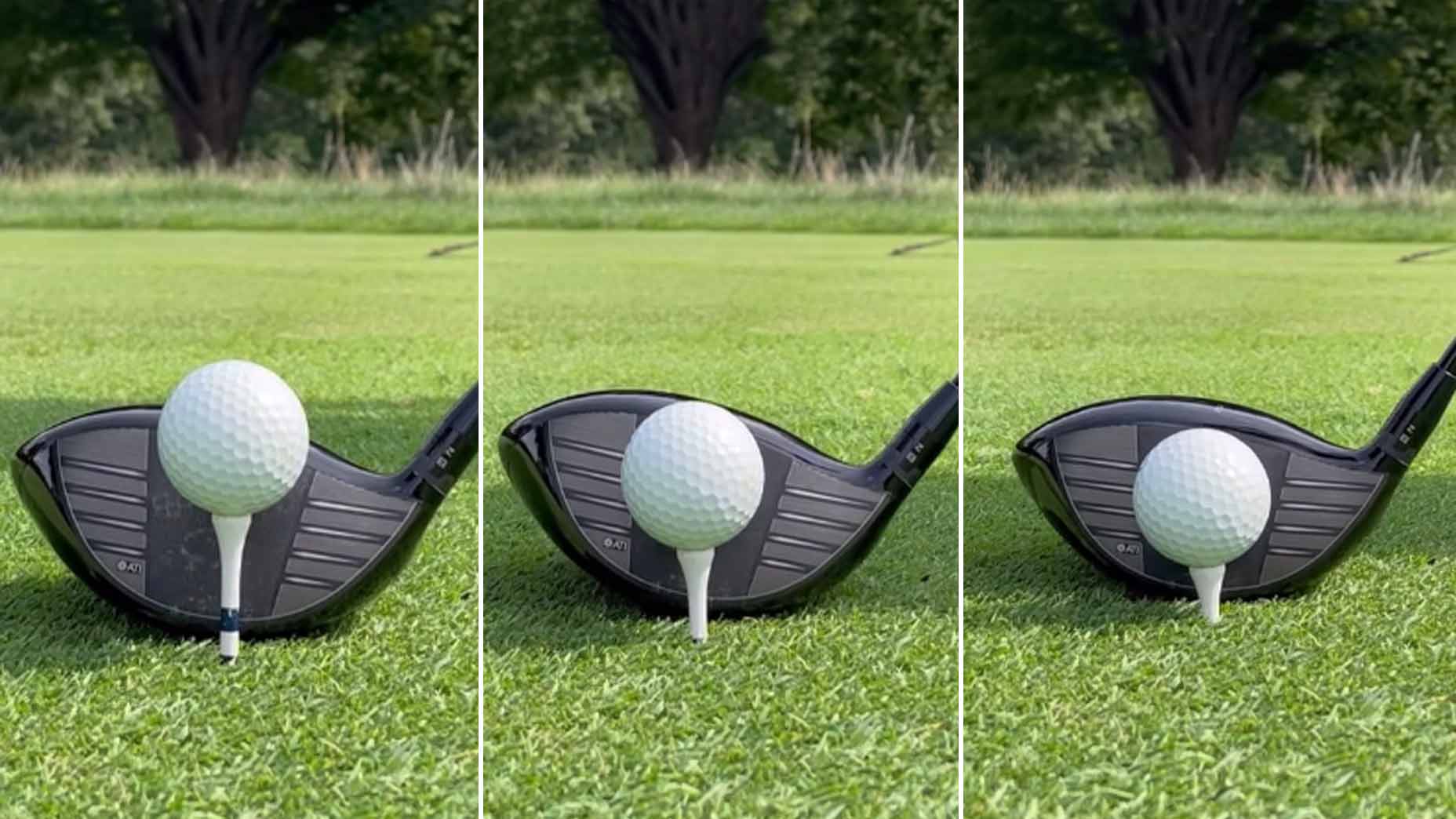
You will test three conditions: Low Tee, Medium Tee, and High Tee. For each condition, hit 5-10 shots and carefully observe the results.
-
Condition 1: Medium Tee (Your Baseline)
- Setup: Tee the ball so that about half of it is visible above the top edge (crown) of your driver. This is a common, neutral starting point.
- Execution: Hit 5-10 shots. Between each shot, if using spray, reapply and check your impact location. Note the typical trajectory, height, and distance.
-
Condition 2: Low Tee
- Setup: Tee the ball down so its top is roughly level with the crown of the driver.
- Execution: Hit 5-10 shots. Before you swing, notice how this setup might subconsciously alter your swing intentions. Observe the ball flight. Do the balls fly lower? Do they seem to have more curve? Check your impact location—it will likely be lower on the face.
-
Condition 3: High Tee
- Setup: Tee the ball up so that the entire ball is above the crown of the driver.
- Execution: Hit 5-10 shots. This setup should feel like it encourages you to swing up at the ball. Observe the flight. Is it higher? Does it feel more powerful? Also, be aware of the risks: this height can lead to "sky balls" (pop-ups) if you get too steep. Check your impact location, aiming for high on the face.
The following resource outlines this exact experimental process.
Driver Tee Height: How to Find the Right One for Your Swing · Practical-Golf.com
This section of the Practical-Golf article details the drill you are about to perform.
Read the section "How to Find the Right Driver Tee Height". The author's use of foot spray to find the optimal strike pattern is exactly what you should aim to replicate.
Analyzing Your Results
After you've hit shots from all three heights, it's time to analyze your data. Think of this like reviewing the output of a test query. You changed an input parameter (TeeHeight) and now you need to evaluate the output KPIs.
Watch the following video from 2nd Swing Golf. They conduct the same experiment using a Trackman launch monitor, providing a perfect example of what to look for.
The Impact of Golf Tee Height | How High Should You Tee The Ball Up? | Trackman Test
This video is a comprehensive demonstration of your experiment, complete with data analysis.
Watch the entire video, but pay special attention to the data summaries after each set of shots: Low Tee Results: Note the negative attack angle and low launch. Stock Tee Results: See how the numbers improve dramatically, especially carry distance and AoA. High Tee Results: Observe the highest launch and longest distance, but also the trade-off with a wider dispersion. Final Data Breakdown: This summary is a model for how you should think about your own results.
When you analyze your own shots, focus on these key metrics, even if you're just observing them without a launch monitor:
| Metric | Low Tee (Observation) | Medium Tee (Observation) | High Tee (Observation) |
|---|---|---|---|
| Impact Location | Likely low/center | Likely centered | Likely high/center |
| Launch Angle | Low | Medium | High |
| Peak Height | Low, boring trajectory | Medium trajectory | High, towering trajectory |
| Carry Distance | Shortest | Medium | Potentially Longest |
| Dispersion | Potentially tightest | Medium | Potentially widest |
| Feel/Confidence | May feel restrictive | Should feel 'normal' | May feel powerful but risky |
Your goal is to find the tee height that helps you consistently strike the ball slightly above the center of the face. This is the height that best matches your specific swing's angle of attack. As the SGGT video concludes, there is no single "perfect" height for everyone; it's an individual optimization process. For a beginner, consistency is key, so finding a height that helps you remove the worst-case scenario (a low-face strike) is a huge win.
Conclusion
You have now conducted a fundamental experiment in golf performance. By manipulating a single variable, you've witnessed its direct and significant impact on launch dynamics. This process of testing, observing, and analyzing is the foundation of becoming a knowledgeable and self-sufficient golfer.
Key Takeaways:
- Tee height is a primary control for influencing impact location on the driver face.
- High-face contact is desirable as it produces high launch and low spin, the key ingredients for distance, due to the vertical gear effect.
- A low tee height tends to produce low-launch, high-spin shots, while a high tee height promotes the opposite, though potentially at the cost of control.
- The optimal tee height is personal; it's the one that allows you to consistently strike the ball just above the center of the face with your unique swing.
In our next lesson, we will perform our final practice drill for this module. You'll take what you've learned about optimizing launch and apply it to the fairway wood, practicing hitting off a low tee with the shallow, sweeping motion required for that club. This will solidify your understanding of how different clubs in your bag require distinct approaches to achieve the best results.