Welcome to the first lesson of our new module, "Full Swing: Power with Woods." Over the last few weeks, you've built an excellent foundation in iron play, culminating in a systematic approach to controlling wedge distances. The key principle for irons, as you've learned, is creating a descending blow to achieve crisp, ball-first contact for precision and control.
Now, we shift our focus from the surgical precision of irons to the raw power of the driver. The objective with the driver is fundamentally different: to maximize distance. To do this, we need to change our swing's intention from hitting down on the ball to hitting up on it. This single change in objective necessitates a series of important adjustments to your setup before you even start the swing.
In this lesson, you will learn to explain the key setup differences between driver and iron play, focusing on four critical variables: ball position, tee height, stance width, and spine tilt. Mastering this new setup is the first and most important step to unlocking power and consistency with the longest club in your bag.
The Core Principle: Hitting Down vs. Hitting Up
Before we break down the specific adjustments, it's crucial to understand the "why." An iron is hit off the turf, so we need to strike the ball before the club reaches the lowest point of its arc to ensure clean contact. A driver is hit off a tee, which gives us the opportunity to strike the ball after the low point, on the upswing. This is called creating a positive, or upward, angle of attack. Hitting up on the ball with a driver launches it higher with less backspin, which is the primary formula for maximizing distance.
The following video from Me and My Golf provides an excellent overview of this fundamental difference in purpose.
IRON vs DRIVER Set-Up Basics | ME AND MY GOLF
This clip introduces the different goals for the driver (distance via an upward strike) and an iron (control via a downward strike), which provides the essential context for all the setup changes we will discuss.
Watch the introduction from difference between a driver to understand why we must treat these two clubs differently. Pay close attention to the distinction between an "upward attack angle" for the driver and a "downward attack angle" for the iron.
With this core principle in mind—that we are setting up to hit up on the driver—let's examine how to systematically adjust your address position.
The Four Key Setup Adjustments
We will now go through each of the four variables, comparing the driver setup to the iron setup you've already learned. The Me and My Golf video provides a fantastic visual guide for these changes.
IRON vs DRIVER Set-Up Basics | ME AND MY GOLF
The instructors will now detail the specific setup changes for both the driver and the iron. Watch these two segments back-to-back to see the direct comparison.
First, watch the detailed breakdown of the driver setup. Note the discussion on tee height, ball position, stance width, and body tilt. Next, watch the review of the iron setup. This will reinforce what you already know but put it in direct contrast with the driver setup you just saw.
Let's solidify those concepts with a more detailed breakdown and some supporting text.
1. Ball Position and Tee Height
This is the most obvious and impactful difference.
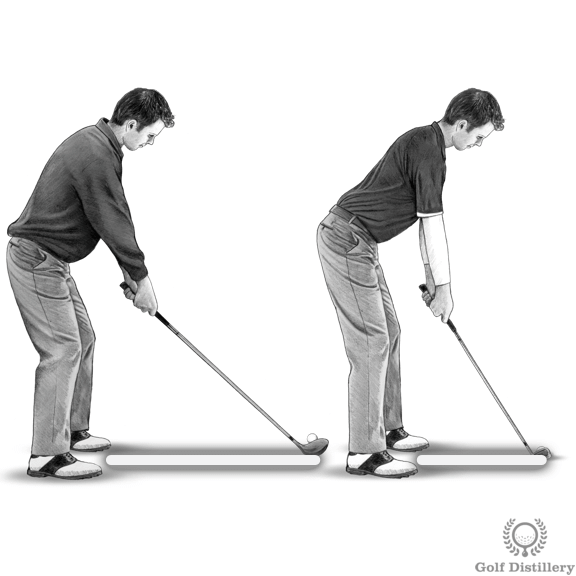
- Driver: The ball is teed up high (roughly half the ball above the top of the driver head) and positioned far forward in the stance, directly in line with the heel or even the big toe of your lead foot (left foot for a right-handed player).
- Iron: The ball is on the ground (or a very short tee) and positioned near the center of your stance. As you learned, it may move slightly forward for longer irons and slightly back for shorter irons, but its home base is the middle.
Why the change? Placing the ball forward gives the clubhead time to pass the low point of its swing arc and begin its ascent before making contact. The high tee facilitates this upward strike.
This image clearly illustrates the difference in ball position relative to your feet.
2. Stance Width
- Driver: Your stance should be wider, with your feet set just outside of your shoulders.
- Iron: Your stance is narrower, approximately shoulder-width apart.
Why the change? The driver swing is your fastest, most powerful swing. A wider stance provides a more stable base of support for this athletic motion. It also helps to create a wider, shallower swing arc, which promotes the sweeping motion required for an upward strike.
To reinforce these first two points, let's turn to a concise article from MyGolfSpy.
Golf Driver Setup Versus Golf Iron Setup | MyGolfSpy
This article provides a clear, written explanation of the key setup variables.
Read the sections on Ball position and Posture and stance width. This will reinforce what you just saw in the video regarding where to place the ball and how wide to stand.
3. Spine Tilt and Shoulder Tilt
This adjustment is more subtle but just as critical for promoting an upward strike.
- Driver: Your spine should be tilted away from the target, causing your trail shoulder (right shoulder) to be noticeably lower than your lead shoulder (left shoulder). Your head and sternum should feel like they are "behind" the golf ball.
- Iron: Your spine is more neutral, and your shoulders are much more level. Your trail shoulder is naturally slightly lower simply because your trail hand is lower on the club's grip, but you do not add any extra tilt.
Why the change? Tilting your upper body away from the target pre-sets your body in a position to launch the ball upwards. It effectively moves the low point of your swing further back, ensuring you catch the ball on the upswing.
This image perfectly captures the difference in spine tilt.
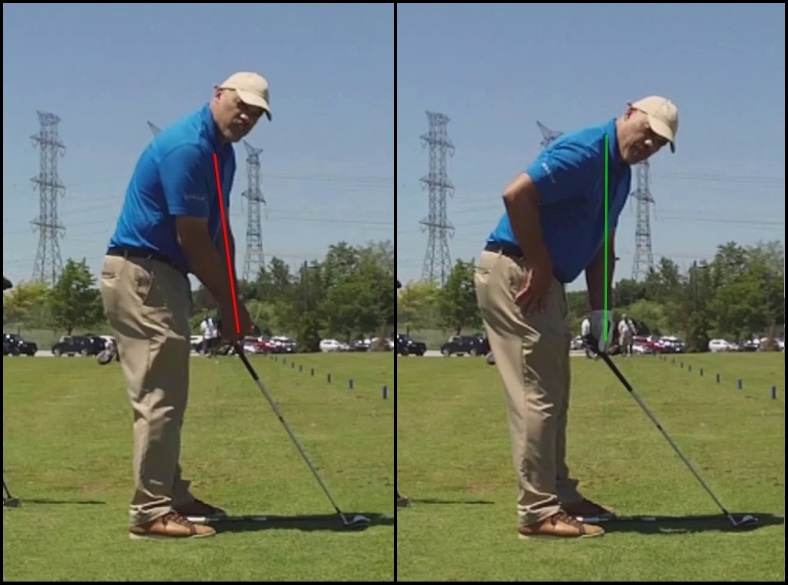
The following video segment explains this concept using the idea of a "compression line" and feeling your nose stay behind the ball.
The DIFFERENCE | Driver Vs Iron | Setup & Swing Basics
This video from Top Speed Golf offers another excellent perspective on why spine tilt is so crucial and how it differs between clubs.
First, watch the section on driver spine tilt, where the instructor explains the feeling of keeping your nose and belt buckle behind the ball. Then, watch the comparison with the iron setup, where the goal is to be more "stacked" over the ball.
Summary: A Tale of Two Setups
You've now analyzed the four key variables. Because your work involves structuring and analyzing data, here is a summary table that consolidates these differences into a clear, comparative framework. Think of this as the system specification for two different tasks: "Iron Shot - Precision" and "Driver Shot - Power."
| Setup Variable | Iron (Precision) | Driver (Power) | The "Why" for the Driver |
|---|---|---|---|
| Ball Position | Center of Stance | Inside Lead Heel | Allows club to start ascending before impact. |
| Tee Height | On the ground | High Tee | Puts the ball in the path of the upswing. |
| Stance Width | Shoulder-width | Wider than shoulders | Creates a stable base for a powerful swing. |
| Spine Tilt | Neutral / Centered | Tilted away from target | Pre-sets the body to launch the ball upwards. |
You can find a similar concise summary in the "Proper Golf Stance" article from Swing Align, which is a great resource to bookmark.
Proper Golf Stance Position for Irons & Drivers | Swing Align
This article provides excellent, quick-reference summaries for both setups.
Review the two final sections, Golf Stance For Irons and Stance & Position For Drivers. These lists are a perfect way to quickly recall the key differences.
Conclusion
Today you've taken the first step into the world of power golf by learning how to fundamentally alter your setup for the driver. It's not a different swing, but rather a different setup that produces a different impact condition. By making these conscious, systematic adjustments, you are programming your body to achieve the upward angle of attack required for maximum distance.
Key Takeaways:
- The goal with a driver is to hit up on the ball (an ascending blow), whereas with an iron, the goal is to hit down on the ball (a descending blow).
- This difference in objective requires four key setup changes for the driver: a forward ball position, a high tee, a wider stance, and a distinct spine tilt away from the target.
- Each of these adjustments works together to move the low point of the swing arc behind the ball, ensuring you make contact on the upswing.
In our next lesson, we will delve deeper into the physics of the driver swing. We'll formally define "angle of attack" and explore how it combines with launch angle and spin rate to determine your total driving distance. This will connect the setup changes you learned today directly to the results you see in the ball's flight.