Hello! In our previous lessons, we've focused on the critical preparatory work for consistent iron play: learning to read your divots for feedback and meticulously adjusting your setup for each category of iron. Now it's time to put that knowledge into action with a powerful and practical exercise.
Today's lesson addresses the learning outcome: to perform the towel drill to train consistent ball-first contact. This drill is a cornerstone of effective practice because it provides immediate, unmistakable feedback, helping you groove the correct impact dynamics we've been discussing. Think of this as moving from system analysis to live implementation—you've studied the blueprints, and now you're going to build the machine.
The Logic of the Drill: A Simple Feedback System
Before you head to the range, let's solidify the "why" behind this drill. As we've covered, the key to a pure iron shot is making a descending blow, where the club strikes the ball first and then the turf. This ensures the low point of your swing arc occurs just in front of where the ball was.
Many amateurs struggle with this, hitting the ground behind the ball (a "fat" or "chunk" shot). The towel drill creates a simple physical constraint that makes this error impossible to ignore. By placing a towel a few inches behind the ball, you create a binary feedback loop:
- Hit the towel: Your swing bottomed out too early. The feedback is immediate and sensory.
- Miss the towel: You successfully kept the club head on a path to strike the ball first.
This kind of clear, unambiguous feedback is invaluable for training motor patterns, as your brain and body can quickly learn to make the necessary adjustments without getting lost in complex swing thoughts.
The following video from Titleist provides an excellent overview of low point control and introduces the towel drill as a primary tool for mastering it.
Golf Swing Fundamentals: Controlling Low Point and Making Solid Contact | Titleist Tips
This video effectively explains the concept of low point and demonstrates how the towel drill helps you control it.
First, watch from the beginning to vital vital for a refresher on the fundamentals of achieving quality contact, including ball position, weight shift, and a centered backswing. Then, pay close attention to the introduction and demonstration of successful golf shots. Notice how the instructor sets up the drill, executes the shot, and then explains how to progress by making the margin for error smaller.
Setting Up and Executing the Towel Drill
Now, let's get into the specifics of setting up and performing the drill. All you need is a standard golf towel, some balls, and a mid-iron like a 7-iron to start.
The setup is straightforward. You'll place the towel on the ground a specific distance behind the golf ball, parallel to your target line.
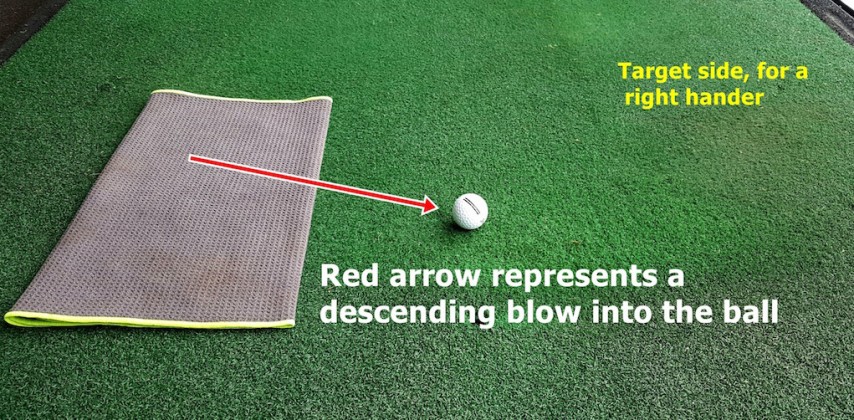

The following short article and video provide clear, step-by-step instructions for performing this drill effectively.
Looking for a better ballstriking drill? A towel is all you need
Top instructor Peter Kostis explains the simple logic and execution of the drill, reinforcing the concept of a descending angle of attack.
Read the entire short article. Focus on Kostis's instructions for setting up the drill, where he specifies placing the towel 3-5 inches behind the ball. Also, note his crucial advice for learning any new motor pattern: start slow and small, and build confidence before increasing the swing's length and speed.
The instructors at Me and My Golf offer another fantastic walkthrough, complete with a simple swing thought to keep you focused.
The PERFECT Drill For Consistent Ball Then Turf Contact With Your Irons! (So Simple)
This video provides a very practical guide to setting up and performing the towel drill, with excellent tips for getting the right feel.
Watch the setup instructions from the back of the ball, where they recommend starting with the towel about one clubhead's width behind the ball. Then, focus on the execution and key feeling from so crucial. The swing thought "feel like you're going to chop down into the back of the ball" is a great mental cue for achieving a descending strike.
A Structured Practice Protocol
To get the most out of this drill, approach it systematically. Don't just hit balls randomly; have a clear plan.
- Club Selection: Start with a mid-iron, like a 7-iron or 8-iron.
- Initial Setup: Place your towel about one clubhead's width (around 3-5 inches) behind the ball. Apply the setup principles from our last lesson—for a 7-iron, this means a shoulder-width stance with the ball slightly forward of center.
- Start Small: Begin with slow, half-swings (hip-to-hip or shoulder-to-shoulder). The goal is not power, but precision. Feel the clubhead miss the towel and brush the grass just after the ball.
- Execute and Evaluate: Hit a series of 5-10 shots with this half-swing. After each shot, assess the feedback:
- Success: You missed the towel and made clean contact. Your divot should start at or just after the ball's position.
- Failure: You hit, scuffed, or moved the towel. This is your data point indicating the low point was too early.
- Progress: Once you can consistently hit 5-10 shots without touching the towel using a half-swing, you can progress to a full, smooth swing. Once that becomes consistent, you can increase the difficulty by moving the towel slightly closer to the ball (e.g., from 4 inches to 2 inches).
Troubleshooting
If you find yourself consistently hitting the towel, don't get frustrated. This is simply feedback guiding you toward a solution. Here are the most common causes and their fixes:
- Weight Stays Back: A very common fault is "hanging back" on your right side during the downswing. This shifts the low point behind the ball. Fix: Consciously feel your weight shift onto your lead (left) foot as you start the downswing. The step-through drill from Module 2 is a great way to rehearse this feeling.
- Incorrect Ball Position: Double-check your setup. If the ball is too far forward for the club you're using, your swing will naturally bottom out before it reaches the ball. Refer back to the previous lesson's guidelines.
- Casting the Club: This is an early release of the wrist angles at the top of the downswing, throwing the clubhead at the ball and causing it to hit the ground too soon. Fix: Go back to slow half-swings and focus on maintaining the angle between your lead arm and the club shaft for as long as possible, feeling like you are "pulling" the club handle down towards the ball.
The "Still Hitting Towel" section in the following resource provides a good summary of these points.
Golf Towel Drill: The $1 Solution to Fix Shanks and Master Mental Game
This resource offers a concise list of potential causes and solutions if you're struggling with the drill.
Read the section titled Still Hitting Towel. This serves as a quick diagnostic checklist for when the drill isn't going as planned. Note that the advice to "Move towel slightly farther out" is your primary way to adjust the difficulty and build confidence.
Conclusion
You now have a complete guide to one of the most effective drills in golf. The towel drill is your personal, real-time data feedback system for mastering ball-first contact. It strips away ambiguity and trains the correct impact dynamics through a simple, repeatable process.
Key Takeaways:
- The towel drill provides binary feedback (hit or miss) to train a descending angle of attack.
- Set up by placing a towel 3-5 inches behind the ball, parallel to the target line.
- Start with short irons and slow, half-swings to build confidence and feel.
- If you hit the towel, diagnose the cause: typically, it's improper weight shift or an incorrect setup.
- Progress by making the swings longer and faster, and by gradually moving the towel closer to the ball.
In our next practice session, we'll build directly on this skill. You will be asked to hit shots alternating between a short iron and a mid-iron, which will require you to apply both your setup adjustments and your newfound ball-striking consistency.