Following our last lesson on tee shot strategy, where we focused on positioning the ball to set up your next shot, we now turn our attention to that second shot itself: the approach. If the tee shot is about setting the strategic foundation for the hole, the approach shot is where you execute the plan to give yourself the best possible scoring opportunity.
Your goal for this lesson is to learn how to describe an approach shot strategy by considering distance, the lie of the ball, the pin's location, and any surrounding hazards. This is where the game moves firmly into the realm of risk management and optimization—concepts you are very familiar with from your work in business intelligence and investment management. You'll be gathering data, assessing risk, and selecting a course of action designed to produce the highest probability of a good outcome.
The True Goal of an Approach Shot: A Data-Driven Perspective
For most golfers, the default approach shot strategy is simple: aim at the flag. However, data shows this is often a suboptimal, high-risk plan. The goal of an approach shot isn't necessarily to knock it close for a tap-in birdie; it's to get the ball safely on the putting surface, minimizing the chance of a penalty or a difficult recovery shot. Lowering your score is primarily about avoiding big numbers (double bogeys or worse), not about making more birdies.
The following article from Practical Golf uses statistical analysis to make a compelling case for a more conservative approach.
Approach Shot Strategy: How to Lower Your Scores With Smarter ...
This article provides a data-driven argument for why smart approach strategy is crucial. It aligns well with your analytical background by using statistics to debunk common myths about scoring.
Read the first three sections, starting from the introduction, through the section explaining why aiming at the pin is a losing strategy, and finishing with the section titled "It's All About GIR." Pay close attention to the statistics on PGA Tour player proximity and the direct correlation between Greens in Regulation (GIR) and a player's handicap.
As the article makes clear, your number one objective on most approach shots is to hit the green. This simple act drastically reduces the probability of a high score and gives you a chance to make par with two putts.
A Framework for Approach Strategy: Assess and Execute
Just as you would analyze a problem in business, your approach shot requires a systematic process. You need to consider four key variables before selecting your club and target.
1. Pin Location & Surrounding Hazards: This is the most important part of your risk assessment. Where is the flagstick relative to trouble?
- "Sucker Pins": Course designers often place pins near hazards like water, deep bunkers, or steep drop-offs. These are called "sucker pins" because they tempt you into a high-risk shot.
- "Green Light" Pins: A pin in the center of the green, far from any trouble, is a "green light" to be more aggressive.
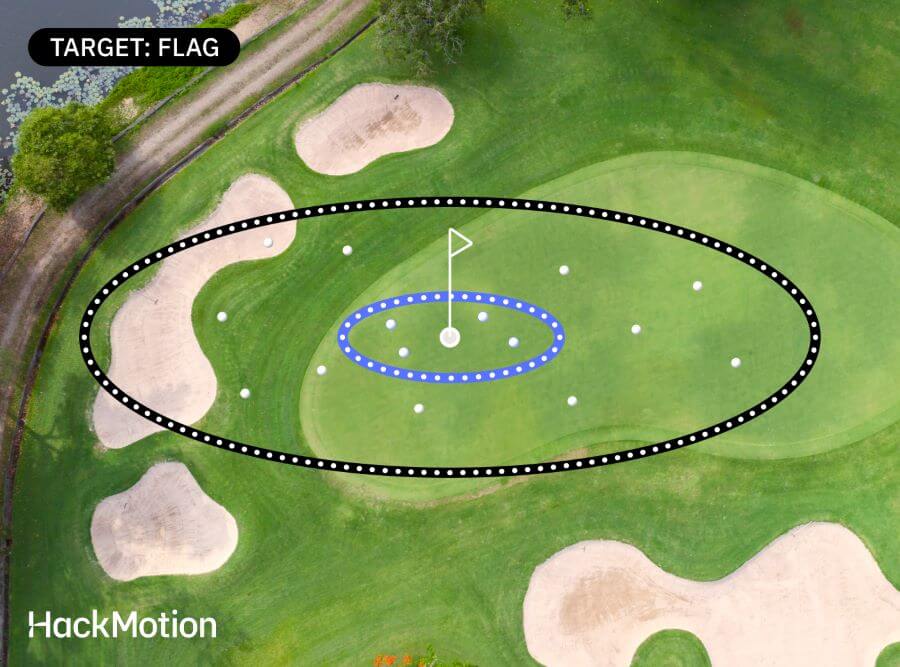
The images below illustrate this concept perfectly. A smart player understands their shot dispersion—the natural pattern of where their shots land—and plans accordingly.

2. Distance to the Hole: Distance dictates your level of aggression.
- Long Approaches (e.g., > 150 yards): Your dispersion pattern is naturally wider with longer clubs. From this range, your strategy should be defensive. The goal is simply to find the putting surface.
- Short Approaches (e.g., < 100 yards): Your dispersion is much tighter with wedges. From this range, you can be more offensive and attack pins, as even a miss is likely to be in a manageable spot.
3. The Lie of the Ball: Where your ball is resting has a huge impact.
- Fairway: A clean lie from the fairway allows you to execute your intended shot with the highest probability of success.
- Rough: From the rough, you have less control. The grass can grab the clubhead, affecting direction and distance. The primary goal from the rough is often just to advance the ball back into a good position or onto the green, even if it's far from the hole. A heroic shot is rarely the correct play.
4. Conditions: Always factor in wind and elevation. A 150-yard shot into a headwind might require the club you'd normally hit from 165 yards. A downhill shot will play shorter.
A Simple and Effective Heuristic: "Back and Middle"
Now that you understand the variables, you need a simple, repeatable process. For a beginner, one of the most effective strategies is to aim for the center of the green on every approach shot.
Approach Shot Strategy: How to Lower Your Scores With Smarter ...
Now that you understand the "why," let's focus on a simple, effective "how." The same article provides a great starting framework.
Read the section titled "Back and Middle Is a Good Idea." This explains a simple, powerful heuristic you can apply immediately to improve your green-hitting performance.
The logic is sound: aiming at the center gives you the largest margin for error left and right. Taking enough club to reach the back edge accounts for the fact that most amateur misses are short. This strategy maximizes your chances of hitting the Green in Regulation.
To help you commit to this conservative target, you can use a powerful mental model: the "wall."
Rotaryswing - Course Management 101: When to Attack and When Not To
The Rotaryswing article provides excellent diagrams and a mental model for executing this risk-averse strategy.
Read the sections from "So What Should You Do?" through "What if You Aim for the Pin?" The diagrams visually break down a safe versus risky strategy. Focus on how the shot dispersion patterns change based on the initial target and absorb the powerful mental concept of the "wall."
Refining the Strategy: Quadrants and Smart Aggression
As you become more consistent, your strategic thinking can become more nuanced. It's not just about hitting the green, but about hitting the correct portion of the green to leave yourself the easiest possible putt—which is almost always an uphill putt.
Hit Better Iron Shots with This Approach Strategy | Titleist Tips
This video from Titleist provides a professional's thought process on an approach shot, introducing a more refined level of targeting.
Watch the entire clip, from the start to the shot's conclusion. Notice how the instructor analyzes the pin location to divide the green into four quadrants. He then selects a target zone that ensures his ball will be below the hole, setting up a preferred uphill putt.
This "quadrant" thinking is the next layer of strategy. You are no longer just playing to avoid a bad outcome; you are playing to create a specific, advantageous outcome (an uphill putt) while still respecting the hazards.
Conclusion
Developing a sound approach shot strategy is one of the fastest ways to lower your scores. It requires discipline to resist the temptation of "pin-hunting" and instead play a smarter, higher-percentage game.
Key Takeaways:
- The primary goal is hitting the green. This is the single greatest predictor of lower scores.
- Strategy is a process of risk management. Your decision should be based on a clear-eyed assessment of pin location, hazards, distance, and lie.
- Adopt the "Back and Middle" heuristic. For most shots, aim for the center of the green and take enough club to cover the back-edge yardage.
- Use mental models like "the wall." Visualize a wall protecting the trouble and commit to playing to the safe side.
- Smart aggression is key. Reserve your attacks for short approach shots where your dispersion is tight and the risk of a big number is low.
In our next lesson, we will focus on strategies for playing par 3 holes. You will see that a par 3 is essentially one long approach shot, and all of the strategic principles we have discussed today—assessing risk, choosing a smart target, and managing your dispersion—will apply directly.