Welcome back. In our previous lesson, you learned to become your own swing detective, using ball flight patterns as data to diagnose the underlying mechanics of clubface and swing path. We analyzed the "what" and "why" behind slices, hooks, and mis-strikes. Now, we shift our focus from diagnosing faults to engineering success.
This lesson delves into one of the most crucial components of a powerful, professional-looking golf swing: shaft lean at impact. Your objective is to understand what shaft lean is, why it's non-negotiable for high-level iron play, and how it directly affects ball compression and trajectory. Think of this as moving from root cause analysis of errors to defining the system parameters for an optimal outcome.
What is Shaft Lean?
At its simplest, shaft lean refers to the angle of the club shaft relative to the ground at the moment of impact. Specifically, we're interested in forward shaft lean, where the hands are ahead of the clubhead, causing the shaft to lean toward the target.
The images below illustrate the three possibilities. The goal for an iron shot is positive or forward shaft lean.

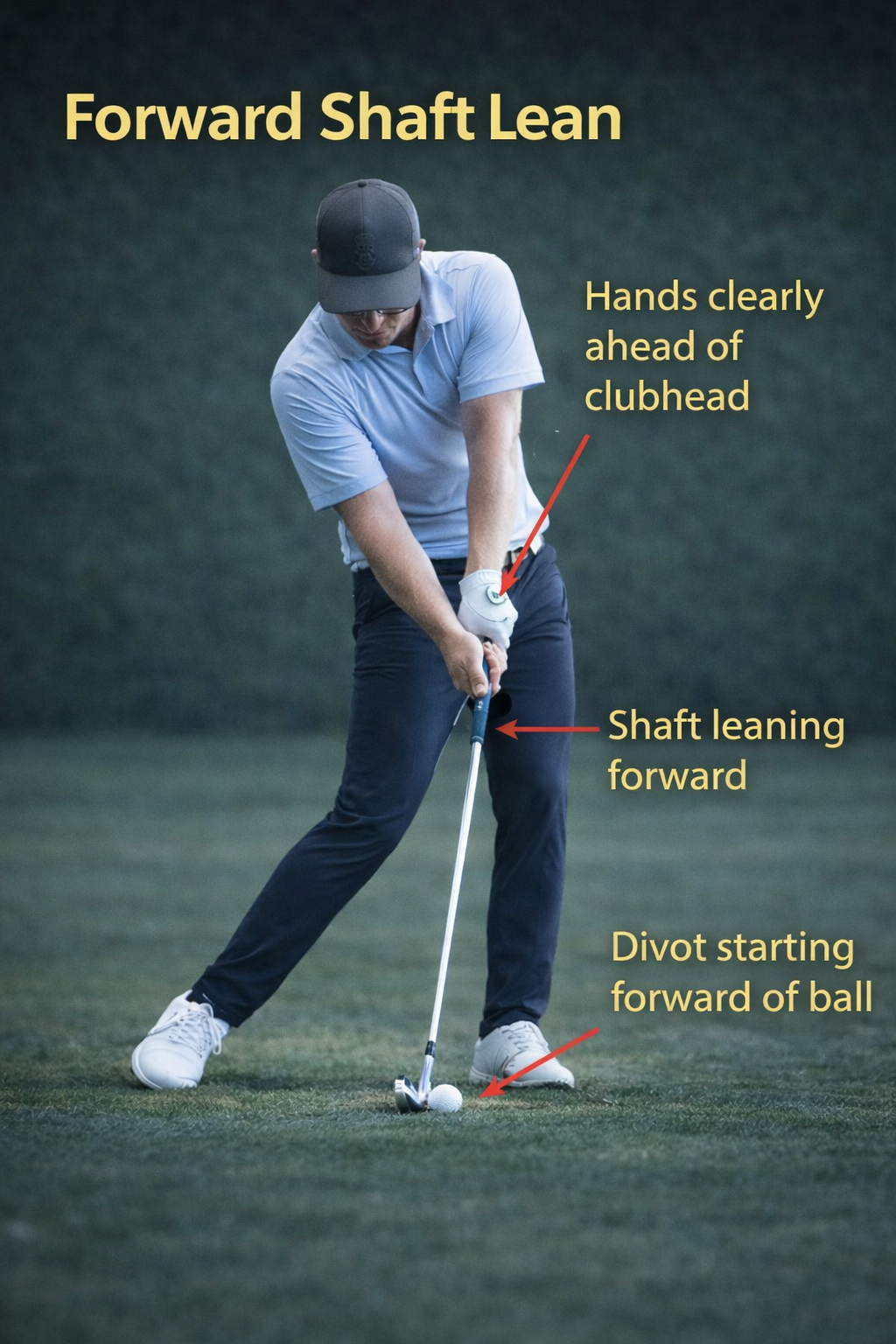
A common question from analytically-minded golfers is: "Why not just use a lower lofted club, like a 6-iron instead of an 8-iron, to get the same low trajectory?" It's a logical question, but it misses the fundamental physical benefits of creating shaft lean dynamically.
To grasp these benefits, let's turn to a short article from MyGolfSpy that clearly defines the concept and its effect on trajectory.
How To Control Trajectory With Shaft Lean And Ball Position | MyGolfSpy
This article provides a concise and clear explanation of what shaft lean is and how it interacts with ball position to control how the ball flies.
Read the first two main sections: "How shaft lean affects trajectory" and "How ball position affects trajectory". Pay close attention to the concepts of dynamic loft and how losing forward lean moves the low point of your swing.
As the article explains, forward shaft lean produces two critical outcomes:
- It controls the low point of the swing. By keeping the hands ahead of the clubhead, you ensure the club is still traveling downward when it strikes the ball. This guarantees the "ball-first, turf-second" contact that is the hallmark of a pure iron shot. A loss of shaft lean (a "flip") moves the low point behind the ball, leading to "thin" or "fat" shots.
- It delofts the club for compression. Forward lean reduces the club's dynamic loft (the actual loft presented to the ball at impact) compared to its static loft (the loft designed into the club). This creates a powerful, compressing strike, transferring energy more efficiently into the ball. The result is a more penetrating ball flight with higher spin, offering both distance and control.
The Data Behind Shaft Lean
To quantify these effects, let's analyze the performance difference between a swing with forward shaft lean and a swing without it (a "flip"). This is where the abstract concept becomes concrete data. The following resource from Top Speed Golf provides an excellent comparison using a launch monitor.
C050. Golf Contact Drill - Is Shaft Lean at Impact Necessary?
This article and its embedded video provide a data-driven answer to the question of why shaft lean is essential, comparing launch monitor numbers from two different types of swings.
First, read the section that details how pros deloft their clubs to get a sense of the numbers involved. Then, carefully review the data comparison between a swing with proper lean and a "flip" swing in the section that begins "Well, there's several reasons". Finally, read the explanation of the other benefits, particularly the point about stability, in the section starting "What do you think".
The data from the article paints a clear picture. Let's organize the results for an 8-iron into a table for comparison:
| Metric | Good Swing (with Shaft Lean) | "Flip" Swing (no Shaft Lean) | Difference |
|---|---|---|---|
| Clubhead Speed | 93.2 mph | 90.1 mph | -3.1 mph |
| Dynamic Loft | 31.2° | 39.2° | +8.0° |
| Carry Distance | 158 yards | 133.9 yards | -24.1 yards |
| Ball Flight | Solid, controlled | High, weak, off to the right | Loss of control |
The insights here are profound. The "flip" motion, where the clubhead outraces the hands, not only adds a massive 8 degrees of loft but also bleeds clubhead speed. The combination of these factors results in a staggering loss of over 24 yards. Furthermore, as the article mentions, the "pushing" motion of a flip is inherently less stable than the "pulling" or "dragging" motion of a swing with proper shaft lean, leading to inconsistency.
The Mechanics of Creating Shaft Lean
Now for the critical question: If shaft lean is so important, how do you do it? The biggest problem golfers encounter is that if they simply try to push their hands forward, the clubface will open, sending the ball far to the right.
The solution lies in a specific movement of your lead wrist. The following video explains this crucial piece of the puzzle.
Master Golf Compression & Shaft Lean Techniques for a Powerful Swing
In his video "Master Golf Compression & Shaft Lean Techniques," instructor Jonathan Kim-Moss provides one of the clearest explanations of the wrist action required to achieve shaft lean without opening the face.
First, watch from the beginning to understand the visual difference between a "floaty" shot and a compressed one. Next, focus intently on the segment from this point, where he explains the problem of the opening face and demonstrates the solution: adding flex or "bow" to the lead wrist. Finally, watch his advice on starting with small chip shots from this section. This demonstrates the audible and visual difference between a flip and a compressed chip.
As the video demonstrates, the key is to counteract the face-opening effect of leaning the shaft by simultaneously flexing (or bowing) your lead wrist through impact. This rotation keeps the clubface square to your swing path while the hands lead the clubhead.
Practice Drills for Shaft Lean
To build this feeling, you need drills that isolate the correct movements. Your goal is to make this new impact dynamic feel natural. As you prefer, here are two practical drills you can take to the range. The following video offers excellent demonstrations.
The Best SHAFT LEAN Lesson Ever! || 4 Shaft Lean Drills
The video "The Best SHAFT LEAN Lesson Ever!" from Porzak Golf offers several effective drills. We will focus on two foundational ones.
Watch the introduction from the start to understand the "finish line" concept. Then, study the first drill, Impact Position Rehearsal, from this section. Finally, watch the second drill, the Drag Drill, from this clip.
Drill 1: Impact Position Rehearsal
- Setup: Take your normal address with a mid-iron (e.g., 7 or 8-iron).
- Preset Impact: Without swinging, move your body and club into the ideal impact position:
- Hips are slightly open to the target.
- About 70-80% of your weight is on your lead foot.
- Your hands are ahead of the ball, creating forward shaft lean.
- Your lead wrist is flat or slightly bowed, keeping the clubface square.
- Execution: From this preset position, make a small backswing (hands to hip height) and then swing through, focusing on returning to and rotating through that same powerful impact position. Feel the connection between your arms and your body's rotation.
Drill 2: The Drag Drill
- Setup: Address the ball as normal. Place your clubhead on the ground about a foot behind the ball.
- Execution: From this starting point, initiate the downswing by rotating your hips and torso toward the target. Keep the clubhead on the grass and feel like you are dragging the grip through the impact zone, ensuring your hands lead the clubhead. As the instructor notes, feel the "hip and the grip go together."
- Progression: After a few rehearsals, try hitting balls with a short, punchy swing, focusing only on replicating that "dragging" sensation and keeping the hands ahead.
Conclusion
You have now analyzed the components of a powerful and consistent impact position. Shaft lean is not an optional flair; it is a fundamental mechanical advantage that directly influences efficiency, distance, and consistency.
Key Takeaways:
- Definition: Forward shaft lean at impact means the hands are ahead of the clubhead, with the shaft leaning toward the target.
- Effects: It promotes a descending, ball-first strike and dynamically de-lofts the club. This creates a compressed feel, a penetrating trajectory, and more efficient energy transfer, resulting in greater distance and control.
- The Problem & Solution: Simply pushing the hands forward opens the clubface. The key is to pair this forward motion with flexion (bowing) of the lead wrist to keep the clubface square.
- The Feeling: The goal is to feel like you are "pulling" or "dragging" the club through impact, not "flipping" or "pushing" the clubhead at the ball.
In our next lesson, we will explore the engine that delivers the club to this ideal impact position: the kinetic chain. We'll examine how elite players generate and transfer speed from the ground up through their legs, hips, torso, and finally to the club.