Hello! Welcome to the start of your journey into the world of AI agents. I'm excited to guide you through this fascinating field.
Given your goal to build AI agents and your preference for a top-down approach, we'll start with the powerful engines that drive many modern agents: Large Language Models (LLMs). We'll begin by understanding them at a high level before diving into the code.
This first lesson is designed to answer the fundamental questions: What exactly is an LLM? What are its key capabilities? And, just as importantly, what are its limitations? Mastering these concepts will provide a solid foundation for everything we build in the coming modules.
Let's get started.
What is a Large Language Model?
At its core, an LLM is a type of AI model designed to understand and generate human-like text. You can think of it as a highly sophisticated autocomplete system. Its fundamental task is to predict the next word in a sequence of text.
To get a concrete sense of what an LLM is, from the perspective of a software engineer, let's watch the first few minutes of a talk by Andrej Karpathy, a prominent AI researcher. He explains that a powerful, 70-billion-parameter LLM is essentially just two files: a very large file of numbers (the parameters or weights) and a relatively small piece of code to run them.
[1hr Talk] Intro to Large Language Models
This clip from Andrej Karpathy's 'Intro to Large Language Models' breaks down what an LLM is in simple, practical terms.
Watch the segment from 00:16 to 03:46. Pay attention to the description of an LLM as two files (parameters and code) and how it generates text.
So, an LLM takes a sequence of words as input and, based on the patterns it has learned, calculates the probabilities for what the next word might be. By repeatedly picking the next word and feeding the new sequence back into itself, it can generate entire sentences, paragraphs, or more.
For a quick, animated overview of this process, the following video from 3Blue1Brown is excellent.
Large Language Models explained briefly
This short video provides a beautifully animated explanation of the core next-word prediction task and the training process.
Watch from the beginning to 04:14. Notice how the model generates text one word at a time and how the concepts of pre-training and fine-tuning are introduced.
How Are LLMs Created? The Two-Stage Training Process
As you just saw, creating an LLM involves a massive training process, which happens in two main stages.
Stage 1: Pre-training (Building Knowledge)
This is where the model learns about language, grammar, facts, reasoning styles, and countless other patterns.
- Data: The model is trained on an enormous dataset, essentially a huge chunk of the public internet (think Wikipedia, books, articles, code repositories, etc.). For a model like GPT-3, this amounts to hundreds of billions of words.
- Objective: The model's only goal during this stage is to get good at next-word prediction.
- Outcome: The result is a base model. As Karpathy puts it, this process is like creating a "lossy compression of the internet." The model isn't just memorizing text; it's creating an internal representation of the knowledge contained within it. These base models are not yet helpful assistants; they are more like "internet document dreamers."
This pre-training process is computationally immense and expensive, costing millions of dollars and requiring thousands of specialized processors (GPUs) running for weeks.
Stage 2: Fine-Tuning (Teaching a Skill)
A base model knows a lot, but it doesn't know how to be a helpful assistant. The fine-tuning stage aligns the model with this goal.
- Data: Instead of the raw internet, the model is now trained on a much smaller, curated, high-quality dataset. This dataset consists of example conversations, often in a question-and-answer format, crafted by humans to demonstrate desired behavior (e.g., being helpful, harmless, and following instructions).
- Objective: The training objective is the same (next-word prediction), but the data teaches the model a specific conversational style.
- Outcome: The result is an assistant model, like the one you interact with in ChatGPT. It leverages the vast knowledge from pre-training but applies it in a helpful, conversational format.
This fine-tuning process is much cheaper and faster, allowing companies to iterate and improve their assistant models regularly. Karpathy provides a great overview of these two stages.
[1hr Talk] Intro to Large Language Models
Let's return to Karpathy's talk, where he details the pre-training and fine-tuning stages.
Watch from 03:46 to 11:19 for the discussion on pre-training, and then from 14:00 to 21:01 for the fine-tuning stage. Note the distinction between the 'knowledge' gained in pre-training and the 'alignment' achieved in fine-tuning.
What Can LLMs Do? Capabilities
The simple process of next-word prediction leads to a surprising range of emergent capabilities.
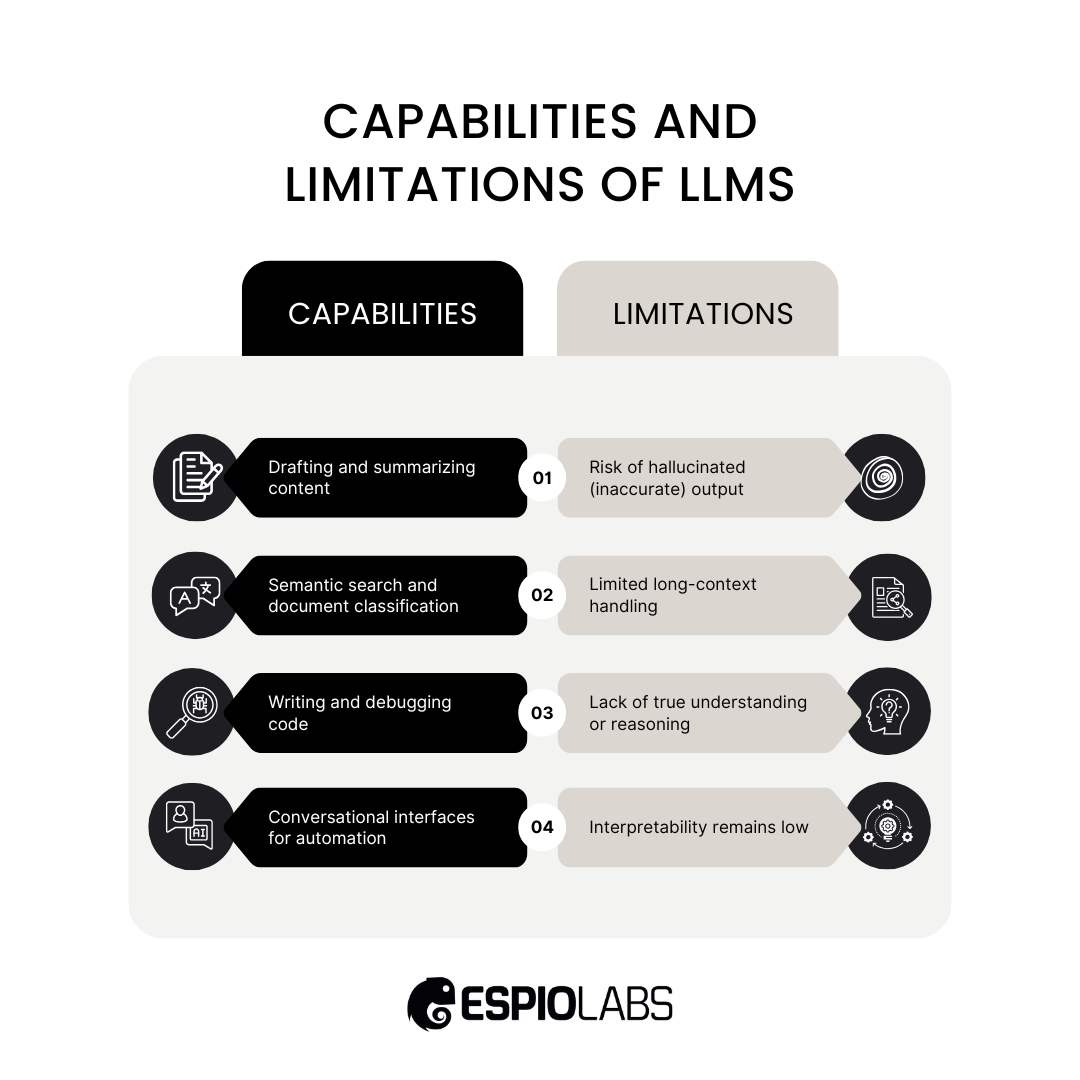
As the image shows, LLMs are excellent at:
- Content Generation and Summarization: They can draft emails, write articles, create marketing copy, and summarize long documents.
- Semantic Search and Classification: They understand the meaning behind words, allowing them to perform searches based on concepts, not just keywords. They can also classify text (e.g., sentiment analysis).
- Code Generation and Debugging: They can write functions, translate code between languages, explain code snippets, and help identify bugs. This is a powerful application for software engineers.
- Conversational Interfaces and Tool Use: This is the core of their use in agents. LLMs can act as a reasoning engine that understands a user's intent and decides to use external tools—like a calculator, a search engine, or an API—to accomplish a task.
This "tool use" capability is a major leap forward and is what separates a simple chatbot from a true agent. Let's see a powerful demonstration of this.
[1hr Talk] Intro to Large Language Models
In this segment, Karpathy demonstrates how ChatGPT uses tools like a web browser, a calculator, and a Python interpreter to perform a multi-step data analysis task based on natural language prompts.
Watch from 27:43 to 33:25. Observe how the LLM breaks down the request and decides which tool to use at each step. This is a preview of the agent architectures we will build later.
What Can't LLMs Do? Limitations and Risks
Understanding the limitations of LLMs is critical for using them effectively and safely. Their power comes from statistical pattern matching, not from true understanding or consciousness.
-
Hallucinations (Factual Inaccuracy): Because LLMs are designed to generate plausible-sounding text, they can confidently invent facts, sources, or details. This is often called "hallucination." They are not knowledge databases and cannot be relied upon for factual accuracy without verification.
-
Lack of True Reasoning: LLMs mimic reasoning patterns they've seen in their training data. They don't possess genuine logic or causal understanding. They may struggle with complex, multi-step reasoning, especially in novel situations that deviate from patterns they've seen before. For a deeper explanation of this distinction, the article "The Strengths and Limitations of Large Language Models" is a good resource.
-
Limited Context Window: LLMs can only consider a certain amount of text (the "context window") at one time. For very long conversations or documents, they will forget what was said earlier. We will explore techniques to mitigate this in Module 3.
-
Security Vulnerabilities: As LLMs are integrated into applications, they introduce new attack vectors. This is especially relevant for agent development.
- Jailbreaking: Tricking a model into bypassing its safety rules, often through clever role-playing prompts.
- Prompt Injection: This is a serious vulnerability where an attacker hides malicious instructions within a piece of text (like a webpage or a document) that the LLM processes. The LLM may then follow the attacker's instructions instead of the user's, potentially leading to data leaks or other malicious actions.
The following segments from Karpathy's talk provide some striking and important examples of these security risks.
[1hr Talk] Intro to Large Language Models
This final clip from Karpathy's talk demonstrates real-world examples of jailbreaking and prompt injection attacks. Understanding these is crucial for building robust agents.
Watch from 45:51 to 56:29. Pay close attention to the prompt injection examples, where hidden text in a webpage or a Google Doc hijacks the LLM's behavior.
A Glimpse Inside the Black Box
You might be wondering how an LLM internally represents language to achieve these capabilities. While we will cover this in-depth in Module 10, here's a quick, high-level conceptual overview.
LLMs don't see words as strings of characters. Instead, they convert them into numerical lists called word vectors or embeddings. Each vector represents a word's position in a high-dimensional "meaning space." Words with similar meanings have similar vectors. This allows the model to reason about relationships between words.
If you're curious, the following article explains these concepts very clearly without requiring deep mathematical knowledge.
Large language models, explained with a minimum of math and jargon
This article, 'Large language models, explained with a minimum of math and jargon,' provides an excellent, accessible explanation of the core concepts inside an LLM.
Read the sections titled 'Word vectors', 'Word meaning depends on context', and 'Transforming word vectors into word predictions'. This will give you a good mental model of how an LLM processes language internally.
Conclusion
In this lesson, we've taken a high-level tour of Large Language Models. Here are the key takeaways:
- What they are: LLMs are AI models that excel at predicting the next word in a sequence. They are trained in two stages: pre-training on vast internet text to gain knowledge, and fine-tuning on curated examples to become helpful assistants.
- Their capabilities: Their core text-prediction ability enables a wide range of applications, including content generation, semantic understanding, code writing, and, most importantly for us, acting as a reasoning engine to use external tools.
- Their limitations: They are not infallible. They can hallucinate incorrect information, they lack true reasoning, and they introduce new security risks like prompt injection that developers must be aware of.
Understanding this balance of power and peril is the first step to becoming a capable AI agent builder.
In our next lesson, we will move from concept to practice. You'll set up your development environment and use the OpenAI API to send your first prompts to an LLM and get responses back. This will be our first hands-on step toward building an agent.