Welcome to the final lesson of your Backend Engineering course!
Throughout this journey, we've gone from the fundamentals of HTTP to building, securing, and deploying a sophisticated Django application. In our last module, we've focused on making our application ready for the real world by exploring scalability. The previous lesson on stateless application design was crucial, as it established the principle of treating application servers as interchangeable units, which is a prerequisite for horizontal scaling.
This naturally leads us to a fundamental, high-level question about system design: as an application grows, should we continue to build it as one large, unified system, or should we break it apart into smaller, independent pieces?
This final lesson addresses the learning outcome: Contrast monolithic and microservices architectures, including their primary trade-offs. We will explore these two dominant architectural styles, analyzing their characteristics, benefits, and drawbacks to help you make informed architectural decisions in your future projects. This topic is the capstone of our course, tying together concepts of APIs, databases, deployment, and scalability.
1. The Monolithic Architecture: The All-in-One Approach
The monolithic architecture is the traditional and often default way of building an application. The name "monolith" comes from "mono" (single) and "lithos" (stone), implying a single, massive, unified structure.
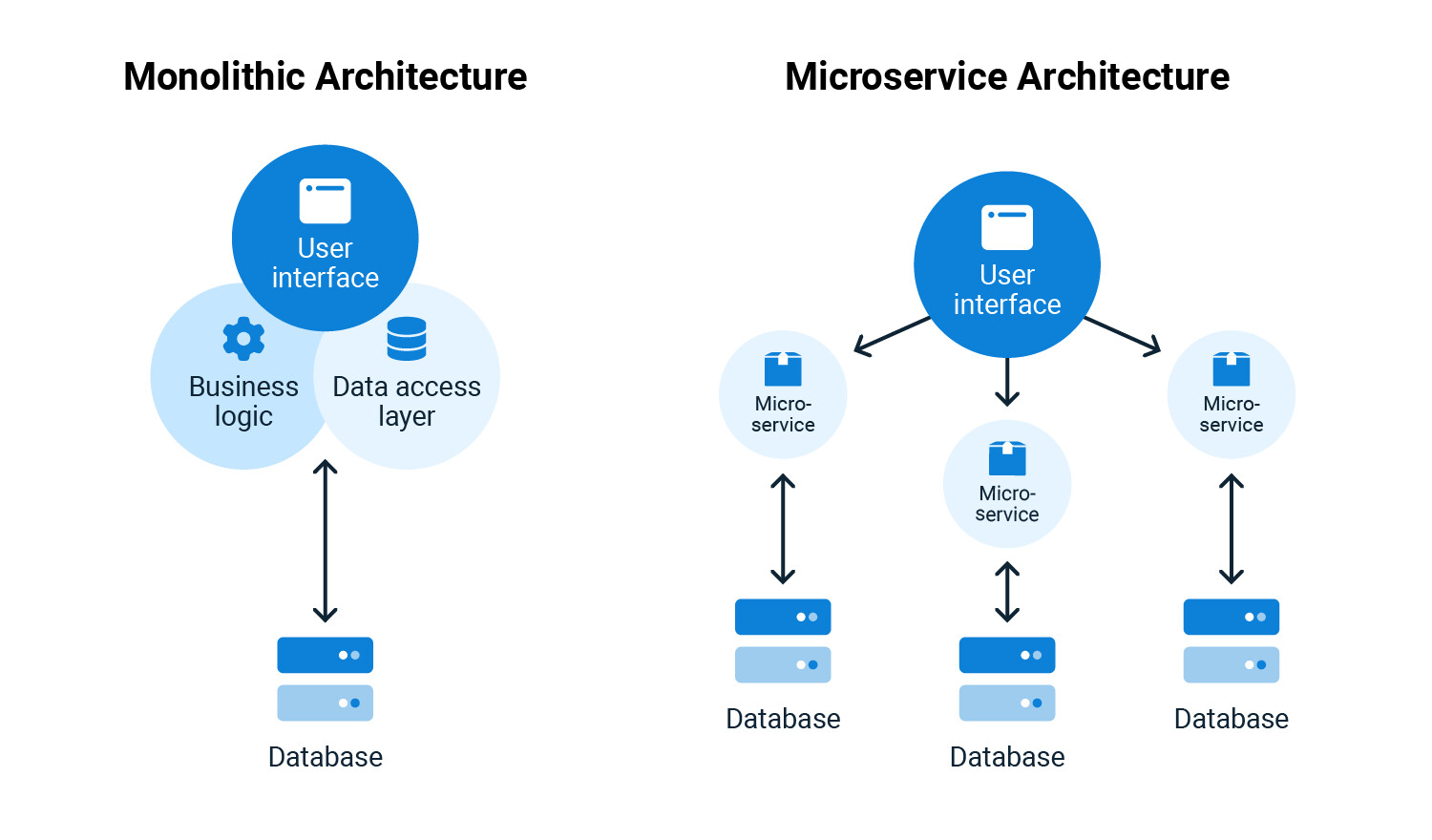
In a monolithic architecture, all the components of your application—the user interface logic, business logic, and data access layer—are developed as a single unit. Think of the Django project we've been building throughout this course. It has user authentication, API endpoints, and database models all within one project, deployed as a single application. This is a classic monolith.
To get a feel for the characteristics and trade-offs of this approach, let's watch a short video that provides a clear and concise explanation.
Monolithic vs Microservice Architecture: Which To Use and When?
The video 'Monolithic vs Microservice Architecture' from the Alex Hyett channel offers an excellent starting point. It clearly defines what a monolith is and walks through its main advantages and disadvantages.
Please watch from the beginning to 03:33. Pay close attention to the definition of a monolith and the key points made about its pros (ease of development, deployment, debugging) and cons (bloat, slow releases, scaling difficulties).
As the video highlighted, the main trade-offs of a monolithic architecture can be summarized as follows:
Pros:
- Simplicity: With a single codebase and a single deployable unit, development, testing, and deployment are straightforward, especially in the early stages of a project.
- Easier Debugging & Testing: You can run and debug the entire application on a single machine. End-to-end testing is simpler as it all happens within one process.
- Performance: Communication between components happens via function calls within the same process, which is much faster than network calls between different services.
Cons:
- Scaling Challenges: As the video mentioned, if one specific part of your application (e.g., an AI-powered recommendation engine) is under heavy load, you must scale the entire application. You can't scale just that one component, which is inefficient and costly.
- Decreased Agility: As the codebase grows, it becomes harder to understand and modify. Development slows down because even a small change requires the entire application to be re-tested and re-deployed, increasing the risk and duration of release cycles.
- Technology Lock-in: The entire application is committed to a single technology stack. Adopting a new language or framework for a specific feature is extremely difficult.
- Low Fault Tolerance: A bug or unhandled exception in one module can crash the entire application.
2. The Microservices Architecture: A Federation of Services
The challenges of large-scale monolithic applications led to the rise of the microservices architecture. This approach structures an application as a collection of loosely coupled, independently deployable services. Each service is self-contained, responsible for a specific business capability, and communicates with other services over a well-defined network interface, typically a REST API or a message queue.
Let's return to the video to see how microservices address the problems of monoliths and what new challenges they introduce.
Monolithic vs Microservice Architecture: Which To Use and When?
We'll now continue with the same video from Alex Hyett to learn about the microservices approach.
Please watch from 03:33 to 09:20. Focus on how microservices are defined, the ways they communicate (API, message brokers), and their key pros and cons.
The core idea is to break down a large system into manageable pieces. For an e-commerce site, you might have separate services for:
- User Authentication
- Product Catalog
- Shopping Cart
- Order Processing
- Payment Gateway
Each of these could be a small, independent application, perhaps even written in different programming languages if it makes sense for the task (e.g., Python for a machine learning service, Go for a high-concurrency API gateway).

Let's summarize the key trade-offs for microservices:
Pros:
- Independent Scalability: You can scale each service independently. If your payment service is under heavy load during a sale, you can add more instances of just that service.
- Improved Agility and Speed: Small, focused teams can work on different services in parallel. They can develop, test, and deploy their service independently without waiting for the rest of the application, leading to faster release cycles.
- Fault Isolation: If one service fails, it doesn't necessarily bring down the entire application. Other services can continue to function (perhaps with degraded functionality), improving overall system resilience.
- Technology Flexibility: Teams can choose the best technology stack (language, database) for their specific service's needs.
Cons:
- Distributed System Complexity: This is the most significant drawback. You are no longer building one application; you are building a distributed system. This introduces challenges like network latency, fault tolerance (what if a service you depend on is down?), and data consistency across services.
- Operational Overhead: You now have dozens or even hundreds of services to build, deploy, monitor, and manage. This requires significant investment in DevOps practices and automation (like the CI/CD pipelines and containerization we covered).
- Complex Debugging: Tracing a single user request that travels through multiple services can be very difficult. It requires sophisticated distributed logging and tracing tools.
- Data Management: Each service often manages its own database. Ensuring data consistency across these separate databases (e.g., using patterns like sagas or event sourcing) is a non-trivial problem.
3. Contrasting the Architectures: A Head-to-Head Comparison
Now that we understand both approaches, let's directly contrast them across several key dimensions. The following table synthesizes the information from the videos and is also well-supported by the article "Monolithic vs Microservices" from Superblocks.
| Category | Monolithic Architecture | Microservices Architecture |
|---|---|---|
| Deployment | Single, large deployment unit. The entire app is released at once. | Each service can be deployed independently. |
| Scalability | Coarse-grained. The entire application must be scaled as a whole. | Fine-grained. Services are scaled independently based on demand. |
| Development | Simpler to start. One codebase, one environment to manage. | More complex initial setup, but easier to manage as complexity grows. |
| Team Structure | Large teams work on a shared codebase, leading to potential conflicts. | Small, autonomous teams own individual services end-to-end. |
| Technology Stack | Constrained to a single, unified tech stack. | Polyglot. Different services can use different technologies. |
| Fault Tolerance | Low. A failure in one module can bring down the entire system. | High. Failures are isolated to individual services. |
| Data Management | Single, shared database. Ensures strong consistency (ACID). | Each service often has its own database. Requires managing eventual consistency. |
| Operational Complexity | Low initially. One application to monitor and manage. | High. Requires managing a distributed system, service discovery, etc. |
For a more detailed breakdown, you can refer to the comparison table in the "Monolithic vs Microservices" article (resource LINK) under the "Key differences" section.
Test your understanding!
You are tasked with building a "Deepfake Detection as a Service" platform. Users will upload videos via a web interface, the videos will be processed by a complex set of deep learning models, and the results will be displayed on a dashboard. The video processing part is extremely computationally intensive, while the user management and dashboard parts are standard web functionalities.
Which architectural style (monolithic or microservices) would you choose and why? Justify your choice based on the trade-offs we've discussed, particularly concerning scalability and technology stack.
Show answer
A microservices architecture would be a much better fit for this platform.
Here's the reasoning:
-
Independent Scalability: The video processing component is the system's bottleneck. With microservices, you could create a dedicated "Processing Service." This service could be scaled independently on powerful, GPU-enabled machines, while the "User Service" and "Dashboard Service" could run on standard, cheaper hardware. In a monolith, you'd be forced to scale the entire application on expensive GPU instances, which is highly inefficient.
-
Technology Flexibility: Your expertise lies in AI/ML, and you'd likely want to build the processing service in Python using libraries like TensorFlow or PyTorch. The web-facing components (user management, dashboard) could be built using a different stack better suited for web development if desired (e.g., Node.js for real-time updates on the dashboard). Microservices allow this polyglot approach.
-
Fault Isolation: If the computationally intensive processing service crashes due to a large or malformed video file, it won't bring down the user-facing web application. Users could still log in, view past results, and upload new videos (which would be queued for processing).
A monolithic approach would tightly couple the simple web logic with the complex, resource-intensive AI logic, leading to severe scaling and maintenance challenges.
4. Making the Choice: Strategy and Evolution
So, which one should you choose? The answer is almost always: "Start with a monolith."
Monolithic vs Microservices: Differences, Pros, & Cons in ...
For pragmatic advice on making this architectural choice, let's review a section from the 'Monolithic vs Microservices' article.
Please read the sections titled 'When to choose monolith vs microservices' and the 'Frequently asked questions' at the end. These provide clear, real-world guidance on this decision.
As the resources suggest, for most new projects, startups, and small teams, the simplicity and speed of a monolith are invaluable. You avoid the "distributed systems tax" and can get your product to market faster.
You should only consider moving to microservices when you start feeling the pain points of a monolith:
- Your development process has slowed to a crawl.
- Your teams are stepping on each other's toes.
- You have clear scaling bottlenecks in specific parts of the application.
The migration from a monolith to microservices is often a gradual process. A common strategy is the "Strangler Fig" pattern, where you incrementally "strangle" the monolith by building new features as microservices and slowly carving off pieces of the monolith's functionality into new services over time.
Course Conclusion
Congratulations on completing the Backend Engineering course!
You began this journey as an AI expert with no prior backend experience. Over the last 12 modules, you've acquired a comprehensive skill set, from understanding the fundamental protocols of the web to building, securing, scaling, and deploying a real-world application with Django and its ecosystem.
Key Takeaways from Today's Lesson:
- Monolithic architecture prioritizes simplicity and development speed, making it ideal for new projects. It is a single, unified application deployed as one unit.
- Microservices architecture prioritizes scalability, flexibility, and team autonomy at the cost of significant operational and distributed systems complexity. It is a collection of small, independent services.
- The choice between them is a strategic trade-off. The most common and recommended path is to start with a monolith and evolve towards microservices only when the complexity of the monolith becomes a significant impediment.
Your goal is to be a full-stack AI developer. The backend skills you have mastered here are the critical bridge between your AI models and real-world users. The ability to wrap a model in a robust API, manage user data in a database, handle authentication, and deploy it all to the cloud on a scalable architecture is what separates a research project from a production-ready AI product.
You are now equipped with the foundational knowledge to build the systems that power modern technology. Well done, and best of luck in your continued journey