Hello! In our last lesson, we explored how sequence words can control the rhythm of your stories, creating suspense or slowing down time. Now, we're going to add another powerful tool to your creative writing kit: dialogue.
Giving your characters a voice is one of the best ways to make them feel real and to move your story forward. But for dialogue to work, it needs to be easy to read and follow. In this lesson, we will focus on the fundamental rules for making your characters' conversations clear and effective. You will learn how to punctuate and format short dialogues correctly using dialogue tags, which are the phrases that tell us who is speaking.
The Three Golden Rules of Dialogue
Before we get into the details, let's start with a simple visual guide. The rules for writing dialogue might seem complicated, but they mostly come down to three key principles.

As the chart illustrates, these are the non-negotiable foundations:
- Quotation Marks (""): The words your character speaks must always be enclosed in double quotation marks.
- New Speaker, New Line: Every time a different character begins to speak, you must start a new paragraph. This is the single most important rule for preventing reader confusion.
- Punctuation Inside Quotes: The punctuation that ends the spoken sentence—like a period (
.), comma (,), question mark (?), or exclamation point (!)—always goes inside the closing quotation mark.
Understanding Dialogue Tags
In the examples above, you see phrases like "replied Maya" or "shouted Liam." These are called dialogue tags. Their job is simple: to tell the reader who is speaking. A dialogue tag is usually a noun (the speaker) paired with a verb related to speaking.
This next image breaks down a single line of dialogue into its parts. Notice the word "tag."
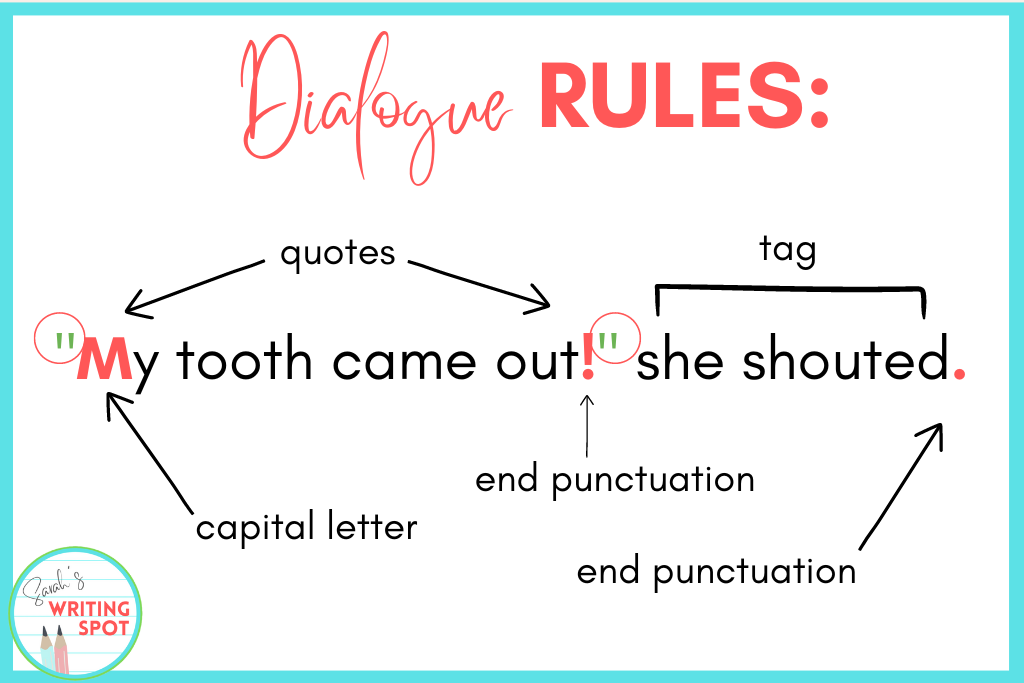
The most common—and often the best—dialogue tags are "said" and "asked." While it can be tempting to use more descriptive words like "exclaimed," "whispered," or "mumbled," using "said" and "asked" most of the time makes your writing smooth and keeps the focus on the words your characters are speaking.
Let's watch a video that explains how to use these tags effectively.
Mastering DIALOGUE TAGS in Writing (With Examples!) | Fiction Writing Advice
In this video, writer Brandon McNulty offers some excellent, practical advice on using dialogue tags without distracting the reader.
Please watch these specific clips: First, get an overview of what tags are and why "said" and "asked" are usually the best choices. Next, see the three main ways you can place a tag: before, after, or in the middle of the dialogue. Finally, pay close attention to the rules for punctuation and capitalization. This is the most important part!
As the video explained, the punctuation changes depending on where you put the tag. Here's a quick summary:
- Tag at the end: The dialogue ends with a comma inside the quotation marks.
"I don't think that's a good idea," Maria said.
- Tag at the beginning: The tag is followed by a comma, and the dialogue starts with a capital letter.
Maria said, "I don't think that's a good idea."
- Tag in the middle (interrupting one sentence): Use commas on both sides of the tag, and don't capitalize the second part of the dialogue.
"I don't think," Maria said, "that's a good idea."
- Tag in the middle (between two sentences): The tag ends with a period, and the next sentence starts with a capital letter.
"I don't think that's a good idea," Maria said. "Let's do something else."
Showing, Not Just Telling: Action Beats
Dialogue tags tell us who is speaking. But in creative writing, you often want to show what characters are doing while they speak. This is where action beats come in. An action beat is a short sentence describing a character's action, placed right before or after their dialogue.
The punctuation for action beats is different from dialogue tags, and using them makes your writing much more vivid. Let's watch another short video to understand the difference.
This video from the Quotidian Writer channel has a fantastic section that clarifies the difference between dialogue tags and action beats.
Watch these two parts: First, see a clear example of how paragraph breaks are used to show a conversation between two people. Then, focus on the detailed explanation of dialogue tags vs. action beats. Notice how the punctuation changes from a comma to a period.
Here is the key distinction to remember:
- Dialogue Tag: It is part of the same sentence as the dialogue. It uses a verb of speaking (said, asked, whispered) and is connected by a comma.
"I'm leaving now," he said.
- Action Beat: It is a separate sentence that describes an action. The dialogue ends with a period, and the action beat is its own sentence.
"I'm leaving now." He grabbed his coat.
Using an action beat allows you to show a character's feelings or intentions without saying them directly. He grabbed his coat shows he is serious about leaving. It's more powerful than He said seriously.
Creative Task: A Simple Disagreement
Now it's your turn to put these rules into practice. Imagine two friends, Alex and Sam, are trying to pick a movie to watch. Alex is excited about an action movie, but Sam wants to watch a quiet documentary.
Write a short dialogue (about 4-6 lines) between Alex and Sam.
Your dialogue must include:
- Correct quotation marks and punctuation (commas, periods) inside the quotes.
- A new paragraph for each speaker.
- At least two dialogue tags (e.g.,
Alex said,Sam asked). - At least one action beat (e.g.,
Alex leaned forward,Sam sighed).
...
Example Answer
Here is one possible version of the scene. Your dialogue will be different, but check to see if you followed the same punctuation and formatting rules.
"Let's watch Explosion Planet! It's supposed to have the best car chase ever," Alex said, grabbing the remote.
Sam sighed. "I'm not really in the mood for explosions. What about that new documentary on penguins?"
"Penguins? Seriously?" Alex asked. "But there won't be any car chases."
"Exactly." Sam smiled.
Notice how the action beats (grabbing the remote, Sam sighed, Sam smiled) add personality to the conversation and show the characters' feelings without telling them.
Conclusion
Well done! You've just learned the essential mechanics for writing dialogue that is clean, clear, and professional. Mastering these rules is a huge step in bringing your characters to life on the page.
Key Takeaways:
- Always put spoken words inside quotation marks (
" "). - Punctuation marks like periods and commas go inside the final quotation mark.
- Start a new line/paragraph every time the speaker changes.
- A dialogue tag (
she said) is connected to dialogue with a comma. - An action beat (
She nodded.) is a separate sentence and uses a period.
In our next lesson, we'll combine your skills in narration and dialogue. You will practice writing a short paragraph to describe a character's key past experience, making your characters feel even more developed and real.