Welcome to our next lesson on sentence construction! In our previous sessions, we explored how to join ideas using coordinating conjunctions like for and but (FANBOYS) and subordinating conjunctions like because and although. Today, we'll learn about another powerful tool: correlative conjunctions.
These are special pairs of words that work together to connect parts of a sentence. This lesson focuses on two of the most common pairs: either/or and neither/nor. By the end of our 60 minutes, you'll be able to use these pairs to construct sentences that clearly express choices or reject options, adding precision and a new dimension to your creative writing.
The Basics: Expressing a Choice or a Negation
Correlative conjunctions are like a team—the two words must work together. Either is always paired with or, and neither is always paired with nor. They connect two equal grammatical items, such as two nouns, two verbs, or two phrases.
- Either/or is used to present a choice between two possibilities. It means "one or the other."
- Neither/nor is used to negate two possibilities at once. It means "not this one and not that one."
To get a clear understanding of this core difference, let's watch a video that breaks it down with great examples.
Either Or vs Neither Nor | Correlative Conjunctions | English Grammar Lesson With Ananya
This lesson from "Learn English | Let's Talk" clearly explains the fundamental difference between using either/or and neither/nor.
Watch these segments to grasp the main concepts: Start with the introduction to see why these pairs can be tricky. Learn how either/or is used for choices in the segment from this part. It shows that one of the two options will happen. Next, see how neither/nor joins two negative ideas from this section. It shows that both options are not true or not happening.
As the video explains, the idea behind either/or is positive (at least one option is possible), while neither/nor is inherently negative (zero options are possible).
These infographics provide a quick visual summary of how these conjunctions work.

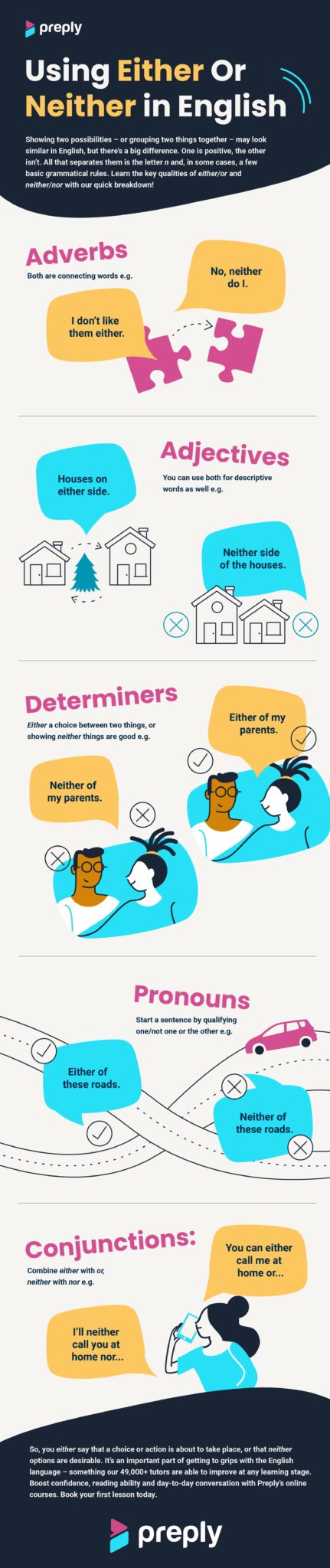
Important Grammar Rules
Using these pairs correctly involves a few important rules. Getting them right will make your writing much more polished and professional. Let's go back to the video, which explains these rules very clearly.
Either Or vs Neither Nor | Correlative Conjunctions | English Grammar Lesson With Ananya
Let's continue with the same video to learn the critical grammar rules that you need to apply when using these conjunctions.
Pay close attention to these three key rules: Avoid Double Negatives: Neither is already a negative word. Watch the explanation from this section to understand why you should not use another negative word like "don't" or "not" in the same clause. Incorrect: I don't like neither tea nor coffee. Correct: I like neither tea nor coffee. Subject-Verb Agreement: This is the most important rule! When you connect two subjects with either/or or neither/nor, the verb agrees with the subject that is closest to it. Watch the detailed breakdown from this crucial segment. Example 1: Neither my mom nor my sisters like pop music. (The verb like agrees with sisters, which is plural). Example 2: Neither my sisters nor my mom likes pop music. (The verb likes agrees with mom, which is singular). Use Parallel Structure: The two items you are connecting should be the same grammatical type (e.g., noun + noun, verb + verb). The video explains this when discussing common mistakes. Watch the segment on mixing wrongly. Correct: We can either watch a movie or play a game. (verb phrase + verb phrase) Incorrect: We can either watch a movie or a game. (verb phrase + noun)
Mastering these three rules, especially the subject-verb agreement rule, is the key to using correlative conjunctions confidently.
Creative Writing Task
Now it's your turn to practice. This task is perfect for creative writing, especially for showing a character's thoughts or decisions.
Your Task:
Imagine your character is looking at the menu in a small, unexciting café. They are trying to decide what to order. Write a short inner monologue (2-3 sentences) from their perspective.
- Use
either/orto show the choice they are considering. - Use
neither/norto reject two other options.
Take a few minutes to write the monologue. Focus on making the character's voice sound natural.
...
Sample Answer:
Of course, there are many ways to complete this task. Here is one possible answer:
"Ugh, this menu is terrible. I guess I can have either the greasy soup or the day-old sandwich. Neither the salad nor the pasta looks fresh, so I'll pass on those."
Notice how either/or presents the character's two reluctant choices, while neither/nor firmly dismisses two other items. This is a great way to reveal character and attitude through simple grammar.
Conclusion
Excellent work today! You've added another sophisticated tool to your sentence-building toolkit. Correlative conjunctions like either/or and neither/nor allow you to express complex relationships between ideas with clarity and style.
Here are the key takeaways from our lesson:
- Correlative conjunctions work in pairs to connect equal sentence elements.
- Use
either/orto present a choice between two options. - Use
neither/norto make a statement that negates two options. - Remember the proximity rule: the verb must agree with the subject closest to it.
- Avoid double negatives by using a positive verb with
neither/nor.
In our next lesson, we will expand on the topic of subject-verb agreement. We'll look at how to make sure your subject and verb match even when they are separated by long phrases, a skill that builds directly on the "proximity rule" we learned today.