Welcome to your first lesson in the Quantum Computing for Cyber Security course. We'll begin our journey by exploring a concept that lies at the very heart of quantum mechanics and distinguishes it from the classical world you're familiar with from your engineering physics studies: wave-particle duality.
The goal of this lesson is to explain this fundamental principle and, crucially, to understand its direct relevance to how quantum computers perform their calculations. We will see that objects at the quantum scale, like electrons, defy our everyday intuition by behaving as both localized particles and spread-out waves. This dual nature is not just a philosophical curiosity; it is the physical mechanism that enables the powerful computational techniques we will study throughout this course.
The Classical Divide: Particles and Waves
In classical physics, the distinction between particles and waves is absolute.
- Particles, like a bullet or a planet, are localized in space. At any given moment, a particle has a definite position and momentum.
- Waves, like ripples on a pond or sound waves, are delocalized disturbances that spread through a medium. They are characterized by properties like wavelength and frequency, and they exhibit hallmark behaviors such as diffraction (bending around obstacles) and interference (combining to reinforce or cancel each other out).
This clear division was challenged by a long-standing debate about the nature of light. For centuries, scientists argued whether light was a stream of particles (Newton's "corpuscular" theory) or a wave (Huygens' theory).
To understand this historical context and the experimental evidence that shaped it, please watch the following segments from the video "What is Wave Particle Duality?" by Physics Explained.
What is Wave Particle Duality?
This video provides an excellent overview of the key historical experiments. We'll start with the two competing classical theories and the experiment that seemed to settle the debate in favor of waves.
First, watch the brief explanation of Newton's particle theory, which describes light as particles. Next, see how Huygens' wave theory and Thomas Young's famous double-slit experiment provided powerful evidence for the wave nature of light, by demonstrating interference patterns. Focus on how crests and troughs of waves can add up (constructive interference, creating bright spots) or cancel out (destructive interference, creating dark spots).
By the end of the 19th century, Young's experiment and subsequent work by Maxwell had convincingly established that light was an electromagnetic wave. However, this tidy picture was about to be shattered.
The Quantum Twist: Duality Emerges
At the turn of the 20th century, physicists encountered phenomena that the wave theory of light simply couldn't explain. The most famous of these was the photoelectric effect, where shining light on a metal surface could knock electrons loose.
The following segment of the same video explains this puzzle and its revolutionary solution by Max Planck and Albert Einstein.
What is Wave Particle Duality?
This part of the video explains the crisis in classical physics and the birth of the quantum concept.
Please watch the section covering the "ultraviolet catastrophe" and Einstein's explanation of the photoelectric effect. Note how he revived the particle concept by proposing that light energy comes in discrete packets, or "quanta," which we now call photons.
Einstein's work showed that light, which was demonstrably a wave, also behaved as a particle. The energy of a single photon is directly proportional to its frequency, , where is Planck's constant. This was the first concrete evidence of wave-particle duality.
De Broglie's Hypothesis: Duality for All Matter
In 1924, the physicist Louis de Broglie posed a daring question: If waves (like light) can behave like particles, can particles (like electrons) behave like waves? He proposed that they could, and that any moving particle with momentum has an associated wavelength , given by the relation:
This is the de Broglie wavelength. This wasn't just a philosophical claim; it was a testable prediction. If electrons have a wave nature, they should exhibit wave-like behaviors such as diffraction and interference.
This remarkable idea was confirmed experimentally just a few years later by Davisson and Germer, who observed electrons diffracting off a nickel crystal, behaving exactly like waves with the wavelength predicted by de Broglie.
The most striking demonstration of this is the double-slit experiment, but performed with electrons instead of light. The short video below from the Perimeter Institute provides a superb visualization of this.
Wave Particle Duality Explained | Perimeter Institute for Theoretical Physics
This video crisply illustrates the core mystery of wave-particle duality.
Please watch the part of the video that shows the double-slit experiment with electrons. Pay close attention to what happens when electrons are sent through the slits one by one.
As you saw, even when a single electron is sent at a time, an interference pattern builds up over time. This is profoundly strange. There are no other electrons for it to interfere with. The only conclusion is that the single electron, in its wave-like form, passes through both slits simultaneously and interferes with itself.
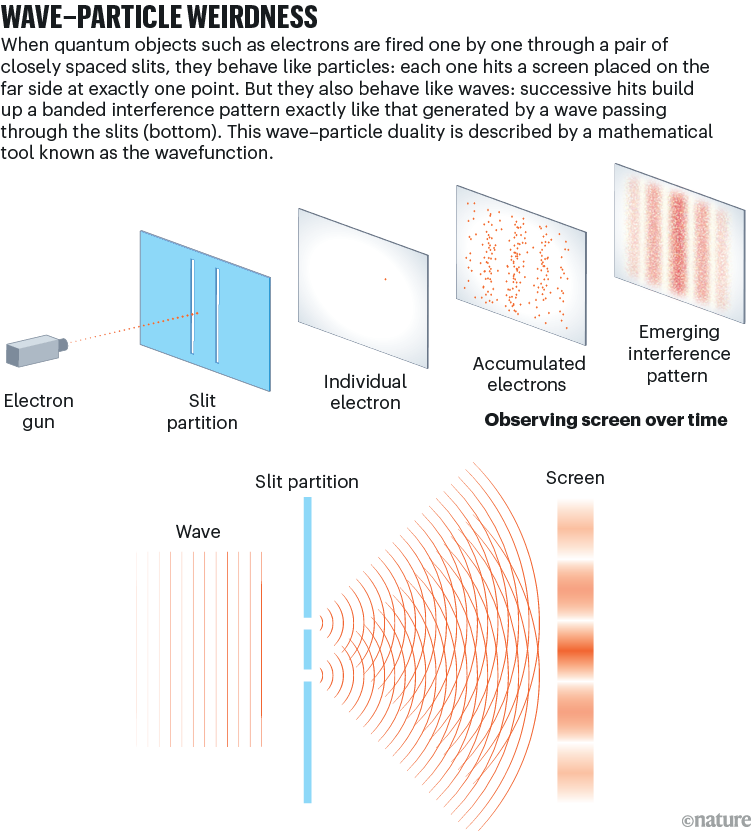
This forces us to abandon the classical notion of a particle as a tiny billiard ball. A quantum particle like an electron is not one or the other; it is a single entity that embodies both sets of properties. Its particle-like nature appears when we measure it (e.g., when it hits the detector screen at a single point), while its wave-like nature governs its motion when it is not being observed.
Relevance to Quantum Computing: The Power of Interference
So, what does this have to do with computing? The wave associated with a particle is not a physical wave like a ripple in water. It is a probability wave, mathematically described by a wavefunction (often denoted by the Greek letter psi, ). The amplitude of this wave at a certain point in space relates to the probability of finding the particle there if we were to measure it.
Because these are waves, they can interfere. This is the key. While classical probabilities are always positive and simply add up, the amplitudes of a wavefunction can be positive, negative, or even complex numbers. This allows them to cancel each other out.
This property, quantum interference, is the engine of quantum computation.
Quantum Interference Powers Quantum Computing
Let's now connect this physical phenomenon to its crucial role in computation. This article explains how the wave-like nature of quantum particles gives rise to interference, which is harnessed by quantum algorithms.
Please read the section "What is Quantum Interference?". Focus on the distinction it makes between classical probabilities and quantum amplitudes, particularly the idea that amplitudes can cancel each other out. Pay close attention to the paragraph explaining this key difference.
As the article explains, quantum algorithms are designed to be a form of "wave choreography." They manipulate the wavefunctions of quantum bits (qubits) so that the computational paths leading to incorrect answers interfere destructively and cancel out, while the paths leading to the correct answer interfere constructively and reinforce one another.
To solidify this point, please read the very next section of the same article.
Quantum Interference Powers Quantum Computing
This short section provides an excellent summary of how the principle of interference is applied in practice.
Read the section "From Wave Patterns to Computation." The quote from computer scientist Scott Aaronson elegantly summarizes the objective of designing a quantum algorithm.
When the final measurement is made, the correct answer emerges with a very high probability, not because the computer checked every possibility in the classical sense, but because it used the physics of waves to nullify the wrong ones.
Conclusion
In this lesson, we have taken our first step into the quantum world. Let's summarize the key takeaways:
- Wave-Particle Duality: Quantum objects like electrons and photons exhibit both wave-like properties (interference, diffraction) and particle-like properties (localized detection, quantized energy). They are not one or the other, but a unified entity with both aspects.
- The Wavefunction: The wave nature of a quantum particle is described by a mathematical object called the wavefunction, which can be thought of as a probability wave. The square of its amplitude at a location gives the probability of detecting the particle there.
- Quantum Interference: Because wavefunctions can have positive, negative, or complex amplitudes, different computational paths in a quantum computer can interfere constructively (reinforcing) or destructively (canceling).
- Relevance to Computing: Quantum algorithms are designed to orchestrate this interference. They manipulate wavefunctions to cancel out the paths leading to wrong answers and amplify the paths leading to the right one, which is a primary source of their potential power.
We've established that quantum objects can exist in a strange, wave-like state. In our next lesson, we will give this a formal name: superposition. We will explore how this principle allows a quantum bit, or qubit, to represent both 0 and 1 simultaneously, and we will introduce the mathematical notation used to describe these quantum states.