In our last lesson, we mastered the art of evaluating limits, a crucial skill that forms the very foundation of calculus. We saw how to handle indeterminate forms using techniques like factorization, L'Hôpital's rule, and standard formulas. Today, we'll put that knowledge to immediate use as we explore the concept of continuity.
This lesson directly addresses your learning outcome: to be able to check for continuity of a function at a point and over an interval. For your MHT-CET exam, this often translates into solving for unknown constants in piecewise functions, a very common and scoreable question type. By connecting the abstract idea of a limit to the concrete value of a function, we'll build the next essential layer of your calculus understanding.
1. What Does It Mean for a Function to be Continuous?
Intuitively, a function is continuous if you can draw its graph without lifting your pen from the paper. There are no sudden jumps, holes, or breaks.
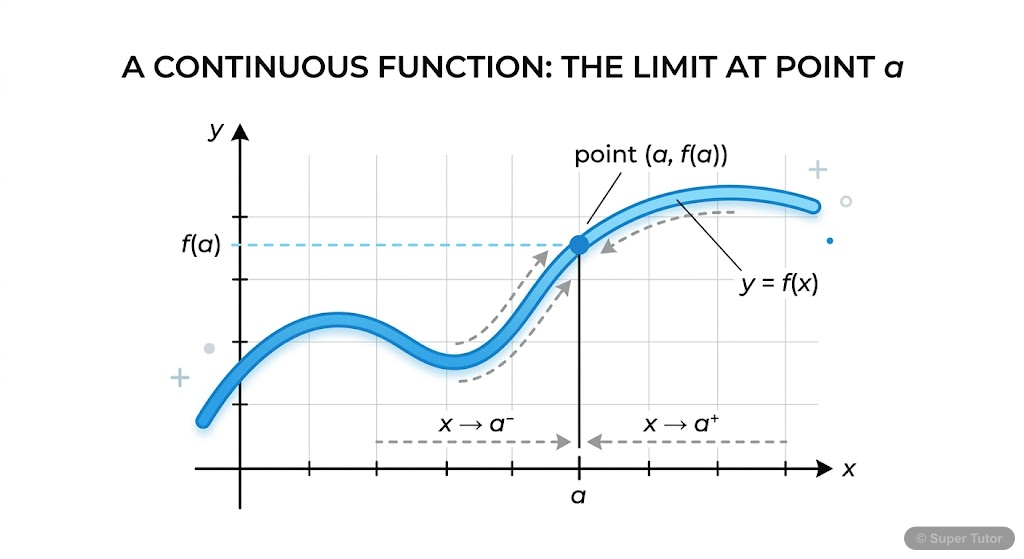
This intuitive idea is formalized using the concept of limits we studied previously. For a function to be continuous at a point, three conditions must be met. The video below from Dinesh Sir gives a great, quick overview of this core principle.
Continuity Shortcuts | MHT-CET 2022 Shortcuts Series' by Dinesh Sir | Dinesh Sir
This video introduces the fundamental condition for continuity in a very direct, exam-oriented way.
Watch from the start of the explanation. The key takeaway is that for a function to be continuous, its limit at a point must equal its value at that point.
The following reading provides the formal, three-part definition that you will use to solve problems.
Limit Continuity and Differentiability Explained
This article from Vedantu clearly lays out the necessary and sufficient conditions for continuity.
Read the sections titled Criterion for Continuity at a Point and the answers to the questions "What is continuity?" and "State the conditions". Pay close attention to the three specific conditions listed.
To summarize, a function is continuous at a point if and only if:
- is defined. (The point exists).
- exists. (This means the Left-Hand Limit and Right-Hand Limit are equal: ).
- . (The limit equals the value).
In short: LHL = RHL = Value of the function. This is the master key to solving all continuity problems.
2. Testing for Continuity at a Point
Most MHT-CET questions will give you a piecewise function and state that it is continuous. Your task will be to find the value of an unknown constant, like or . The strategy is to apply the LHL = RHL = f(a) condition.
Let's see this in action. The video below explains the concept and then jumps into a typical MHT-CET problem.
Continuity - Class 11 | MHTCET 2024 | GanitAnk Beta 3.0 #mhtcet #mhtcet2024 #mhtcet2024
This video from GanitAnk is tailored for MHT-CET and explains continuity at a point before solving a representative problem using L'Hôpital's rule, which you learned in the previous lesson.
First, watch the conceptual explanation from this section. The instructor reinforces that Limit = Value. Then, watch the first worked example from this part. Notice how the problem of finding the function's value for continuity is converted into a limit problem. Since it results in a \frac{0}{0} form, he applies L'Hôpital's rule to find the limit, which then gives the required value.
As you saw, checking for continuity often boils down to solving a limit problem. Here is another example that involves a logarithmic function, requiring a slightly different approach.
Continuity - Class 11 | MHTCET 2024 | GanitAnk Beta 3.0 #mhtcet #mhtcet2024 #mhtcet2024
This example demonstrates a case where you first need to use a property of logarithms before applying L'Hôpital's rule.
Watch the problem solved between these timestamps. The key first step is using the change of base formula \log_a b = \frac{\log b}{\log a}. After this transformation, it becomes a standard \frac{0}{0} limit problem.
3. Continuity Over an Interval
Sometimes, you'll be asked about a function's continuity over an entire interval, such as . This is particularly common for piecewise functions that have different definitions for different parts of the domain.
A function is continuous over an interval if it's continuous at every point in that interval. For piecewise functions, you only need to check for continuity at the break points — the points where the function's definition changes.
The following video demonstrates this perfectly. It involves finding two unknown constants, and , by setting up two separate continuity equations at the two break points.
Continuity - Class 11 | MHTCET 2024 | GanitAnk Beta 3.0 #mhtcet #mhtcet2024 #mhtcet2024
This segment shows the strategy for handling continuity over an interval for a piecewise function.
First, watch the quick introduction to continuity in an interval from this section. The instructor explains that you must check continuity at the points where the function's definition changes. Next, see a simple example solved from this part. It shows how to equate the function pieces at the break point x=1. Finally, watch the more complex example involving trigonometric functions and two break points (\pi/4 and \pi/2) from this segment. This creates a system of two linear equations to solve for a and b, a classic MHT-CET pattern.
4. Special Functions: Modulus and Greatest Integer
Some functions have inherent points of interest for continuity.
-
Modulus Function, : The modulus function itself is continuous everywhere. However, when it appears in piecewise definitions or fractions, you must analyze its behavior. Remember:
- For , .
- For , .
This change in definition is crucial for evaluating Left-Hand and Right-Hand Limits.
-
Greatest Integer Function, : This function is discontinuous at every integer. It "jumps" up by 1 at each integer value. This is a fact you should memorize.
The video below quickly recaps these properties and solves problems involving the modulus function.
Continuity - Class 11 | MHTCET 2024 | GanitAnk Beta 3.0 #mhtcet #mhtcet2024 #mhtcet2024
This video covers the essential properties of modulus and greatest integer functions and then applies them to solve MHT-CET problems.
Watch the brief explanation of the modulus function's behavior around its critical point from this section. Next, see the quick review of the greatest integer function and its points of discontinuity from this part. Now, watch the worked example involving a modulus function at x=0 from this segment. Notice how the LHL and RHL are evaluated using different definitions of |x|. Finally, see one more advanced modulus problem solved from this example, where equations are set up to find constants a and b.
Conclusion
In this lesson, we have built upon our knowledge of limits to understand and test for continuity. You've learned the formal definition and, more importantly, the practical methods to solve the kinds of continuity problems you will face in the MHT-CET.
Key Takeaways:
- The core condition for continuity at a point is LHL = RHL = f(a).
- For piecewise functions given as continuous, use this condition to set up equations and solve for unknown constants.
- To check for continuity over an interval, test for continuity at the "break points" where the function's definition changes.
- Remember that the greatest integer function is discontinuous at all integers, and be prepared to split the modulus function into its positive and negative cases for LHL and RHL.
In our next lesson, we will take the next logical step to differentiability. We'll learn that continuity is a prerequisite for a function to be differentiable and begin exploring the rules for finding derivatives of more complex functions, such as composite and implicit functions.