Hello! Welcome back to Day 2 of your IELTS Writing preparation.
In our previous lesson, we focused on the critical first step for Task 2: analyzing the prompt to formulate a direct thesis statement. You can think of this as defining the core objective and high-level design for your essay.
Today's lesson builds directly on that foundation. We will address the next learning outcome: Outline a four-paragraph essay structure (Introduction, Body 1, Body 2, Conclusion).
Having a clear, predictable structure is your most powerful tool for writing a high-scoring essay under time pressure. It ensures your ideas are presented logically, which is essential for the 'Coherence and Cohesion' marking criterion. For your background in software engineering, this is analogous to having a solid architectural pattern or template before you start writing code; it provides organization and ensures all requirements are met efficiently.
1. The Blueprint: The Four-Paragraph Essay Structure
While IELTS essays can sometimes have five paragraphs (one introduction, three body paragraphs, one conclusion), the four-paragraph structure is the most reliable and efficient model, especially when you're aiming for clarity and speed. It is suitable for almost every type of Task 2 question.
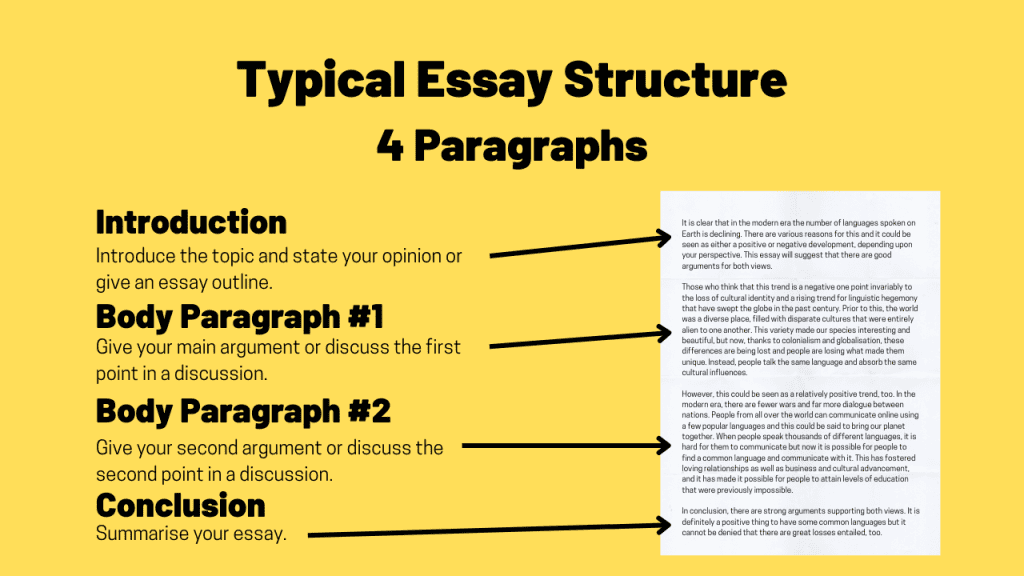
The structure is simple:
- Introduction: Sets the context and states your main argument (thesis).
- Body Paragraph 1: Develops your first main point.
- Body Paragraph 2: Develops your second main point.
- Conclusion: Summarizes your points and concludes your argument.
To see this structure explained in the context of a specific essay type, please watch this short segment.
IELTS ESSAY WRITING Secrets That Got 1.9 MILLION VIEWS!
This clip from Asad Yaqub's 'IELTS ESSAY WRITING Secrets' video clearly lays out the four-paragraph plan for an 'advantages and disadvantages' essay, which is a very common format.
Watch from 17:24 to 18:48. The instructor explicitly names the function of each of the four paragraphs.
Here is a visual representation of this standard structure:
2. The Function of Each Paragraph
To score well, you need to understand not just the structure, but the specific job of each paragraph. A well-structured essay guides the examiner through your argument seamlessly.
Let's break down the role of each component.
IELTS Essay Structure & Paragraphs
The article 'IELTS Essay Structure & Paragraphs' from IELTS Liz is an excellent resource that explains the 'why' behind the structure. It connects paragraphing directly to the IELTS marking criteria.
Please read the sections 'Overall IELTS Essay Structure' and 'Individual Paragraphs & Content'. Focus on the purpose of the introduction, body paragraphs, and conclusion as described.
To summarize and reinforce the key points from the article:
-
Introduction: Its function is to introduce the topic to the reader and present your specific argument. It always contains two key elements:
- Paraphrased Question: You rephrase the background statement from the prompt in your own words.
- Thesis Statement: You state your main answer to the question (as we practiced in the last lesson).
-
Body Paragraphs: This is where you build your case. Each body paragraph must focus on one single main idea. Mixing ideas will confuse the reader and lower your 'Coherence and Cohesion' score. The typical structure for a body paragraph is:
- Topic Sentence: The first sentence, which states the main idea of the paragraph.
- Explanation: Sentences that explain the topic sentence in more detail.
- Example: A specific example to support your point.
-
Conclusion: This paragraph provides closure. Its job is to briefly summarize the main points from your body paragraphs and restate your thesis in different words. Crucially, you should not introduce any new ideas here.
For a quick video summary of these roles, the following clips are very helpful.
Understand IELTS Writing Task 2 in 5 Minutes
The video 'Understand IELTS Writing Task 2 in 5 Minutes' by IELTS Advantage provides a very concise breakdown of each paragraph's function.
Watch the following three short segments: 'Introduction Paragraph' (02:37 - 03:22) 'Main Body Paragraphs' (03:22 - 03:59) 'Conclusion Paragraph' (03:59 - 04:24) Notice how each part has a distinct and clear purpose.
3. From Theory to Practice: Creating an Outline
Now, let's apply this knowledge to create a concrete plan. Before you write a single sentence of your essay, you should spend 3-5 minutes creating an outline. This plan is your roadmap.
The following resource provides a perfect example of how to create a simple, effective paragraph plan.
This article from the British Council's IELTS Canada site demonstrates how to create a paragraph plan for an advantages/disadvantages essay.
Read the section 'Putting it all together' and pay close attention to the 'Paragraph Plan'. See how it breaks the essay down into four clear parts.
Let's walk through the process using the example from the article:
Prompt: Many people leave their home country to study abroad nowadays. What are the advantages and disadvantages of this trend?
Step 1: Formulate a Thesis Statement (Recap from last lesson)
A possible thesis could be: "While studying in a foreign country provides access to superior educational opportunities, it also presents considerable financial and emotional difficulties."
Step 2: Plan the Body Paragraphs
Your thesis gives you the main ideas for your body paragraphs.
- Main Idea 1 (Advantage): Access to better/wider range of courses and facilities.
- Main Idea 2 (Disadvantage): High costs and potential for loneliness/isolation.
Step 3: Create the Four-Paragraph Outline
- Paragraph 1 (Introduction):
- Paraphrase: It's increasingly common for students to pursue education overseas.
- Thesis: State that this trend has both significant benefits (e.g., educational access) and drawbacks (e.g., cost and isolation).
- Paragraph 2 (Body 1 - Advantages):
- Topic Sentence: Studying abroad offers several key advantages, primarily access to better resources.
- Explain: Students can find specialized courses or use advanced facilities not available at home.
- Example: A student moving to the US for a unique law degree.
- Paragraph 3 (Body 2 - Disadvantages):
- Topic Sentence: However, there are notable difficulties associated with international study.
- Explain: High tuition fees, living expenses, and feelings of isolation from family.
- Example: Friends who returned home early due to unhappiness, losing their tuition fees.
- Paragraph 4 (Conclusion):
- Summary: Briefly restate the main advantage (career/skill advancement) and disadvantage (expensive, emotionally draining).
- Final thought/Opinion: Conclude that despite the drawbacks, the benefits make it a worthwhile endeavor.
This simple outline is the blueprint for a well-structured, 250+ word essay.
4. Practice Activity
Now it's your turn. Read the following prompt and create a four-paragraph outline. For each paragraph, write down the main point or function in one short sentence or a few bullet points.
Prompt:
In many cities, the use of video cameras in public places (CCTV) is becoming more common. What are the advantages and disadvantages of this development?
Take about 10 minutes to create your outline. When you're ready, compare it with the model answer below.
Model Outline
-
Paragraph 1 (Introduction):
- Paraphrase: The installation of CCTV cameras in urban areas is a growing trend.
- Thesis: This essay will argue that while CCTV enhances security, it does so at the cost of personal privacy.
-
Paragraph 2 (Body 1 - Advantages):
- Topic Sentence: The primary advantage of widespread CCTV surveillance is the potential to deter crime and assist in investigations.
- Main Idea: Increased security and crime prevention.
-
Paragraph 3 (Body 2 - Disadvantages):
- Topic Sentence: On the other hand, the constant monitoring of citizens raises serious concerns about the erosion of privacy.
- Main Idea: Loss of personal privacy and potential for misuse of data.
-
Paragraph 4 (Conclusion):
- Summary: CCTV offers a trade-off between public safety and individual freedom.
- Final thought/Opinion: Conclude that while beneficial, the implementation of CCTV must be carefully regulated to protect citizens' rights.
Conclusion
Well done. You have now learned how to create a solid structural foundation for any Task 2 essay. This skill is invaluable for writing clearly and efficiently under exam conditions.
Key Takeaways:
- The Four-Paragraph Template: Use the Introduction, Body 1, Body 2, and Conclusion structure as your default for Task 2.
- One Idea Per Paragraph: Each body paragraph should explore only one main idea, introduced by a clear topic sentence.
- Plan Before You Write: A 3-5 minute outline is not wasted time; it's an investment that ensures a logical and coherent essay.
In our next lesson, we will zoom in on the body paragraphs. You will learn how to construct a body paragraph using the Point-Example-Explain structure to develop a single main idea, turning your outline into a fully developed argument.