Introduction
Welcome to the final lesson of our first module on Number Systems. Over the past few lessons, we have built a solid foundation by covering:
- Conversions between different number bases.
- Representation of signed numbers, especially the crucial 2's complement system.
- Binary arithmetic, including addition, subtraction, and the detection of overflow.
- Special-purpose codes like BCD, Excess-3, and Gray code.
Today, we bring all these concepts together. The goal of this lesson is to put your knowledge into practice by tackling a range of GATE-style problems. We will focus on developing the strategies, speed, and accuracy needed to excel in the exam. This session is all about application, reinforcing what you've learned and showing you how these topics appear in the actual GATE paper.
1. Strategy for Unknown Base Problems
A common type of question in GATE involves an equation with numbers in unknown bases. A direct algebraic solution can sometimes be time-consuming or complex if there are multiple unknowns. A more efficient exam strategy is often to test the given options.
Let's look at a typical problem of this kind from a recent GATE paper.
GATE 2021–2025 Digital Electronics PYQs (ECE/EE) (1 Mark) | Champions Series | GATE 2026
This video from OHM INSTITUTE Hyderabad solves a GATE 2021 question involving two unknown bases. Pay close attention to the instructor's reasoning for why substituting the options is the most practical approach here.
Watch the segment from 03:52 to 08:30. The instructor explains that with one equation and two unknowns (X and Y), solving it conventionally is not feasible. Observe how he systematically checks the options to find the one that satisfies the equation.
This problem-solving technique is vital. When you see an equation like , your first thought should be to assess if a direct solution is faster than checking the 2-3 valid options provided. The video also highlights a useful common-sense check: for a number with more digits to equal a number with fewer digits (e.g., 1235 vs 303), the base of the first number must be smaller than the base of the second. However, in this case, the numbers are different, but the logic about base size vs. digit values still applies. A smaller base requires more digits to represent the same value.
2. Tackling 2's Complement and Overflow
2's complement is the most important topic within this module for the GATE exam. Questions will test your ability to convert, perform arithmetic, and, most importantly, detect overflow conditions.
2.1. Representation and Sign Extension
Before performing arithmetic with numbers of different bit lengths, you must make them the same length. This is done through sign extension, where the sign bit is copied to the new, more significant bit positions.
- For a positive number (sign bit = 0), extend by adding
0s to the left. - For a negative number (sign bit = 1), extend by adding
1s to the left.
Example Problem (based on GATE '07, Q.38):
X = 01110 (a 5-bit positive number) and Y = 11001 (a 5-bit negative number) are in 2's complement format. We want to calculate their sum, X + Y, and represent it using 6 bits.
Solution Steps:
- Sign-extend both numbers to 6 bits:
- X =
01110becomes001110(add a0at the front). In decimal, this is . - Y =
11001becomes111001(add a1at the front). In decimal, this is .
- X =
- Add the 6-bit numbers:
001110 (14) + 111001 (-7) ---------- 000111 (7) (The carry-out of 1 is discarded) - The result is , which is . This matches our decimal calculation .
You can find a similar problem (Q.38) in the "GATE SOLVED PAPER - EC" PDF (resource_id: [LINK](https://www.mywbut.com/gate/gate%20chapter%20wise%20solved%20papers/ec/Digital%20Circuits.pdf)).
2.2. Overflow Detection
Overflow is a critical error condition in signed arithmetic. It occurs when the result of an operation is too large to be represented by the available number of bits.
An overflow can only happen when adding two numbers of the same sign. It never occurs when adding numbers with different signs.
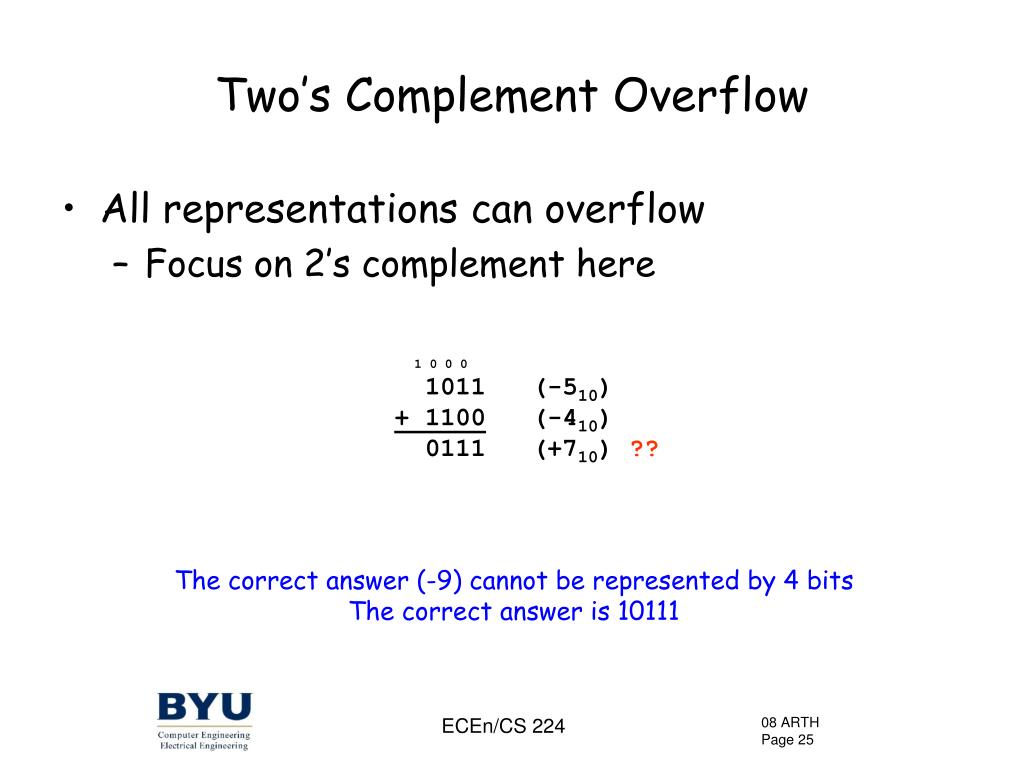
There are two primary ways to detect overflow in an N-bit system:
-
Sign-based Rule: Check the sign bits of the operands and the result.
- An overflow occurs if you add two positive numbers and get a negative result.
- An overflow occurs if you add two negative numbers and get a positive result.
-
Carry-bit Rule: Compare the carry-in and carry-out of the Most Significant Bit (MSB) column.
- Let be the carry into the MSB (sign bit) column.
- Let be the carry out of the MSB column.
- Overflow occurs if and only if .
Let's watch a video that formalizes this carry-bit rule.
Twos Complement Addition & Overflow
This video by Dr. Shane Oberloier explains the formal rule for detecting overflow using the carry bits and applies it to several examples.
Watch the segment from 03:22 to 08:30. Focus on the explanation of the rule C_n != C_{n-1} (where C_n is the carry-out of the MSB and C_{n-1} is the carry-in to the MSB) and see how it's applied to determine overflow in the three examples.
GATE often asks for the Boolean expression that detects overflow. Let the sign bits of the two numbers being added be and , and the sign bit of the result be . The condition for overflow is captured by this classic logic expression:

3. Application in Arithmetic Circuits
These concepts aren't just abstract; they are the foundation of how arithmetic circuits like adders and subtractors work. Let's analyze a circuit that performs both addition and subtraction using 2's complement.
This problem connects the theory of 2's complement subtraction (i.e., ) to a hardware implementation.
GATE 2021–2025 Digital Electronics PYQs (ECE/EE) (1 Mark) | Champions Series | GATE 2026
Let's return to the OHM INSTITUTE video and look at a problem that analyzes a 4-bit adder/subtractor circuit. This is a great example of how number system concepts are applied in combinational circuits.
Watch the segment from 37:35 to 42:00. The circuit uses a control input 'Z'. Pay close attention to how the XOR gates and the initial carry-in C_0 = Z work together. When Z=1, the XOR gates invert the B inputs, and the C_0=1 completes the 2's complement, effectively performing subtraction.
This example shows that understanding 2's complement is not just about manual calculation but also about recognizing its implementation in digital hardware—a key skill for an ECE engineer.
4. Practice Problems for Self-Assessment
To solidify your understanding, try these problems from the provided resources. They cover the key concepts we've discussed.
- Decimal Conversion: The 2's complement numbers
11001,1001, and111001correspond to which set of decimal numbers? (See Q.72 in the PDF LINK). - Range of Representation: What is the range of signed decimal numbers that can be represented by a 6-bit 1's complement representation? (See Q.68 in the PDF LINK). This tests your understanding of the differences between 1's and 2's complement ranges.
- Subtraction: Two numbers in signed 2's complement are P =
11101101and Q =11100110. If Q is subtracted from P, what is the result in signed 2's complement? (See Q.30 in the PDF LINK).
Conclusion
This lesson concludes our module on number systems. You've transitioned from foundational theory to applying that knowledge to solve complex, exam-relevant problems.
Key Takeaways:
- Problem-Solving Strategies: For unknown bases, option substitution is a powerful tool. For arithmetic, always be mindful of sign extension.
- 2's Complement is Key: Master the conversion, arithmetic, and especially the two rules for overflow detection (sign-based and carry-based).
- Hardware Connection: Understand that concepts like 2's complement subtraction are directly implemented in circuits using components like adders and XOR gates.
Next Lesson Preview:
We have built the foundation of how information is represented in digital systems. Now, we will move on to processing that information. In the next module, Boolean Algebra and Logic Gates, you will learn the mathematical principles and the fundamental building blocks (AND, OR, NOT, NAND, NOR gates) that are used to design all digital circuits.