Introduction
Welcome to your personalized course on Digital Electronics for the GATE exam. This first lesson kicks off our journey by focusing on the absolute foundation of digital systems: number representation. In the GATE ECE paper, questions involving number systems are frequent, and being fast and accurate is key.
Today's learning outcome is to master the conversion of numbers between the four most important systems in digital logic: binary, octal, decimal, and hexadecimal. We'll cover the systematic methods for these conversions, including essential shortcuts that will save you valuable time during the exam. This knowledge forms the bedrock for all subsequent topics, such as binary arithmetic, codes, and logic design.
What are Number Systems?
Before we dive into conversions, let's quickly formalize the concepts of different number systems. A number system is defined by its base or radix, which is the number of unique digits it uses to represent numbers.
For a solid overview of the four key number systems, please read the first few pages of the following document.
This document from The New College Kolhapur provides a clear introduction to the number systems we'll be dealing with. It defines the concept of radix and lays out the basic symbols for each system.
Please read the first two pages of the PDF. Start from the beginning (section 'NUMBER SYSTEM') and stop just before the section 'Interconversion from one Number system to another Number system'. Focus on the table that summarizes the base and symbols for Binary, Octal, Decimal, and Hexadecimal systems.
As you've seen, each number can be expressed as a sum of powers of its base. For example:
- Decimal (base 10):
- Binary (base 2):
This positional weight method is the key to converting any number system to decimal.
Converting from Decimal
The most fundamental conversion technique is changing a decimal number into another base. This process is slightly different for integer and fractional parts.
- Integer Part: Use the method of successive division by the target base. You collect the remainders from bottom to top to form the new number.
- Fractional Part: Use the method of successive multiplication by the target base. You collect the integer parts of the results from top to bottom.
This video provides excellent, clear demonstrations of this process for binary, octal, and hexadecimal systems.
Convert Decimal to any other Base(Binary, Octal, Hexadecimal)| Conversion from One radix to another
Watch this video by Sudhakar Atchala to see the 'division/multiplication' method in action. It covers conversions from decimal to binary, octal, and hexadecimal with worked-out examples for both integers and fractions.
Watch the entire video from the beginning to 13:04. Pay close attention to how the integer part is handled with division and the fractional part with multiplication. Notice how remainders are read upwards and the integer parts of the fractional conversion are read downwards.
Let's look at one of the examples from the video in more detail, say converting to hexadecimal (base 16).
Integer Part (382):
- remainder (which is 'E' in hex)
- remainder
- remainder
Reading remainders from bottom to top: .
Fractional Part (0.525):
- . Integer part is .
- . Integer part is .
- . Integer part is .
Reading integer parts from top to bottom: .
So, .
The following image provides another great set of examples for these conversions.

Shortcut Conversions: Using Binary as a Bridge
For the GATE exam, speed is crucial. Direct conversions between octal and hexadecimal are slow. The fastest method is to use binary as an intermediate step. This works because 8 and 16 are powers of 2 (, ).
Binary to Octal and Hexadecimal
- Binary to Octal: Group binary digits (bits) in sets of three, starting from the binary point. Each group corresponds to one octal digit.
- Binary to Hexadecimal: Group bits in sets of four, starting from the binary point. Each group corresponds to one hexadecimal digit.
This video focuses on the binary to hexadecimal conversion, which is a very common task.
How To Convert Binary to Hexadecimal - Computer Science
The Organic Chemistry Tutor channel provides a concise tutorial on converting binary numbers to hexadecimal. It clearly explains the 4-bit grouping method and how to handle numbers that aren't a multiple of four bits long.
Watch the video from the beginning to 04:21. Focus on the core technique of grouping bits into fours and what to do when the leftmost group has fewer than four bits (padding with leading zeros).
Octal and Hexadecimal to Binary
This is the reverse process.
- Octal to Binary: Convert each octal digit into its 3-bit binary equivalent.
- Hexadecimal to Binary: Convert each hexadecimal digit into its 4-bit binary equivalent.
Octal to Hexadecimal (and vice-versa)
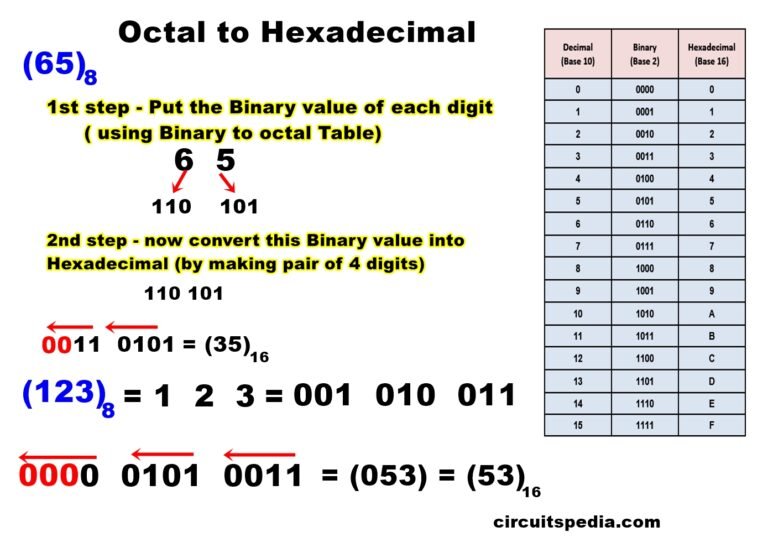
This is a two-step process:
- Convert the starting number (e.g., octal) to its binary form.
- Regroup the binary bits for the target system (e.g., into groups of four for hexadecimal) and convert.
This image perfectly illustrates the Octal -> Binary -> Hexadecimal conversion process.
Practice Problem
Let's apply these shortcut methods, which are high-yield for GATE questions.
Convert to Hexadecimal.
-
Octal to Binary:
Convert each octal digit to its 3-bit binary equivalent.
So, .
-
Regroup for Hexadecimal:
Group the bits in sets of four, starting from the binary point. Add trailing or leading zeros if needed to complete a group.- Integer part (right to left): . We added three leading zeros.
- Fractional part (left to right): . We added two trailing zeros.
The regrouped binary number is .
-
Binary to Hexadecimal:
Convert each 4-bit group.
The final result is or simply .
For a complete reference on all these conversions, you can consult the following document. It's a useful resource to bookmark for practice.
Review of number systems-representation-conversions
This PDF provides detailed procedures and examples for all the conversions discussed, including the shortcut methods. It's a great resource for reviewing the specific steps.
Skim through pages 2-4 of this document, under the heading 'Number system Conversions'. You don't need to read it in depth right now, but see how it lays out all the conversion types with examples. It's a good summary of what we've covered.
Conclusion
In this lesson, we established the fundamental skill of number system conversion, a must-have for your GATE preparation.
Key Takeaways:
- To Decimal: Use the positional weight method (sum of products).
- From Decimal: Use successive division for the integer part and successive multiplication for the fractional part.
- Shortcuts: Always use binary as an intermediary for conversions between octal and hexadecimal. Group bits into sets of 3 for octal and sets of 4 for hexadecimal.
Mastering these conversions will not only help you solve direct questions but will also be essential for understanding upcoming topics.
Next Lesson Preview:
In the next lesson, we will build directly on our understanding of the binary system. We will explore how computers represent signed numbers using methods like sign-magnitude, 1's complement, and 2's complement. This is the foundation for understanding how digital circuits perform arithmetic operations like subtraction.