Hello! In our last lesson, we explored how to factorise general quadratic expressions. Today, we'll build on that by looking at a very common and useful special case: the difference of two squares. This is a pattern that, once you learn to spot it, provides a powerful shortcut for factorising certain types of expressions.
Your goal for this lesson is to master factorising expressions that fit this pattern. This skill is more than just an algebraic trick; it's a fundamental technique you'll use constantly when simplifying complex expressions, especially when we get to algebraic fractions in our next lesson. It's also another key to unlocking the roots of functions, which is central to analysing their behaviour in applications like game physics or AI model optimisation.
We'll start, as you prefer, by trying to discover the pattern for ourselves before diving into the formal method.
Part 1: Discovering the "Difference of Two Squares" Pattern
In the previous lesson, you learned that factorising a quadratic like x^2 + bx + c involves finding two numbers that multiply to give c and add to give b. Let's apply that logic to a specific type of quadratic: x^2 - 49.
Here, b = 0 and c = -49. So, we need two numbers that multiply to give -49 and add to give 0. What are those two numbers?
They must be opposites: +7 and -7.
- Product:
7 * (-7) = -49 - Sum:
7 + (-7) = 0
So, x^2 - 49 factorises to (x + 7)(x - 7).
This reveals a general pattern. Whenever you have an expression that is one squared term subtracted from another, it's called a difference of two squares. The general formula is:
a^2 - b^2 = (a + b)(a - b)
Notice the name: "difference" refers to the subtraction, and "two squares" refers to the a^2 and b^2 terms.
The "Why" Behind the Formula
There are a couple of ways to build a strong intuition for why this formula works.
1. Algebraic Proof:
The formula works because when you expand the brackets (a + b)(a - b), the middle terms cancel each other out, just like our +7x and -7x would have.
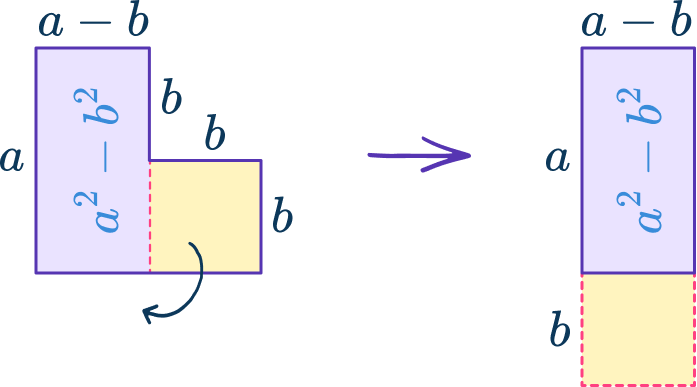
2. Geometric Proof:
We can also visualize this using geometry. The area of the purple L-shape on the left is the area of the large square (a^2) minus the area of the small yellow square (b^2). By moving the small yellow-outlined rectangle, we can rearrange this L-shape into a single large rectangle with sides (a+b) and (a-b).
To solidify this concept, the following video explains the three simple conditions an expression must meet to be a difference of two squares. It also clearly demonstrates why this pattern only works for a "difference" (subtraction) and not for a "sum" of squares, which addresses your interest in the "why" behind the rules.
Gr 9 Factorisation: Difference of Squares Introduction
This video from Kevinmathscience provides a foundational look at what makes a difference of squares and why the minus sign is essential.
First, watch the section that outlines the three conditions that an expression must satisfy. Then, watch the clear explanation of why it doesn't work for an expression like x^2 + 4. This is a key detail.
Part 2: Applying the Method
Now that you understand the pattern, let's put it into practice. The method is straightforward once you can spot the pattern.
As per your preference, let's start with a problem. Try to factorise this expression on your own:
y^2 - 36
- Step 1: Is it a difference of two squares? Yes. We have two terms (
y^2and36), they are separated by a minus, and both are perfect squares. - Step 2: Find the square root of each term. The square root of
y^2isy, and the square root of36is6. - Step 3: Place these into the two-bracket form
(a+b)(a-b).
You should get (y + 6)(y - 6).
Formalising the Steps
The process you just followed is the general method. This article provides a concise summary of the steps involved.
Difference Of Two Squares - GCSE Maths
This resource from Third Space Learning gives a clear, four-step guide for applying the formula.
Read the section under the heading "How to factorise". These four steps are the core method you will use repeatedly.
More Complex Examples
The pattern holds even when the terms themselves are more complex, involving coefficients or multiple variables. Look at this example:

Here, a is 2x and b is 9y. The process remains the same:
- Square root the first term:
sqrt(4x^2) = 2x - Square root the second term:
sqrt(81y^2) = 9y - Write out the two brackets:
(2x + 9y)(2x - 9y)
An Important Extra Step: Common Factors
For your IGCSE Extended paper, you'll encounter problems where you must first take out a highest common factor (HCF) before you can apply the difference of two squares rule. This is a very common place to get stuck if you don't look for it.
For example, consider 3x^2 - 75.
At first glance, this doesn't look like a difference of two squares because 3 and 75 are not square numbers.
What should your first step be?
You should look for a common factor. Here, the HCF is 3.
Factoring out the 3 gives: 3(x^2 - 25)
Now, look at the expression inside the brackets: x^2 - 25. This is a difference of two squares! We can factorise it to (x+5)(x-5).
So, the fully factorised expression is 3(x+5)(x-5).
This video reinforces all the examples we've covered and includes the crucial step of checking for common factors.
Difference between two squares - Corbettmaths
This video from Corbettmaths offers a quick review of the whole process with several examples.
Watch the first example of factorising a simple expression. Then, see how it applies to a general case with variables. Finally, observe how to handle a more complex example involving coefficients.
Conclusion
In this lesson, you've added a vital shortcut to your algebraic toolkit. By learning to recognise and factorise the difference of two squares, you can solve specific types of problems much more quickly and efficiently.
Key Takeaways:
- The difference of two squares formula is
a^2 - b^2 = (a + b)(a - b). - An expression must meet three conditions to use this rule: it must have two terms, they must be separated by a minus sign, and both terms must be perfect squares.
- The method is to square root each term and place the results into two brackets, one with a plus and one with a minus.
- Always check for a highest common factor first before attempting to apply the difference of two squares rule.
In our next lesson, we will focus on simplifying algebraic fractions. The factorising skills you've honed in this lesson and the previous one—for both general quadratics and the difference of two squares—will be absolutely essential for finding common factors in numerators and denominators.