Hello! Let's get started with our fourth lesson.
In our previous session, we honed your factorising skills by using them to simplify complex algebraic fractions. You saw how breaking down expressions into their factors is a powerful way to make them more manageable. Today, we take the logical next step: using factorisation to actually solve equations. Our objective is to solve quadratic equations by factorising.
This is where the algebraic manipulation you've been practicing becomes a tool for finding concrete answers. In the context of your interests in game development, solving a quadratic equation might determine where a thrown object lands, or when two moving items collide. It's a fundamental process for finding specific solutions, or 'roots', which are critical points in many mathematical and physical systems.
The entire method hinges on a single, powerful property of the number zero.
Part 1: The Key Principle - The Zero Product Property
Before we jump into solving problems, let's establish the core logical principle that makes this whole method work. This is the "why" behind the technique.
The principle is called the Zero Product Property. It states that if the product of two or more numbers is zero, then at least one of those numbers must be zero.
In algebraic terms:
If , then either or (or both are zero).
This might seem obvious, but it's a unique property of zero. Consider if the equation was A * B = 10. This doesn't tell us the specific value of A or B. A could be 2 and B could be 5, or A could be -20 and B could be -0.5, and so on. There are infinite possibilities. But when the product is zero, the possibilities are drastically limited.
This property is precisely why the first step in solving these equations is always to ensure one side is equal to zero.
The following video explains this common pitfall and why setting the equation to zero is so crucial.
❖ Solving Quadratic Equations by Factoring - Basic Examples ❖
This video from PatrickJMT provides a clear explanation of why a quadratic equation must be set to zero before solving, a foundational concept for this lesson.
Watch the segment from this point. The presenter highlights a very common mistake and explains the logical reason why simply factoring and setting the factors equal to a non-zero number does not work.
Part 2: The Method in Action
Now that you understand the "why," let's apply it. Following your preference, try to solve this equation first. All the skills you need are ones we've already covered.
Solve for x: x^2 - 9x + 14 = 0
Take a minute to think about the steps. How can you use the Zero Product Property here?
...
Let's break it down.
- The equation is already set to equal 0, which is perfect.
- Your next step should be to factorise the quadratic expression
x^2 - 9x + 14. You're looking for two numbers that multiply to+14and add to-9. These numbers are-2and-7. - This gives you the factorised equation:
(x - 2)(x - 7) = 0. - Now, apply the Zero Product Property. If these two factors multiply to zero, then one of them must be zero.
- Either
x - 2 = 0, which givesx = 2. - Or
x - 7 = 0, which givesx = 7.
- Either
So, the two solutions are x = 2 and x = 7. If you plug either of these values back into the original equation, you will find that it holds true. These are the "roots" of the equation.
The video below walks through this exact process.
❖ Solving Quadratic Equations by Factoring - Basic Examples ❖
This segment of the PatrickJMT video demonstrates the complete process for a standard quadratic equation.
Watch from the beginning. The presenter clearly explains how to factorise the quadratic and then set each factor to zero to find the two solutions.
Part 3: The General Method and Different Cases
The process you just followed is the standard method. Let's formalise it into a repeatable set of steps that will work for any quadratic equation you need to solve by factorising.
How to solve Quadratic Equations by Factorisation
This article from IGCSE Maths Tutor lays out the general step-by-step method very clearly.
Please read the four steps listed under the heading "Step-by-step (general)". This four-step process—rearrange, factorise, set factors to zero, and solve—is the algorithm you will use for all of these problems.
This method applies to all forms of quadratics. Let's look at the common types you'll encounter.
Case 1: Monic Quadratics (a=1)
This is the type we just solved, like x^2 + 6x + 8 = 0. These are generally the most straightforward to factorise.
Case 2: Quadratics with c=0 (Two-term quadratics)
Consider the equation: x^2 + 7x = 0.
Here, there's no constant term. The factorisation is simpler: you just take out the common factor, which is x.
x(x + 7) = 0
Now apply the Zero Product Property. The two things being multiplied are x and (x + 7).
- Either
x = 0. (This is one solution!) - Or
x + 7 = 0, which givesx = -7.
The solutions are x = 0 and x = -7.
A very common mistake here is to divide the original equation by x to get x + 7 = 0, leading only to the solution x = -7. This is incorrect because by dividing by a variable, you lose the x=0 solution. Never divide by a variable unless you know it cannot be zero.
Case 3: Non-monic Quadratics (a>1)
These are the trickiest to factorise, which you identified as an area for practice. Let's try one:
Solve for x: 8x^2 + 2x - 3 = 0
First, you need to factorise 8x^2 + 2x - 3. This is where you use the ac method.
a * cis8 * -3 = -24.bis+2.- We need two numbers that multiply to -24 and add to +2. These are
+6and-4.
Now, we can use these numbers to factorise and solve. The image below shows a useful method for this.
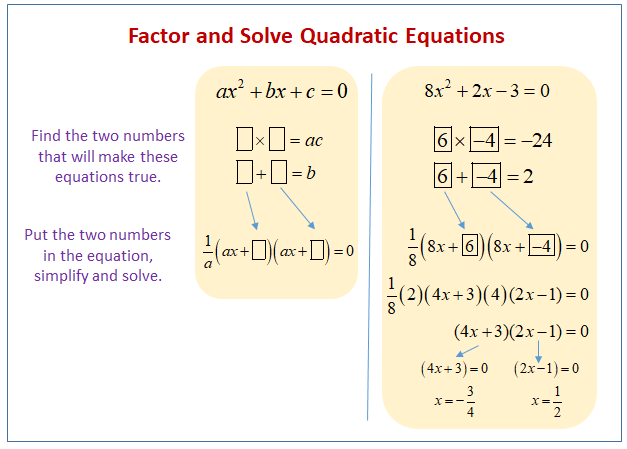
Following the method in the image:
- The factorised form is
(4x + 3)(2x - 1) = 0. - Set each factor to zero:
4x + 3 = 0->4x = -3->x = -3/42x - 1 = 0->2x = 1->x = 1/2
The solutions are x = -3/4 and x = 1/2.
The following video provides a quick summary of how to solve all three of these cases.
Solving quadratic equations by factorising - GCSE Maths
This video from JED Maths provides a concise summary of solving techniques for the different types of quadratics we've discussed.
Watch the first example for a recap on monic quadratics: x^2 + 6x + 8 = 0. See how to handle a two-term quadratic: x^2 + 7x = 0. Finally, observe the method for a non-monic quadratic: 2x^2 + 7x + 3 = 0.
Part 4: A Note on Exam Technique
For the extended paper, a useful shortcut, especially when you're aiming for an A*, is to use your calculator to your advantage. Many calculators can solve quadratic equations directly. While you must show your factorisation steps in an exam to get full marks, you can use the calculator to find the solutions first. Then you can work backwards from the solutions to figure out the factors.
Solving Quadratics by Factorising (Cambridge (CIE) IGCSE ...
This revision note from Save My Exams contains an excellent tip for exams.
Read the section titled "Examiner Tips and Tricks". This shows how knowing the solutions (e.g., from a calculator) can help you quickly determine the factors, which is a great way to check your work or get unstuck on a difficult factorisation.
For example, if your calculator tells you a solution is x = -2/3, you can rearrange this:
3x = -23x + 2 = 0
So, one of your factors must be(3x + 2). This is a very efficient strategy.
Conclusion
You have now connected the skill of factorising directly to the goal of solving equations. By understanding and applying the Zero Product Property, you can find the specific values—the roots—that satisfy a quadratic equation. This moves us from simply manipulating expressions to finding solutions, a cornerstone of algebra.
Key Takeaways:
- To solve a quadratic equation by factorising, you must first rearrange it so that it equals zero.
- The method relies on the Zero Product Property: if factors multiply to zero, at least one of the factors must be zero.
- The four steps are: Rearrange (
...=0), Factorise, Set each factor to zero, and Solve the resulting linear equations. - Always look for a common factor first, especially in two-term quadratics like
ax^2 + bx = 0. Be careful not to divide byxand lose thex=0solution.
In our next lesson, we will explore another method for solving quadratics: completing the square. While factorising is fast and elegant, it doesn't work for all quadratic equations. Completing the square is a more universal method that will also provide a deeper insight into the structure of quadratic functions, preparing us for graphing them later on.