Bonjour ! Welcome to your first lesson in this intensive course to prepare for the DELF B1 exam.
Given your goal to be ready in four weeks, we're diving straight into a foundational topic for narrating past events: the passé composé. Today, we will focus on how to form and use it with the auxiliary verb avoir, which covers the vast majority of French verbs. Mastering this is essential for the DELF exam, where you'll frequently need to describe past experiences in both writing and speaking.
The Blueprint of the Past: What is the Passé Composé?
The passé composé (compound past) is the most common past tense in spoken French. It describes actions that were completed in the past. Think of it as the equivalent of the English simple past ("I talked") or present perfect ("I have talked").
Its name, "compound past," hints at its structure. It's not a single word but a two-part verb form:
[Subject] + [Auxiliary Verb] + [Past Participle]
There are two possible auxiliary ("helper") verbs in French: avoir (to have) and être (to be). Today, we'll focus exclusively on avoir, which is used for most verbs.
To get a solid initial grasp of this concept, let's start with a brief reading.
This article from French Today clearly explains the basic components of the passé composé. It will solidify the general structure in your mind before we dive into the details.
Please read the first three short sections: 'What is the French Passé Composé?', 'What is an Auxiliary Verb?', and 'What is a Participle?'. Focus on understanding the two-part construction.
Building the Passé Composé with 'Avoir'
The structure is like a simple algorithm. For any given verb, you need two components:
- The correct present-tense form of the auxiliary verb avoir.
- The past participle (le participe passé) of the main verb.
1. The Auxiliary: avoir
As you already know the basics, this is just a quick refresher. The auxiliary is simply the verb avoir conjugated in the present tense.
| Pronoun | Avoir |
|---|---|
| J' | ai |
| Tu | as |
| Il/Elle/On | a |
| Nous | avons |
| Vous | avez |
| Ils/Elles | ont |
2. The Past Participle: le participe passé
This is where you determine the form of the action verb. Past participles can be regular or irregular.
Regular Verbs
For regular verbs ending in -er, forming the past participle is straightforward: you remove the -er and add -é.
- Parler (to speak) → parlé
- Manger (to eat) → mangé
- Regarder (to watch) → regardé
Let's watch a short video that puts these two parts together.
Passé composé avec Avoir | French grammar | Learn French
This video from 'The perfect French with Dylane' demonstrates how to assemble the passé composé with 'avoir' for regular -er verbs. Pay attention to how she combines the auxiliary and the past participle.
Watch from 01:04 to 02:24. The first part quickly reviews 'avoir', and the second part shows you how to form the past participle for '-er' verbs and combine them.
So, to say "I ate," you combine J'ai (I have) and mangé (eaten):
- J'ai mangé. (I ate / I have eaten.)
To say "We watched," you combine Nous avons (We have) and regardé (watched):
- Nous avons regardé un film. (We watched a film.)
Test your understanding!
How would you say "You (formal or plural) have studied the lesson"?
Verb: étudier (to study)
Show answer
Vous avez étudié la leçon.
(Vous -> avez, étudier -> étudié)
The Challenge: Irregular Past Participles
Just as in English we have "see/saw" and "do/did," French has many common verbs with irregular past participles. These don't follow a simple pattern and must be memorized. For your DELF B1 preparation, mastering the most frequent ones is a high-priority task.
Key irregulars include verbs like:
- avoir (to have) → eu
- être (to be) → été
- faire (to do/make) → fait
- prendre (to take) → pris
- voir (to see) → vu
- dire (to say) → dit
- pouvoir (to be able to) → pu
- vouloir (to want) → voulu
The following video provides an excellent overview of 20 common irregular verbs, with pronunciation and an example sentence for each. This is a great way to start memorizing them.
Passé composé avec Avoir | French grammar | Learn French
Let's continue with the same video from Dylane. This section is a clear, concise list of essential irregular past participles. Listen carefully to the pronunciation.
Watch the section from 02:45 to 09:19. You don't need to memorize all 20 right now, but focus on recognizing them and understanding the example sentences.
To help you organize these for study, here is a visual summary and a more detailed article. The article groups irregulars by their endings (e.g., participles ending in -is, -it, -u), which can help in finding patterns.
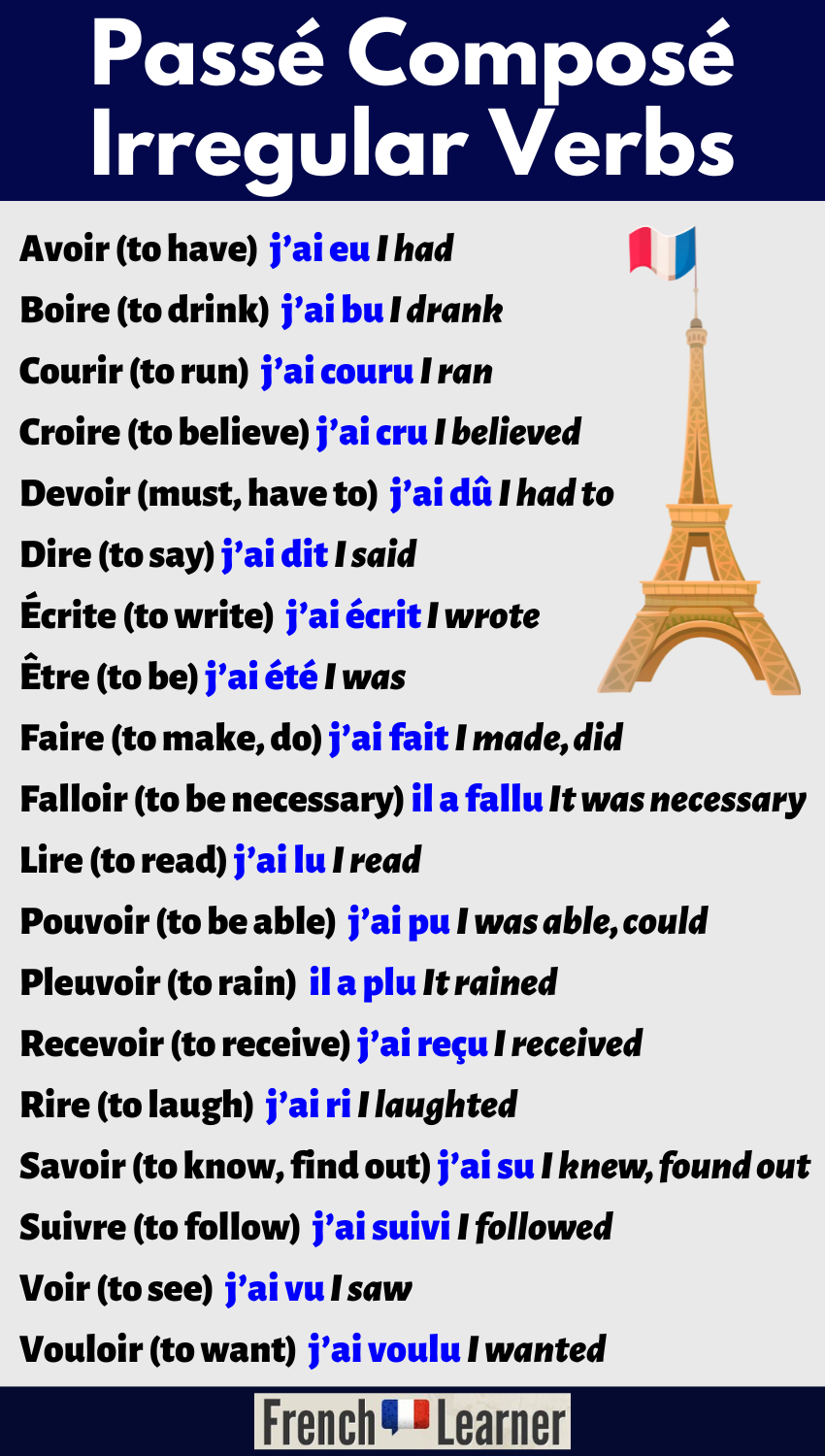
For a more comprehensive reference list, you can consult the following resource.
Passé Composé with [AVOIR] – Irregular Verbs
This article from The LEAF Project provides a detailed list of irregular past participles, neatly organized by their endings. This structured approach can be helpful for memorization.
Skim through the sections listing the past participles (those ending in -ERT, -I, -IS, -IT, -U) and the 'TOTALLY IRREGULAR' ones. Then, read the examples in the 'Adapt' section to see them in context. Use this as a reference guide for the exercises and for future study.
Let's Practice
Now, let's put your knowledge to the test. Complete the following sentences by conjugating the verb in parentheses in the passé composé with avoir.
Exercise 1: Regular Verbs
- Hier soir, nous ____________ (dîner) au restaurant.
- Tu ____________ (parler) avec le professeur ?
- J' ____________ (chercher) mes clés partout !
Show answers
- Hier soir, nous avons dîné au restaurant.
- Tu as parlé avec le professeur ?
- J'ai cherché mes clés partout !
Exercise 2: Irregular Verbs
- Elle ____________ (lire) ce livre en deux jours.
- Qu'est-ce que vous ____________ (faire) ce week-end ?
- Ils ____________ (prendre) le train de 8h.
- J' ____________ (voir) un très bon film hier.
- On ____________ (avoir) une bonne surprise.
Show answers
- Elle a lu ce livre en deux jours. (lire → lu)
- Qu'est-ce que vous avez fait ce week-end ? (faire → fait)
- Ils ont pris le train de 8h. (prendre → pris)
- J'ai vu un très bon film hier. (voir → vu)
- On a eu une bonne surprise. (avoir → eu)
Key Takeaways
Excellent work today! You've covered the most common past tense in French. Here's a summary of what we learned:
- The passé composé describes completed past actions.
- Its structure with avoir is: Subject +
avoir(present tense) + Past Participle. - For regular -er verbs, the past participle ends in -é.
- Many of the most frequent verbs have irregular past participles (e.g., fait, eu, vu, pris, dit) that must be memorized.
What's Next?
In our next lesson, we'll cover the other half of this topic: forming the passé composé with the auxiliary verb être. This is used for a specific list of verbs, mostly related to movement, and introduces a new concept: agreement of the past participle.
Keep reviewing the list of irregular participles. They are fundamental to building fluency in past narration. À bientôt