Welcome back. You have already listened for the bass pulse, offbeat accents, and the difference between a lead voice and harmony voices. This module shifts attention from what is sounding to where you are in a performance. Today you will build a plain-language map of a bluegrass song or instrumental tune: what starts it, what returns, and what changes.
Allow about 35–40 minutes, including a second listen to the performance example. No notation or measure-counting is needed.
Hear the size of a section
A singer pauses at the end of a line, and the guitar fills the gap. That pause does not necessarily mean a verse has ended: it may be a small division within the verse. For this lesson, a section is a larger stretch you can recognize when it comes around again—a whole verse, a recurring chorus, or a passage led by an instrument.
The most useful cue is return. If you hear a familiar melody and familiar words for the second time, you have likely found a chorus. If the tune is recognizably similar but the words carry the story forward, you may be hearing another verse. The bass and offbeat accents can continue steadily underneath both, so a change of section need not sound like a stop.
Bluegrass Rhythm Guitar - Dynamics, Texture, and Song Structure
In Bluegrass Rhythm Guitar - Dynamics, Texture, and Song Structure, Martin Gilmore demonstrates the difference between short musical phrases and larger song sections. His examples make that distinction audible without requiring you to count measures.
In phrases within verses, listen to the sung lines of “Bury Me Beneath the Willow” and “Long Journey Home.” Then watch larger sections, where Gilmore contrasts songs with a returning chorus and songs made up of successive verses. He discusses a common sixteen-measure pattern; for now, follow the returns by ear rather than counting them.
Think of the pauses Gilmore demonstrates as punctuation within a section. To map the performance, wait for the larger event: a complete new set of words, the return of a familiar sung passage, or a stretch where an instrument takes the foreground instead of the singer.
Map a vocal song
A useful starting vocabulary is kickoff, verse, chorus, instrumental break, and ending. These labels describe what each stretch does, not a rule that every song must obey.
The kickoff is the opening instrumental passage that establishes the tune before singing begins. A verse often brings new words. A chorus is the sung passage that returns; harmony voices may make its arrival especially noticeable, but repeated words and melody are stronger evidence than harmony alone. During an instrumental break, a player takes the foreground for a longer passage while the voice rests. The song may finish with a final chorus, a short instrumental flourish, or a repeated closing line often called a tag.
Always do these things at the bluegrass jam.
Always do these things at the bluegrass jam, from Lessons With Marcel, gives a compact account of how vocal sections and instrumental passages commonly alternate. Use it as a template to test against what you hear, not as a fixed script.
Watch the vocal template for the relationship among breaks, verses, and choruses. Then skip to opening and ending for consecutive breaks, the name “kickoff,” and a possible closing flourish.
The labeled waveform below shows one arrangement of “Blue Ridge Cabin Home.” Reading its labels from left to right gives a kickoff, first verse and chorus, an instrumental solo, second verse and chorus, another solo, third verse and chorus, a final solo, and a closing chorus. The image is a model of what a finished map can look like; the aim is to locate those boundaries by listening, before looking at labels.
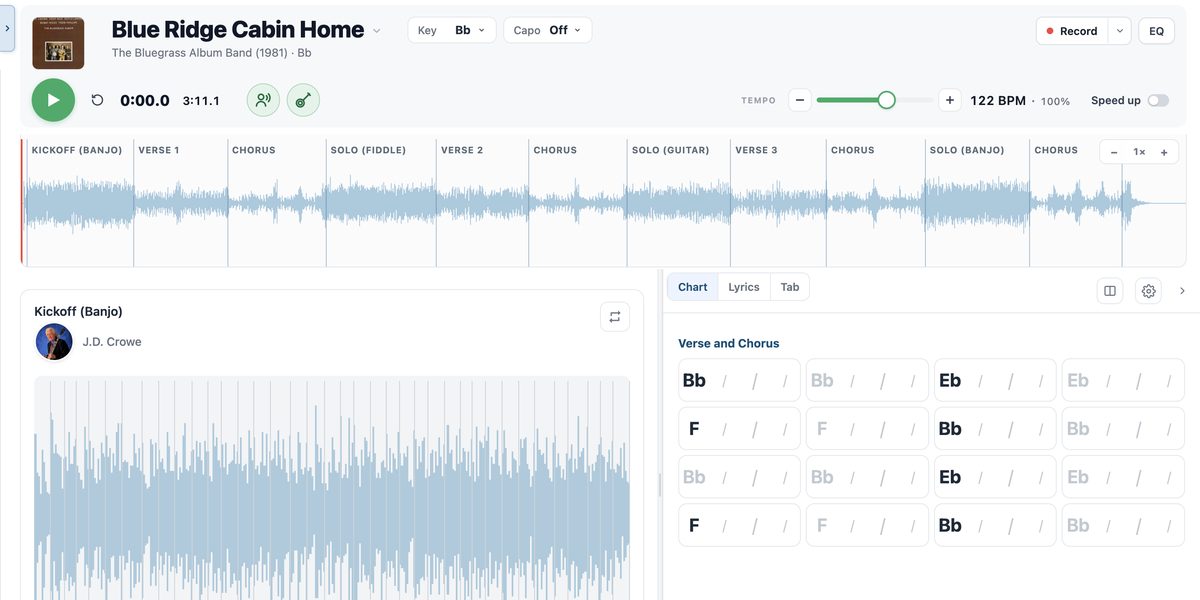
Notice that recurring does not mean identical in every detail. Singers may vary a phrase, and players may add different fills beneath a returning chorus. Conversely, two verses can use much the same melody while telling different parts of the story. Track the identity of the whole passage—especially its words and where it returns—rather than demanding a perfect sound-for-sound match.
Map an instrumental tune
An instrumental tune has no sung verse or chorus to guide you. Instead, listen for two contrasting stretches of melody. Musicians often call the first one A and the second one B. These letters are just convenient names: you could call them “first tune” and “second tune.”
The Bluegrass Sound – The Picker's Guide
Read the “Song forms” subsection of The Bluegrass Sound from The Picker’s Guide for a concise comparison of vocal songs and instrumental tunes.
In “Song forms,” begin with the form overview and stop at the end of that paragraph, after its brief mention of bluegrass blues. Focus on the descriptions of vocal songs and the repeating A and B parts of instrumental tunes; the other forms are reminders that no single map fits every performance.
A common instrumental pattern is A, A, B, B: you hear the first melodic section twice, then a different section twice. The group may make another trip through those four sections. A different player can lead the next trip while the tune’s underlying A and B pattern remains recognizable. Do not mistake a change of player for a change from A to B: one is a change in who is foregrounded, the other a change in which part of the tune is being played.
Always do these things at the bluegrass jam.
Return to Always do these things at the bluegrass jam for its explanation of the common instrumental-tune pattern.
Watch the AABB explanation. Concentrate on the two repeated melodic parts and on the idea that a player can lead a complete cycle before the tune continues with someone else.
In real listening, an A repeat may have different ornaments or a different lead sound. Ask only whether the recognizable melodic idea has returned. Some tunes have more than two parts, and some performances bend the expected pattern. If you cannot hear two clear repeated parts, a provisional map such as “opening theme, contrasting theme, opening theme returns” is more accurate than forcing an AABB label onto the music.
Keep your place during a performance
On a first listen, use broad labels: opening instruments, singing, instruments alone, familiar singing returns, ending. On a second listen, divide the sung stretches into verses and choruses, or an instrumental tune into its recurring melodic parts. This two-pass approach lets you hear the shape before trying to name every boundary.
Gilmore’s performance of “Long Journey Home” provides an audible vocal-song example. It is a solo guitar-and-voice demonstration: when he announces a mandolin, fiddle, or banjo entrance, he is describing imagined band roles, not introducing separate musicians you should expect to hear.
Bluegrass Rhythm Guitar - Dynamics, Texture, and Song Structure
In the later Long Journey Home demonstration from Bluegrass Rhythm Guitar - Dynamics, Texture, and Song Structure, Gilmore sings, plays guitar, and calls out the imagined instrumental passages. Follow the returning sung material rather than relying only on his spoken labels.
Watch the performance once for its overall shape. On a second listen, use opening and return to hear the kickoff, the familiar sung refrain, a verse with different words, and that refrain’s return. Across later passages, notice how instrumental space separates further sung sections. In the close, listen for the last familiar refrain and its brief repeated ending.
One plain-language map of that demonstration is: instrumental opening; familiar sung refrain; new-words verse; refrain returns; instrumental passage; another verse and refrain; further instrumental and sung sections; final refrain; brief ending. It is deliberately less detailed than a musician’s chart. It still lets you predict whether the next substantial event is likely to be singing or an instrumental passage, and recognize when familiar material comes back.
What to carry forward
To map bluegrass by ear, listen at the scale of whole recurring passages, not every pause between sung lines. In vocal songs, new words, returning words and melody, and stretches without singing help distinguish verses, choruses, and instrumental breaks. In instrumental tunes, follow recurring melodic parts—often a repeated A part and a contrasting repeated B part—even when the lead sound changes.
The next lesson will sharpen one part of this map: locating each instrumental break and hearing where one featured player hands the foreground to another.