Welcome back. Last lesson gave you sound clues for the instruments: the rounded thump of upright bass, the fuller guitar strum, and the mandolin’s short, dry chop. This lesson puts those sounds in time. You will learn to hear the low pulse and the answering chord accents that give much bluegrass its forward drive, even when a voice or fast banjo line draws your attention elsewhere.
Hear the space between the low notes
Begin with a simple alternation: a low boom, then a higher, shorter chuck. The boom gives you a place to land; the chuck fills the space before the next boom. In a typical bluegrass group, the upright bass and the guitar’s low notes help establish the boom. Guitar strums and mandolin chops reinforce the answering accent.
The Picker’s Guide describes this division of labor in its brief introduction to the band. Read only the opening and “The band” section, from the sentence beginning “The standard band uses” through the final sentence about the instruments being acoustic and stringed. Focus on when the guitar, mandolin, and bass play, rather than memorizing the rest of the lineup.
The Bluegrass Sound – The Picker's Guide
Read The Picker’s Guide’s concise description of the rhythm section before listening to its parts separately.
In the opening paragraph and “The band,” read the band description. Notice the guitar’s low note and chord, the mandolin’s offbeat chop, and the bass’s low pulse.
A common way to count that pattern is “one, two, three, four” at an even pace. The low bass notes commonly fall on one and three; the prominent chord accents fall on two and four. Musicians call those accents a backbeat. You may also hear the chop called an upbeat: it answers the low beat. Do not confuse it with a guitar upstroke, which describes the direction a hand moves and can occur between the beats you are counting.
The diagram places several instrumental parts over the same stretch of time. Read its bass row first, then look upward to see what happens between the low notes.
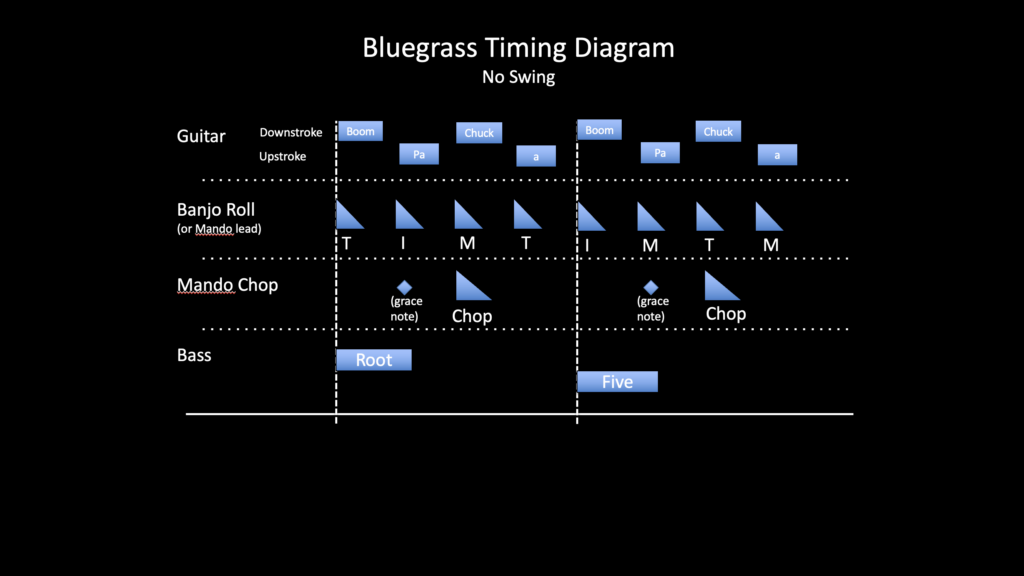
The bass row labels root and five—two low notes commonly used in alternation. You need not identify their pitches by ear. The useful clue is their recurring, weighty position in the pattern. The diagram also shows lighter guitar upstrokes between main beats; they add motion, but the bass-and-chord alternation is the first thing to find.
Separate a guitar chuck from a mandolin chop
The guitar can supply much of the pattern on its own. In “Bluegrass Guitar Lesson: The Boom Chuck Style & Sound,” guitarist Bryan Sutton plays a low picked note followed by a strummed chord. Listen for the change in texture: one pitch on the boom, then several pitches together on the chuck.
Bluegrass Guitar Lesson: The Boom Chuck Style & Sound with Bryan Sutton || ArtistWorks
Watch “Bluegrass Guitar Lesson: The Boom Chuck Style & Sound” from ArtistWorks to hear the low-note-and-chord pattern without a full band masking it.
In the explanation, listen for Sutton’s distinction between the bass-pitch boom and its chord response. Then hear the demonstration with a steady click. Follow the audible low note and strum; the picking-hand technique is not required for this lesson.
In an ensemble, the mandolin often adds a sharper accent in the same answering space. Its chop stops quickly rather than ringing on like a fuller guitar chord. Tim O’Brien demonstrates how that short sound is made in “How-To Chop On The Mandolin.” The comparison with a snare-drum backbeat describes its rhythmic job; it does not mean bluegrass needs a drum kit.
How-To Chop On The Mandolin With Tim O'Brien
Watch “How-To Chop On The Mandolin” from CBC Music to hear why a mandolin chord can act like a crisp rhythmic accent.
In the chop, notice how quickly the sound is stopped and where O’Brien places it between bass notes. In the sound, listen for the woody thud rather than a long-ringing chord.
The guitar chuck and mandolin chop can coincide. Rather than trying to count every strum in a busy recording, first find the repeated low note, chord accent relationship. Then listen for whether the accent contains a fuller guitar brush, a clipped mandolin thud, or both.
Find the drive in a full band
Smithsonian Folkways’ “Feeling the Chop” pairs this idea with recordings. Its instructions use tapping to keep track of the bass and the answering accent; quiet foot taps or simply attending to the alternation work too. Read through the “Roving Gambler” discussion, and use the embedded “Little Birdie” video and “Roving Gambler” audio as your listening examples.
Bluegrass Music: Chopping and Singing Songs of Sorrow
Read Smithsonian Folkways’ “Feeling the Chop” to transfer the separate instrument sounds into full performances.
In “Lesson 1: Feeling the Chop,” begin with the listening guidance and stop after the explanation under “Roving Gambler.” Use the embedded “Little Birdie” video first, then the “Roving Gambler” recording. On one listen, follow the lowest recurring notes; on another, attend to the short accents between them.
When listening to “Little Birdie,” let the quick upper notes and singing remain in the background of your attention for a moment. The bass notes provide a steadier reference. Once you can follow those, the chop becomes easier to place: it is not another bass thump, but a brief chord sound answering it. In “Roving Gambler,” Folkways notes that the mandolin is more prominent, so the answering accent may be easier to hear.
This interlock explains why drive is more than speed. A fast banjo roll can fill the spaces with notes, but its speed alone does not establish the underlying beat. The recurring bass pulse gives the band a foundation, while well-placed chord accents make each return of the low note feel anticipated. The pattern can be quieter or more flexible in a slower performance; you are listening for the relationship, not a required volume or tempo. Nor must the bass always alternate exactly two notes, or the mandolin play every accent. What matters is whether you can hear the low pulse and its offbeat response working together.
Carry one listening cue forward
The most reliable entry point is low note, answering chord, low note, answering chord. In a common four-beat count, the bass anchors one and three, while guitar and mandolin accents emphasize two and four. Guitar chords tend to sound fuller; mandolin chops are shorter and drier. Other instruments can play busier lines over this foundation without replacing it.
You can now listen beneath the most conspicuous sound in a bluegrass performance and locate some of its rhythmic drive. Next lesson, that steadier background will help you hear when a solo singer is joined by two-part or three-part vocal harmony.