Welcome to your first lesson. You've mentioned that you can understand a good deal of French but find it difficult to speak spontaneously. This is a very common and often frustrating stage in language learning, but it's one we can absolutely overcome. This course is designed to help you bridge that exact gap, moving you from comprehension to confident conversation.
In this introductory lesson, we will tackle the core of this challenge head-on. Our goal is to understand how to convert your "passive" vocabulary—the words you recognize—into "active" vocabulary that you can use freely in speech. We'll explore why your brain sometimes "freezes" and introduce powerful, practical techniques to start activating the French you already know.
1. The Gap Between Understanding and Speaking
First, let's diagnose the problem. The experience of understanding everything but being unable to produce sentences is so common because listening and speaking are fundamentally different mental processes. Listening relies on recognition, while speaking demands recall.

To understand this distinction better, let's look at a clear explanation of this "passive-active vocabulary gap."
Passive to Active Vocabulary: Why You Know Words You Can’t Use (And How to Fix It)
This article from the Clozemaster blog provides an excellent breakdown of why you might feel "stuck" when trying to speak. It clearly defines the two types of vocabulary and explains the cognitive difference between recognizing a word and recalling it from scratch.
Please read the first few sections of the article. Start from the beginning and read down to the heading "Not Every Passive Word Needs to Become Active." Pay close attention to the definitions of active and passive vocabulary and the explanation of recognition versus recall. This will give you the "why" behind your current challenge.
As the article points out, your study methods have likely trained recognition much more than recall. This isn't wasted effort—having a large passive vocabulary is a huge asset! The task now is to build the mental pathways for retrieval.
A major obstacle to retrieval is the habit of translating in your head. This creates a "mental traffic jam" that slows you down and prevents fluency. The following video explains this phenomenon well.
How to THINK in French (and WHY you must!)
In this video from the channel Comme une Française, the presenter, Géraldine, explains why mental translation is a trap that keeps you from speaking fluently.
Watch the segment from the beginning of the explanation, where she describes the "mental traffic jam" and how translating reinforces the wrong neural pathways.
2. The Solution: Forced Recall and Chunking
So, if passive listening and mental translation are the problems, what is the solution? The core principle is forced recall. This means engaging in exercises that require you to pull words and phrases from your memory, rather than simply recognizing them.
However, simply trying to speak freely can be inefficient. Under pressure, our brains default to the small set of words that are already active, leaving the vast passive vocabulary untouched. The key is to use structured practice that provides support, or "scaffolding."
A second crucial strategy is to stop thinking in terms of individual words and start thinking in chunks: small, reusable phrases that form the building blocks of conversation. Instead of trying to remember the word rendez-vous (appointment), you practice the entire chunk: J'aimerais prendre un rendez-vous (I would like to make an appointment).
How to Turn Passive Vocabulary into Active Speaking: Powerful Guide 2026
This article offers practical, immediate tactics for activating vocabulary. The section on "chunking" is particularly valuable.
Please read the short section titled "Activation Shortcuts". Focus on the first point, "Turn Nouns into Phrases with a Frame," which perfectly illustrates the power of learning in chunks.
By practicing the retrieval of these chunks, you are building the exact mental pathways needed for spontaneous conversation.
3. Your Activation Toolkit: Practical Exercises
Now, let's move from theory to practice. Here are three powerful techniques you can use to start activating your French vocabulary immediately.
Technique 1: The Storytelling Loop
This is a highly effective method for building fluency on topics that are personal to you. It involves telling a simple story about yourself, identifying the gaps in your knowledge, filling them, and repeating the process. It's a complete feedback loop for activating the specific vocabulary you need for your life.
This One Exercise Made Me Fluent In French (In 30 Days!)
The YouTube channel Language Lords presents a powerful, step-by-step exercise designed for exactly this purpose. While the "30 Days" in the title is ambitious, the method itself is excellent.
Watch from the beginning of the exercise explanation. Pay close attention to these steps: Record: Telling a personal story for five minutes, saying words you don't know in your native language. Review & Identify: Watching the recording to find the words and sentence structures you struggled with. Learn: Looking up the missing pieces. Repeat: Recording the same story again, incorporating the new vocabulary.
Your First Practice Task:
Try this method once.
- Choose a simple, personal story you know well. You could use one of the topics from the prompt cards below as inspiration (e.g., a story about la famille, les vacances, or le collège).
- Record yourself for just 3-5 minutes. Don't worry about perfection. When you get stuck, say the word in English and move on.
- Listen back and write down 3-5 French words or phrases you needed but couldn't recall.
- Look them up.
- Try telling the beginning of the story again, this time using your new words.
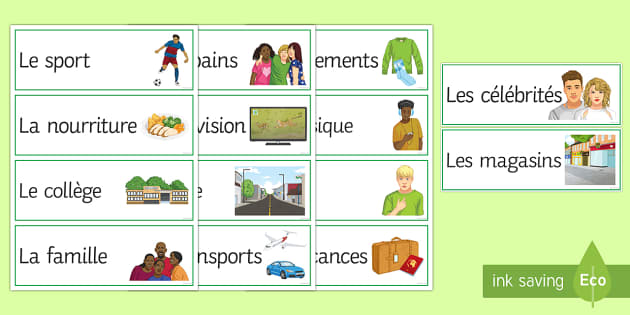
Technique 2: Create a French Micro-Environment
You don't need to move to France to start thinking in French. You can begin creating small moments of immersion in your daily life. The goal is to connect French words directly to concepts, objects, and actions, bypassing English entirely.
How to THINK in French (and WHY you must!)
Let's return to the Comme une Française video for some concrete ideas on how to do this.
Watch the section from where Géraldine lists practical ways to integrate French into your daily life.
Your Second Practice Task:
Choose two of these small habits to try this week:
- Narrate your actions: As you make coffee, say to yourself, « Je prépare le café. Je verse de l'eau. »
- Make your shopping list in French: Don't forget the articles! (du pain, de la salade, un oignon).
- Label 5 items in your room: Use sticky notes to label la table, la chaise, la fenêtre, le lit, la lampe. Say the word out loud each time you see it.
This practice forces you to retrieve simple, high-frequency words in a natural context.
Technique 3: High-Impact Drills
For moments when you only have 5-10 minutes, targeted drills can be very effective. These exercises force you to use specific structures or vocabulary in a controlled way.
How to Turn Passive Vocabulary into Active Speaking: Powerful Guide 2026
The Abblino article we looked at earlier has a fantastic list of "micro-drills" for this purpose.
Read through the section titled "High-Impact Activation Drills". For now, focus on understanding the "Connector Loop" and "Paraphrase Triangle" exercises.
These drills are excellent for building the flexibility and flow needed for real conversation. We will explore them more in future lessons, but feel free to try one if you're feeling ambitious.
Conclusion
In this lesson, we've laid the groundwork for breaking through the speaking barrier. You now have a clear understanding of why speaking can feel so much harder than listening and, more importantly, a set of powerful, practical tools to begin activating the wealth of French you already possess.
Key Takeaways:
- The gap between passive understanding (recognition) and active speaking (recall) is normal and caused by how our brains learn.
- The key to closing this gap is forced recall practice—structured exercises that make you retrieve words and phrases from memory.
- Focus on learning and practicing in chunks (phrases), not isolated words.
- You can start activating your vocabulary today using the Storytelling Loop, by creating a French micro-environment, and through high-impact drills.
In our next lesson, we will build directly on this foundation. Now that you have the strategies to activate vocabulary, we will focus on how to produce simple sentences using this vocabulary without mental translation, increasing your speed and automaticity.