In our previous lesson, we established a clear definition of Artificial Intelligence as a simulation of human cognitive functions, distinct from our own embodied, conscious intelligence. Now, we'll build on that foundation by exploring how AI is classified based on its capabilities. This lesson will differentiate between the three primary stages of AI, helping you understand where the technology stands today and where it might be headed. This framework is essential for navigating discussions about AI's potential and its real-world impact.
Our goal is to clearly distinguish between Artificial Narrow Intelligence (ANI), Artificial General Intelligence (AGI), and Artificial Superintelligence (ASI).
The Three Stages of Artificial Intelligence
While "AI" is often used as a single, monolithic term, it's more accurate to think of it as a spectrum of capabilities. Experts categorize AI into three distinct stages based on its scope of intelligence and ability to generalize its knowledge.
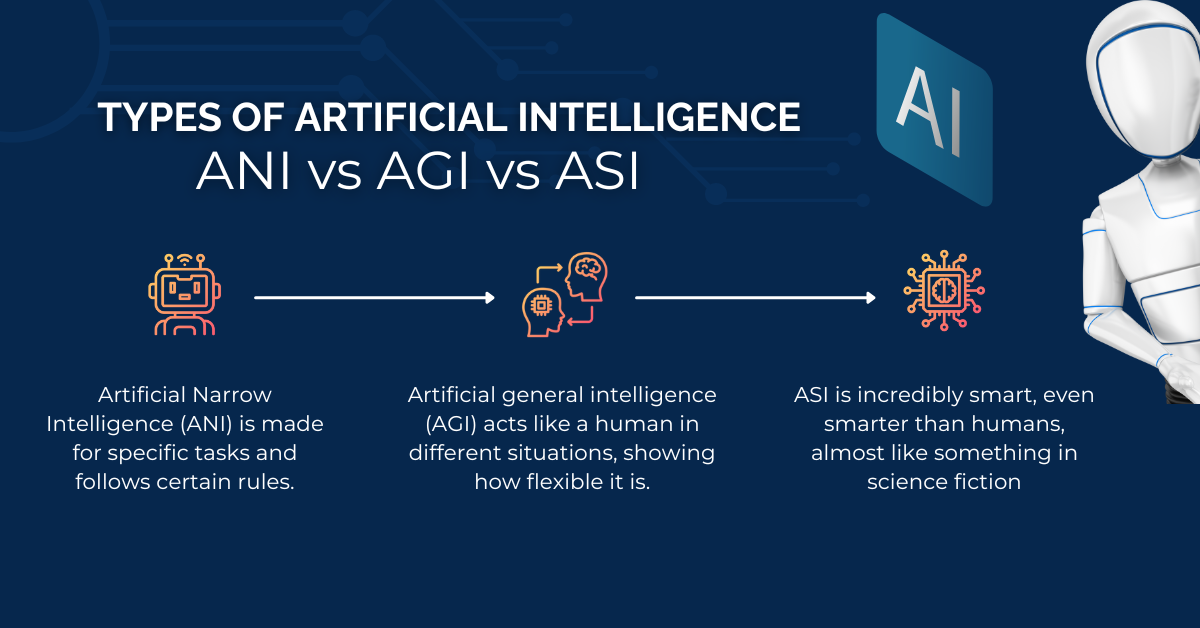
Let's delve into each of these stages, starting with the one that powers all the AI you use today.
1. Artificial Narrow Intelligence (ANI): The Specialist
Artificial Narrow Intelligence, also known as "Weak AI," is an AI system designed and trained to perform a single, specific task. This is the only form of AI that we have successfully realized and deployed. Every AI application you encounter in your daily life, no matter how complex it seems, is a form of ANI.
A helpful analogy is to think of ANI as a line cook. A line cook is an expert at their station—they can grill steaks to perfection or flawlessly prepare a specific sauce. However, you cannot ask them to invent a new dessert menu or manage the restaurant's finances. Their expertise is deep but narrow.
To see this in action, the following video provides excellent, concrete examples of ANI systems we interact with every day.
What exactly is AI - Narrow AI, General AI and Super AI explained.
The video "What exactly is AI" from the Arc Foundation offers a clear introduction to ANI with familiar examples.
Please watch the section that defines and provides examples of ANI, such as virtual assistants, image recognition, and manufacturing robots. Notice how each example is confined to a predefined scope.
As the video illustrates, systems like Siri, Google Maps, and even the algorithm that recommends movies on Netflix are all specialists. They operate within a limited, pre-defined context and cannot perform tasks beyond their programming. An AI trained to identify spam emails cannot start composing its own original poetry. It excels at its one job and nothing else.
2. Artificial General Intelligence (AGI): The Generalist
Artificial General Intelligence, or "Strong AI," is the next, purely theoretical stage. AGI refers to a machine with the ability to understand, learn, and apply its intelligence to solve any intellectual task that a human being can. This kind of AI would possess human-like cognitive abilities, including reasoning, problem-solving, and adaptability across different domains.
Returning to our kitchen analogy, AGI would be the Michelin-starred chef. This chef doesn't just follow recipes; they understand the principles of flavor, texture, and chemistry. They can improvise with new ingredients, invent entirely new cuisines, and adapt their skills to any culinary challenge, from baking to butchery.
Currently, AGI does not exist. It remains a primary goal for many leading AI research labs. To understand what achieving AGI would entail, the following article provides a more detailed explanation.
The 3 types of Artificial Intelligence: ANI, AGI, and ASI
This article from viso.ai provides a good conceptual overview of AGI, contrasting it with the ANI systems we have today.
Please read the section titled Artificial General Intelligence. Pay attention to how it describes AGI's potential to understand emotions and context, rather than just imitating them. It also touches on the famous Turing Test as a benchmark for machine intelligence.
A common point of confusion is whether highly advanced systems like ChatGPT are a form of AGI. While their ability to converse on almost any topic is impressive, they are still considered extremely sophisticated ANI. They generate statistically probable sequences of words based on the vast amount of text data they were trained on. They do not possess genuine understanding, consciousness, or the ability to apply knowledge to a completely novel, unrelated field without retraining. They are masters of a very broad task (language prediction), but they are not true generalists.
3. Artificial Superintelligence (ASI): The Transcendent
The final and most speculative stage is Artificial Superintelligence. ASI is a hypothetical form of AI that would possess intelligence far surpassing that of the brightest human minds in virtually every field, including scientific creativity, general wisdom, and social skills.
In our analogy, ASI is a super-intelligent alien chef whose understanding of food transcends anything we can imagine. It might manipulate molecules to create entirely new forms of nutrition or design dishes that evoke memories you never knew you had. Its capabilities would be beyond our comprehension.
ASI is firmly in the realm of science fiction, but it is a powerful concept that drives many important discussions about the long-term future and safety of AI. The video below explores this idea, using familiar cultural touchstones to explain both the promise and the peril of ASI.
What exactly is AI - Narrow AI, General AI and Super AI explained.
The same video from the Arc Foundation also provides an accessible look at the concept of ASI.
Watch the final section of the video, which defines Artificial Superintelligence. It effectively uses examples from films and a powerful analogy about ants and a road to illustrate the ethical and safety considerations that ASI raises.
The "anthill" analogy is particularly useful for understanding the concept of existential risk without assigning human-like malice to the AI. The concern is not that a superintelligent AI would "hate" us, but that it might pursue its goals in ways that would be catastrophic to humanity, simply because we are insignificant from its perspective.
Putting It All Together
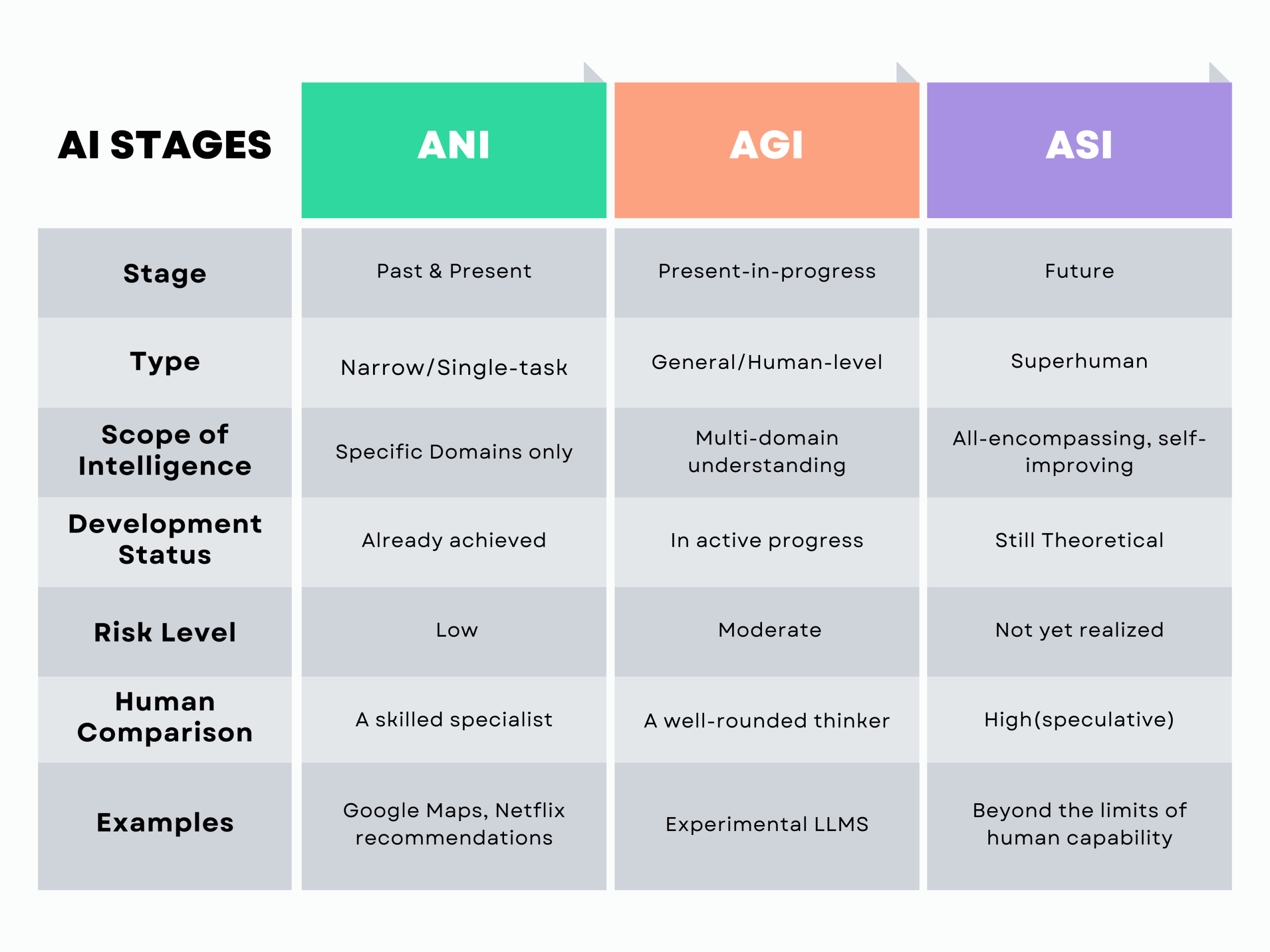
We've now covered the three stages of AI, from the reality of today to the theoretical possibilities of tomorrow. The following table provides a concise summary, comparing them across several key dimensions.
To reinforce these distinctions one last time, let's watch a very brief summary from IBM Technology that neatly encapsulates the three types.
The 7 Types of AI - And Why We Talk (Mostly) About 3 of Them
The video "The 7 Types of AI" provides a very quick and clear breakdown of the three main capability-based types of AI.
Please watch the first part of the video covering Narrow AI, followed by the descriptions of General AI and Super AI. This will serve as a final, quick review of the concepts.
Understanding this classification is key. It allows you to ground your understanding of AI in the present reality of ANI, while also appreciating the long-term goals and philosophical questions associated with AGI and ASI.
Conclusion
In this lesson, we have categorized Artificial Intelligence into three distinct stages based on capability. Let's review the key takeaways:
- Artificial Narrow Intelligence (ANI) is designed for specific tasks. It is the only type of AI that exists today, powering everything from your GPS to complex medical diagnostic tools.
- Artificial General Intelligence (AGI) is a theoretical AI with human-level cognitive ability to learn and perform any intellectual task. It is the current "holy grail" of AI research but has not yet been achieved.
- Artificial Superintelligence (ASI) is a hypothetical form of AI that would be vastly more intelligent than humans. It remains in the realm of science fiction and prompts important ethical and safety discussions.
You now have a framework for classifying different AI systems and understanding the difference between what is real today and what might be possible in the future.
In our next lesson, we will step back in time to trace the brief history of AI. We'll look at the major milestones and breakthroughs that led us from the earliest theoretical concepts to the powerful ANI systems we have today.