Hello! Welcome to your second lesson.
In our first session, we mapped out the main e-commerce channels in the Netherlands: the local leader Bol.com, the global giant Amazon.nl, and the independent route of a dedicated webshop.
Today, we move from description to analysis. The goal of this lesson is to analyze the pros and cons of selling on a marketplace versus launching your own webshop. This is one of the most critical strategic decisions you'll make, as it dictates your initial investment, speed to market, and long-term brand potential. For a new business aiming for high margins, understanding these trade-offs is fundamental.
Given your background in software engineering, you can think of this choice as analogous to deciding between deploying an application on a managed Platform-as-a-Service (PaaS) like Heroku, or building it on your own infrastructure (IaaS/on-prem). Each has distinct trade-offs regarding control, scalability, initial effort, and cost structure.
Defining the Core Models
Before we can analyze, let's ensure we have a crystal-clear understanding of the two models. A marketplace is a shared platform where many businesses sell, while an e-commerce platform is the software used to build a single business's own online store.
Ecommerce Platform vs. Online Marketplace: Which Is Better?
This short video from WebFX does an excellent job of defining the two concepts we'll be comparing throughout this lesson. It clearly distinguishes an e-commerce platform (like Shopify, used for your own webshop) from an online marketplace (like Amazon or Bol.com).
Please watch the segment from 00:28 to 01:53 to solidify these definitions.
With these definitions in mind, let's break down the analysis into the key factors you must consider as a new entrepreneur.
The Trade-Offs: A Detailed Analysis
We will now examine the pros and cons of each model through the lens of a new business. A helpful resource that frames this debate specifically for the Dutch market is the article "Marketplace Netherlands vs Online store in the Netherlands". We'll refer to it as we go.
Factor 1: Traffic and Customer Acquisition
This is arguably the most significant factor for a new business. Where do your customers come from?
- Marketplace Advantage: Built-in Audience
Marketplaces like Bol.com and Amazon spend billions on marketing to attract millions of shoppers. By listing your product there, you gain immediate access to this massive stream of traffic. It's like setting up a stall in a bustling city market; the customers are already there.
How to Sell on Bol.com? (Full Guide 2024)
To reinforce this point, let's revisit a clip about Bol.com. It perfectly illustrates the advantage of tapping into an existing, trusted ecosystem.
Please watch from 00:22 to 01:45. Focus on the 'crowded shopping mall' analogy and the idea of getting sales from day one because the customers are already there.
- Webshop Disadvantage: Building from Scratch
With your own webshop, you start with zero visitors. You are entirely responsible for generating traffic through marketing efforts like search engine optimization (SEO), paid advertising (Google/Facebook ads), and social media content. This requires significant, ongoing investment of both time and money.
The following reading summarizes these points clearly.
Marketplace Netherlands vs Online store in the Netherlands
The article from RYS Agency provides a structured breakdown of the advantages and disadvantages for both models. Let's start by focusing on the pros of a marketplace and the cons of a dedicated webshop.
Please read the following two sections: the 'Advantages of selling on a marketplace in the Netherlands' and the 'Disadvantages of an online store in the Netherlands'. Pay close attention to the points about the 'Huge customer base' for marketplaces and the 'Need to build traffic and visibility' for an online store.
Factor 2: Control and Branding
How much control do you have over your business, brand, and customer relationships?
-
Webshop Advantage: Total Control
Your own webshop gives you complete freedom. You control the website design, the user experience, the sales process, and, most importantly, you own the customer data. This allows you to build a unique brand identity and foster direct, long-term relationships with your customers (e.g., through email marketing). -
Marketplace Disadvantage: Limited Control
On a marketplace, you operate within a rigid framework. You must adhere to the platform's rules on everything from product page layout to return policies. You have little branding opportunity and typically no direct access to customer data, making it difficult to build a relationship outside the platform.
Ecommerce Platform vs. Online Marketplace: Which Is Better?
The WebFX video you watched earlier also covers these points on control and branding very well.
Please watch two short segments: first, the benefits of platforms regarding control (01:53 - 02:41), and second, the drawbacks of marketplaces in the same area (03:59 - 04:29).
Factor 3: Costs and Profit Margins
Your goal is to run a business with high profit margins. The sales channel has a direct impact on this.
-
Webshop Advantage: Higher Gross Margins
When you sell on your own site, you don't pay a commission on each sale. This means your gross margin per item is higher. However, this is offset by the marketing costs needed to attract the customer in the first place. -
Marketplace Disadvantage: Commission Fees
Marketplaces charge a commission (a "referral fee") on every sale, which can range from 5% to over 20% depending on the platform and product category. This fee is their charge for giving you access to their customers. On top of this, there can be monthly subscription fees and costs for using their fulfillment services (like Amazon FBA or Logistiek via Bol).
The following FAQ provides concrete numbers for the Dutch market.
The largest e-commerce companies in the Netherlands
This article from BlossomYourContent has an excellent FAQ section that directly compares the financial aspects. It provides real-world figures for commissions and startup costs.
Please read the two questions in the FAQ section: 'What are the advantages of selling via large platforms versus an own webshop?' and 'How high are commissions at major e-commerce platforms?'. Focus on the specific commission percentages and the estimated marketing budget for a startup webshop.
Factor 4: Competition
How do you stand out from other sellers?
- Marketplace Disadvantage: Intense Direct Competition
On a marketplace, your product is often listed directly beside your competitors' products, making it easy for customers to compare prices. This often leads to intense price pressure and can turn products into commodities, squeezing your margins. The number of sellers can be enormous.

- Webshop Advantage: Controlled Environment
On your own website, you control the "digital shelf." Once a customer lands on your site, you are not directly competing for their attention with other sellers on the same page. Your challenge is getting them to your site, but once they are there, the environment is yours to control.
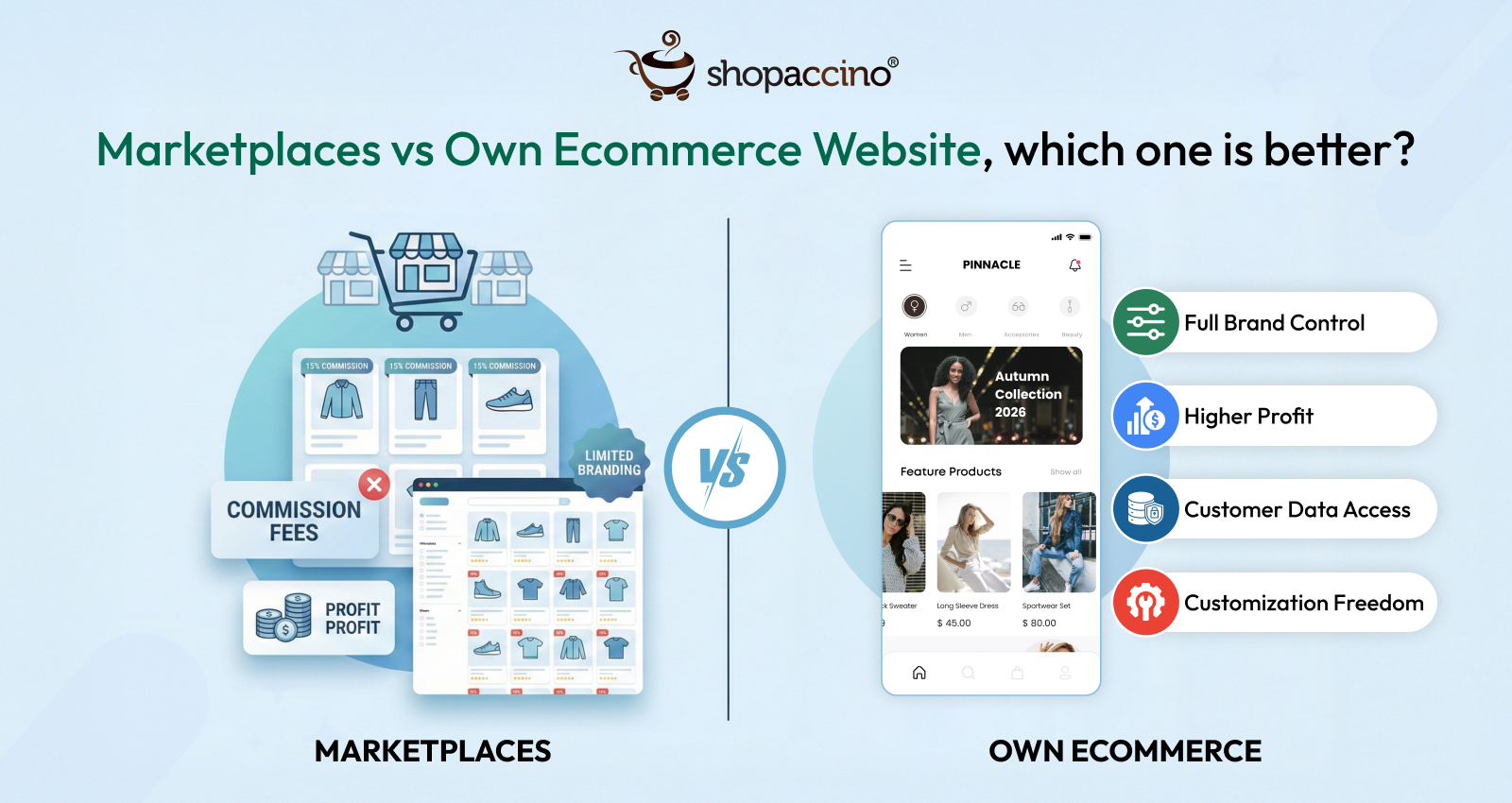
Visual Summary
This image provides a simple but effective visual summary of the core trade-offs we've just discussed.
Synthesis: Which Model is Right for a New Business?
Let's consolidate our analysis into a clear table.
| Factor | Marketplace (e.g., Bol.com) | Dedicated Webshop (e.g., Shopify) |
|---|---|---|
| Initial Effort & Speed | Low & Fast. Ready-made infrastructure. | High & Slow. Requires building the site, traffic, and trust. |
| Customer Acquisition | Easy. Access to millions of existing shoppers. | Difficult. Responsible for all marketing and traffic generation. |
| Brand Control | Low. Must conform to platform rules and design. | High. Full control over brand experience and customer journey. |
| Customer Relationships | Indirect. Platform owns the customer data. | Direct. You own customer data and can build relationships. |
| Profit Margins | Lower per sale due to commissions (5-25%). | Higher per sale (no commission), but offset by marketing costs. |
| Competition | High & Direct. Price competition is intense. | Indirect. Compete with the internet for attention, not on the same page. |
For a new entrepreneur with no existing brand or customer base, the evidence points strongly towards one initial strategy: start on a marketplace.
The consensus among experts, as noted in the resources, is to use a marketplace to:
- Minimize initial risk and investment.
- Test your product ideas on a live audience.
- Generate cash flow without a massive upfront marketing budget.
- Gain market knowledge about what sells and at what price.
Marketplace Netherlands vs Online store in the Netherlands
The author of the RYS Agency article comes to a similar conclusion, recommending a hybrid approach that starts with a marketplace.
Please read the section 'Marketplace Netherlands vs Online store - which to choose?'. Notice the recommendation to start with a marketplace to 'gain time and minimize risk'.
Think of this as launching a Minimum Viable Product (MVP). You use the existing marketplace platform to validate your core business proposition—that you can source a product people want and sell it profitably—before investing the significant resources required to build your own custom, branded infrastructure (a dedicated webshop).
Conclusion
In this lesson, we moved beyond simply identifying the sales channels to analyzing their strategic implications for your new business.
Key Takeaways:
- Marketplaces offer immediate reach and a fast start in exchange for commissions, less control, and intense competition.
- A dedicated webshop offers full control, higher margins, and direct customer relationships but requires substantial investment in traffic generation and building trust from scratch.
- The core trade-off is Reach vs. Control.
- For a new seller, starting on a marketplace is a low-risk strategy to validate products and learn the market before considering expansion to a dedicated webshop.
Preview of the Next Lesson:
We've now established where you can sell and analyzed the strategic models. In the next lesson, we will turn our attention to who you will be selling to. We will identify key Dutch consumer behaviors, such as their preferred payment methods and delivery expectations. This is crucial knowledge for tailoring your service to meet local customer expectations and earning their trust.