Hello! Welcome back to our course on the basics of psychology.
In our first lesson, we established that psychology is the scientific study of mind and behavior. You learned that "mind" refers to internal processes like thoughts and feelings, while "behavior" refers to observable actions.
Today, we'll build directly on that foundation. We'll explore how psychologists approach the study of mind and behavior by examining three core theoretical perspectives. The learning outcome for this lesson is to describe the core psychological perspectives (biological, cognitive, and behavioral) for understanding behavior.
Think of these perspectives as different lenses. If you're looking at a complex phenomenon—like social anxiety, for example—each lens will highlight different aspects and suggest different causes. One might focus on your thought patterns, another on your past experiences, and a third on your brain chemistry. Understanding these viewpoints is the first step toward analyzing the psychological topics you're most interested in, such as emotional regulation and addiction.
What is a Psychological Perspective?
A psychological perspective is a theoretical framework—a particular way of looking at and explaining human behavior. Each perspective operates on a set of shared assumptions about how people function, what aspects of them are most important to study, and which methods are best for that study.
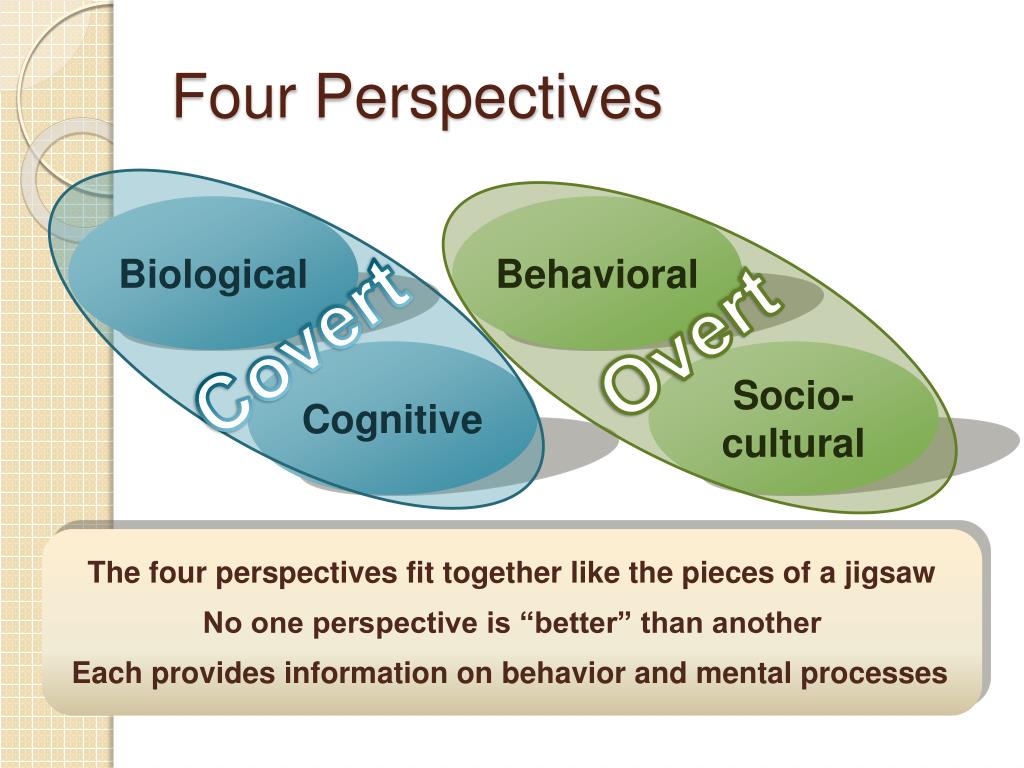
No single perspective holds all the answers. Instead, they are complementary pieces of a larger puzzle.
To start, let's get a brief overview of the three perspectives we'll be focusing on.
Psychology's 7 Modern Perspectives
The video 'Psychology's 7 Modern Perspectives' from the Psych Explained channel provides a clear, concise introduction to several major viewpoints. We will use it to get a quick summary of our three core perspectives, using the fear of public speaking as a running example.
Please watch the following three short segments: The Behavioral Perspective: from 01:41 to 02:29. The Cognitive Perspective: from 02:29 to 03:07. The Biological Perspective: from 04:35 to 05:13. Pay close attention to how each perspective offers a completely different explanation for the same fear.
Now that you have a general sense of each approach, let's dive into them one by one to understand their core assumptions and how they apply to your interests.
1. The Behavioral Perspective: The Impact of Experience
The behavioral perspective, or behaviorism, argues that our actions are almost entirely shaped by our environment. It focuses on observable behavior and suggests that all behavior is learned through a process of conditioning. Behaviorists are not concerned with the internal mental states the video called "irrational thoughts"; they focus only on the measurable relationship between environmental stimuli and the behavioral responses they cause.
There are two main ways this learning occurs:
- Classical Conditioning: Learning by association (e.g., a specific place becomes associated with a feeling of anxiety).
- Operant Conditioning: Learning from the consequences of our actions (e.g., a behavior is repeated because it leads to a rewarding outcome).
To see these ideas in writing, please review the following text.
Perspectives In Psychology (Theoretical Approaches)
The article 'Perspectives In Psychology' from Simply Psychology offers a clear summary of the behaviorist perspective.
Please read the section titled 'Behaviorist Perspective.' Focus on understanding the main idea: behavior is learned from the environment through conditioning.
How this applies to your goals:
From a behavioral viewpoint, an addictive behavior persists because it's been powerfully reinforced (e.g., with feelings of pleasure or relief). Social anxiety might be explained as a learned response where social situations have been associated with negative experiences (like embarrassment), leading to avoidance. We will explore conditioning in much more detail in Module 3.
2. The Cognitive Perspective: The Power of Thought
The cognitive perspective shifts the focus from the external environment to the internal mind. It argues that our behavior is guided by our mental processes: our thoughts, interpretations, memories, and beliefs. It arose in part as a reaction against behaviorism, contending that we are not passive responders to the environment but active information processors.
Given your background in technology, you might find the central analogy of this perspective helpful: the human mind is often compared to a computer.
- Input: We receive information from the world.
- Process: We interpret, store, and manipulate that information using mental "software" (our thoughts, memories, schemas).
- Output: We behave based on that processing.
Perspectives In Psychology (Theoretical Approaches)
Let's return to the 'Perspectives In Psychology' article to read about the cognitive approach.
Please read the section titled 'Cognitive Perspective.' Pay attention to the information-processing model and the focus on mental functions.
How this applies to your goals:
From a cognitive perspective, social anxiety isn't caused by the social situation itself, but by the negative thoughts and interpretations about it (e.g., "I'm going to say something stupid," or "Everyone is judging me"). Emotional regulation involves changing these thought patterns to change the resulting feeling. We will delve into these "thinking traps" in Module 4.
3. The Biological Perspective: The Body's Influence
The biological perspective asserts that "everything psychological is simultaneously biological." It explains our thoughts, feelings, and behaviors by examining their physical basis in the brain, nervous system, genetics, and hormones. This view brings us back to the physical machinery that runs the mental software.
This perspective is foundational for understanding the "why" behind our internal states, which aligns with your stated learning preference. To get a deeper understanding, we'll explore a more detailed resource on this topic.
Biological Approach In Psychology
The article 'Biological Approach In Psychology' from Simply Psychology provides a fantastic breakdown of the core ideas of this perspective. It will give you the strong theoretical foundation you're looking for.
Please read two sections: Start with 'Assumptions' to understand the core principles, focusing on the roles of the brain, neurochemistry (like dopamine and serotonin), and genetics. Then, read 'Everyday Examples: Biology in Action' to see how these biological processes manifest in experiences like the 'fight-or-flight' response and feeling 'hangry'.
How this applies to your goals:
The biological perspective offers powerful explanations for your areas of interest. The mechanics of addiction are deeply rooted in the brain's reward system, which is driven by the neurotransmitter dopamine. Emotional regulation can be seen as managing the body's physiological stress response (like a racing heart). Your emotional reactions are tied to activity in specific brain structures and the release of hormones like adrenaline.
Test your understanding!
Imagine a person feels a sudden surge of anxiety and decides to leave a party. How might each of the three perspectives explain this?
- Behavioral:
- Cognitive:
- Biological:
Show answer
- Behavioral: The person may have had a negative experience at a party in the past (e.g., was embarrassed). Now, the party environment (stimulus) is associated with anxiety, and leaving is a learned behavior that brings relief (a form of reinforcement).
- Cognitive: The person might be having catastrophic thoughts like, "I don't fit in," or "Everyone thinks I'm awkward." The anxiety is a result of these interpretations, not the party itself. Leaving is a direct result of the decision that the situation is threatening.
- Biological: The person's brain may have triggered a fight-or-flight response. A surge of adrenaline and activity in the amygdala (the brain's fear center) created the feeling of intense anxiety, and the impulse to flee is a primal, physiological drive to escape perceived danger.
Conclusion
In this lesson, we've unpacked the three core perspectives that psychologists use to understand mind and behavior. Each provides a unique and valuable lens for analysis.
Key Takeaways:
- The Behavioral Perspective emphasizes that behavior is learned through interactions with the environment (e.g., rewards, punishments, and associations).
- The Cognitive Perspective focuses on how our internal mental processes—like thoughts, beliefs, and interpretations—shape our behavior.
- The Biological Perspective explains behavior and mental states by examining their physical roots in our genes, brain structures, hormones, and neurotransmitters.
- These perspectives are complementary, not contradictory. A complete understanding of any psychological issue often requires integrating insights from all three.
You now have a foundational map for how psychologists think. As we move forward, you will see these perspectives appear again and again.
In our next lesson, we will begin Module 2, "The Brain and Behavior." We'll take a much deeper dive into the biological perspective, starting with the fundamental building blocks of the nervous system: neurons. This will lay the groundwork for understanding exactly how the brain processes information and generates our thoughts and feelings.