Hello! Welcome to the final lesson in our first module, "Foundations of Psychology."
In our last session, we distinguished between the three major research methods: descriptive, correlational, and experimental. You learned that while correlational research is excellent for identifying relationships between variables, it has a critical limitation. Today, we will explore that limitation in depth.
This lesson is dedicated to one of the most important principles in scientific thinking: the distinction between correlation and causation. Our learning outcome is to explain the importance of this distinction when you encounter psychological claims in your daily life. Grasping this concept is essential for building the solid, evidence-based understanding of psychology you're aiming for, allowing you to critically evaluate claims about topics like addiction, anxiety, and emotional regulation.
Let's begin by visualizing the relationship between these two concepts.
Correlation and Causation: What's the Relationship?
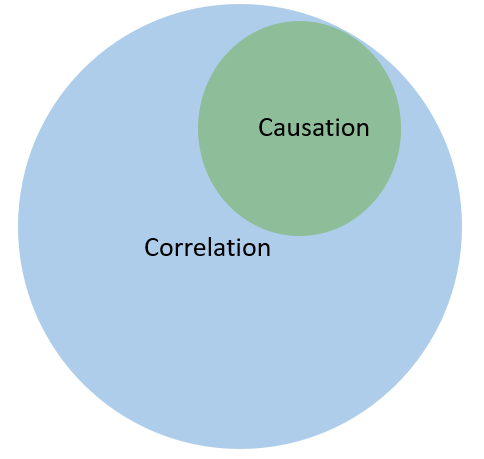
When we say two things are correlated, we simply mean they are related—as one changes, the other tends to change in a predictable way. When we say one thing causes another, we're making a much stronger claim: that a change in the first thing is directly responsible for a change in the second.
The diagram above shows it perfectly: if there is a causal link, there will be a correlation. But just because you find a correlation, it doesn't mean you've found a cause. Confusing the two is one of the most common errors in interpreting psychological information.
So, if two things are correlated, but one doesn't cause the other, what else could be going on? There are three main possibilities.
Why Correlation Does Not Imply Causation
A fantastic short video from the Psych Explained channel breaks down the key reasons why we cannot assume causation from a correlation. It will introduce us to the core concepts for this lesson.
Correlation vs Causation I Explained
This video, 'Correlation vs Causation I Explained', clearly outlines the main reasons why correlation does not equal causation. It uses simple, memorable examples to illustrate each point.
Please watch the video from the beginning until 06:00. As you watch, focus on understanding the three main pitfalls the video describes: the timing fallacy, the directionality problem, and the third variable problem.
Let's break down and expand on the two most critical problems for psychological research mentioned in the video.
1. The Third Variable Problem
This is perhaps the most common reason for a misleading correlation. It occurs when an unobserved "third" or "confounding" variable is influencing both of the variables we are measuring, creating the illusion of a direct relationship.
The video uses the classic example:
- Variable A: Ice cream sales
- Variable B: Shark attacks
- Correlation: Positive (as one goes up, so does the other)
It's absurd to think eating ice cream causes shark attacks. The third variable is clearly hot weather (summer). Hot weather makes people buy more ice cream, and it also makes more people go swimming, which increases the chance of shark encounters.
This problem is everywhere in psychology. For example, a study might find a correlation between a child having a family dinner every night and getting good grades. Does the dinner itself cause good grades? Or is it more likely that a third variable—such as a stable home environment or parents who are highly involved in their child's education—causes both the family dinners and the good grades?
2. The Directionality Problem
Sometimes, two variables are indeed causally related, but the correlation alone doesn't tell us which one is the cause and which is the effect.
The video gives a great example:
- Variable A: Stress
- Variable B: Poor sleep
- Correlation: Positive (more of one is associated with more of the other)
What's the causal story?
- Possibility 1 (A → B): High levels of stress cause you to have difficulty sleeping.
- Possibility 2 (B → A): A night of poor sleep causes you to feel more stressed the next day.
In this case, both are probably true! The relationship can be bidirectional, or a feedback loop. The key point is that simply observing the correlation isn't enough to know the direction of the cause.
To solidify these concepts, the following reading provides concise definitions.
Correlation vs. Causation | Difference, Designs & Examples
The article 'Correlation vs. Causation' from Scribbr offers clear and formal definitions of these key problems.
Please read the section titled 'Why doesn’t correlation mean causation?'. Focus on the definitions provided for the 'third variable problem' and the 'directionality problem'.
The Real-World Consequences of This Mistake
Mistaking correlation for causation isn't just an academic error; it can lead to bad decisions and misguided policies. The following TEDx talk gives some powerful examples of how this has happened.
The danger of mixing up causality and correlation: Ionica Smeets at TEDxDelft
In 'The danger of mixing up causality and correlation', mathematician Ionica Smeets shows how this logical flaw appears in news stories and even influences public policy.
Please watch two segments from the talk: From 01:25 to 02:37, about the correlation between marriage and life expectancy. From 03:53 to 05:15, about the correlation between self-esteem and school performance. For each example, try to identify whether it's a directionality problem or a third variable problem.
The self-esteem example is particularly relevant to psychology. For years, the belief that high self-esteem causes good performance led to educational and parenting strategies focused on boosting confidence at all costs. Later research showed the direction was largely the other way around: achieving things and developing skills is what builds genuine self-esteem.
Test your understanding!
You read a news headline: "Study Finds People Who Drink Green Tea Live Longer." The article reports a strong positive correlation between daily green tea consumption and lifespan. Based on what you've learned, why would it be a mistake to conclude that drinking green tea causes you to live longer?
Propose at least one explanation based on the third variable problem and one based on the directionality problem (even if it seems less likely).
Show answer
It would be a mistake because the study only shows a correlation, not causation.
-
Third Variable Problem Explanation: There could be an underlying factor that causes people to both drink green tea and live longer. For example, people who drink green tea might also be more likely to engage in other healthy behaviors like exercising regularly, eating a balanced diet, not smoking, and having regular medical check-ups. These other health-conscious behaviors, not the tea itself, could be the actual cause of their longer lifespan.
-
Directionality Problem Explanation: While it seems unlikely, we could question the direction. Could it be that people who are inherently healthier and have a predisposition to a long life also happen to prefer the taste of or have a habit of drinking green tea? This is less plausible than the third variable problem, but it illustrates the principle that correlation doesn't specify the causal direction.
Conclusion
This lesson marks the end of our first module on the foundations of psychology. You now understand what psychology is, the perspectives psychologists use, the methods they employ, and the critical importance of distinguishing correlation from causation.
Key Takeaways:
- Correlation is not causation. This is a fundamental rule for interpreting research.
- A correlation between two variables can often be explained by a third variable that influences both.
- Even if a causal link exists, correlation doesn't tell you the direction of the relationship (directionality problem).
- Sometimes, a perceived relationship is just coincidence, or what's called an illusory correlation, which can be strengthened by our tendency to look for patterns that confirm our beliefs (confirmation bias).
- The only way to determine cause and effect in psychology is through a well-designed experiment with random assignment and control over variables, as we discussed in the previous lesson.
Equipped with this knowledge, you can be a much more sophisticated consumer of psychological information, which will serve you well as we move into more specific topics related to your goals.
Preview of the Next Lesson:
We are now ready to begin Module 2, "The Brain and Behavior." You expressed an interest in understanding the biological "why" behind our actions and feelings. We will start this journey at the most fundamental level: the neuron. In the next lesson, you will learn to identify the main structures of a neuron and describe their functions. This is the first step toward understanding the brain's complex communication network, which is the biological basis for everything from a simple reflex to complex emotions like anxiety.