Hello. Last lesson was about matching a safety precaution to a particular hazard. This lesson shifts from safe handling to reliable measurement. You will convert between commonly used units of length, mass and volume, so that a result written in one unit can be used or compared with a result written in another. Allow about 40 minutes, including the short videos and reading.
A new unit does not change the amount
A ruler might show the length of an object as cm. Someone else could record that same length as mm. Neither measurement describes a longer object: the number changes because the size of the unit changes.
The same idea applies to mass and volume. In school science, mass is commonly recorded in kilograms, grams or milligrams; liquid volume is often recorded in litres or millilitres. The video below introduces these three kinds of measurement and the metric prefixes that connect their units.
Learn Metric Units & Unit Conversions (Meters, Liters, Grams, & more) - [5-8-1]
Watch “Learn Metric Units & Unit Conversions” from Math and Science for a visual introduction to metres, grams, litres and metric prefixes.
Watch the units to distinguish length, mass and volume. Then watch the prefixes, focusing on what kilo, centi and milli tell you about the size of a unit. The video uses grams as its reference for mass conversions; the kilogram is the standard SI unit of mass.
The most useful relationships for this course are collected here. Each equality describes the same measurement in two units.
| Length | Mass | Volume |
|---|---|---|
In unit symbols, capital letters matter: means litre, while means metre. The prefix milli is also represented by a lowercase before another unit symbol, as in or .
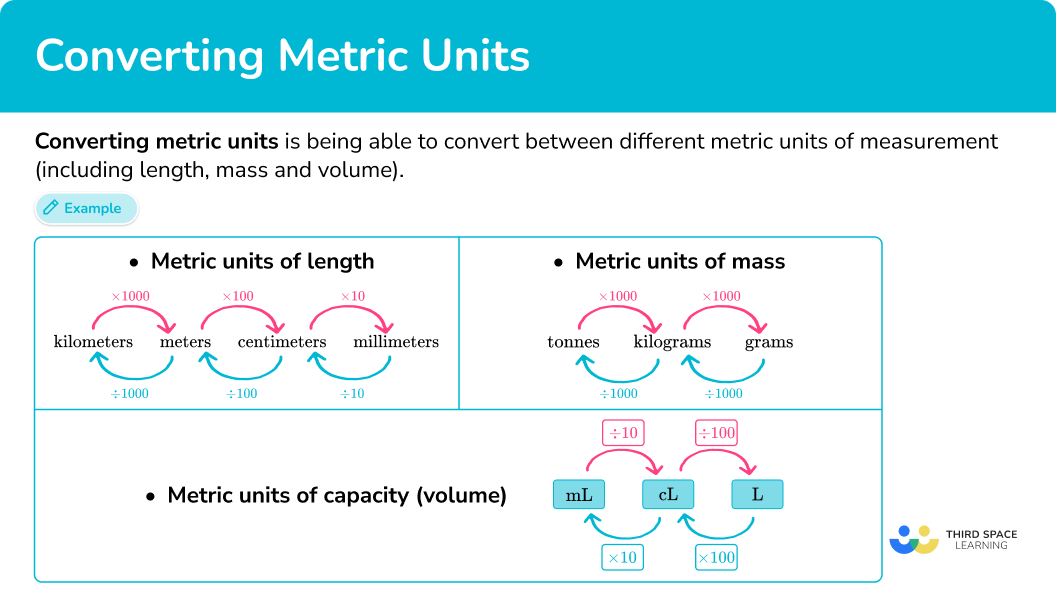
The diagram is a useful reference, but it is safer to start with an equality such as than to memorise a direction for every arrow. You can then work out the operation from what the units mean.
Decide whether the number should grow or shrink
Suppose you convert m into centimetres. A centimetre is smaller than a metre, so it takes more centimetres to describe the same length. Since each metre contains cm:
Going the other way, cm must be a smaller number of metres. Divide by the number of centimetres in one metre:
Read the following explanation and its two worked examples before looking at a more systematic way to set out conversions.
Choosing appropriate units and converting between units - KS3 Maths - BBC Bitesize
Read BBC Bitesize’s explanation of common metric conversions. Its table and paired examples show why converting to smaller units calls for multiplication, while converting to larger units calls for division.
Under “How to convert between metric units”, begin where the text says that objects can be measured in different units depending on their size. Read the table and examples, ending with the worked conversion of 650 cm to 6.5 m under “Examples”. Focus on the unit equality chosen before each calculation. The resource calls its mass column “Weight”; in this lesson, use mass when discussing measurements in grams and kilograms.
A dependable sense check is:
- Converting to a smaller unit gives a larger number.
- Converting to a larger unit gives a smaller number.
That rule checks direction, but it does not tell you the factor. For example, metres to centimetres uses , whereas centimetres to millimetres uses . Always identify the equality first.
Set out conversions so the units guide you
For a straightforward conversion, the equality and a multiplication or division may be enough. For a less familiar one, a conversion fraction helps you choose the correct operation. Because , the fraction represents an equal amount on its top and bottom. Multiplying by it changes the unit used to express a mass, not the mass itself:
The appears once above and once below the fraction line, leaving as the answer’s unit. Reverse the fraction when converting grams to kilograms:
Watch the video’s worked examples to see how this arrangement removes the guesswork about multiplying or dividing.
Learn Metric Units & Unit Conversions (Meters, Liters, Grams, & more) - [5-8-1]
Continue “Learn Metric Units & Unit Conversions” for two worked examples using conversion fractions.
In grams to milligrams, notice why the starting unit goes below the fraction line. In litres to kilolitres, notice that reversing direction reverses the fraction and makes the numerical answer smaller.
Sometimes the units you want are not next to each other in a reference table. Use an intermediate unit. For example, and , so:
You can also do this in two separate calculations: km is m, and m is cm. Both methods express the same length; the fraction method makes it particularly clear which units remain.
Apply the method to volume
Liquid volume, sometimes called capacity when referring to what a container can hold, commonly uses litres and millilitres. Since , a measured volume of L is:
Conversely, mL is L. If a question uses centilitres, use or , whichever directly connects the given and wanted units. Thus cL is mL.
Volume can also be written in cubic centimetres, with the symbol . The word cubic tells you this is a volume unit, not a length unit. There is a particularly useful equality:
Tyler DeWitt briefly introduces this link between cubic units and liquid-volume units in the following video. You only need the relationship for now; calculating the volume of a solid comes later in the course.
Converting Metric Units of Volume
Watch the opening of Tyler DeWitt’s “Converting Metric Units of Volume” to connect millilitres with cubic centimetres.
Watch volume units, concentrating on the statement that one millilitre equals one cubic centimetre. The video also mentions cubic decimetres, which you do not need to use in this lesson.
That equality lets you write without changing the number. Combined with , it also tells you that . Notice the distinction: converting to mL uses a factor of ; converting mL to L uses a factor of .
Before accepting any conversion, check three things: Did you use an equality for the same kind of quantity? Does the number move in the expected direction? Have you written the new unit beside the result? These checks will also help when later lessons ask you to substitute measurements into a formula.
Key takeaways
A unit conversion changes how a measurement is written, not the amount measured. Start from a known equality, such as , and check whether the target unit is smaller or larger. Multiply when expressing an amount in smaller units; divide when expressing it in larger units. For less familiar conversions, arrange conversion fractions so the original unit cancels and the wanted unit remains.
Next, you will use measured values in a supplied formula. Being able to recognise and record the correct units will make those calculations easier to check.