Hello. In the previous lesson, you converted measurements between units without changing the amount measured. Now you will use measurements in a supplied formula to calculate an unknown quantity. The central habit is to show what each number represents, carry out the stated calculation, and give the answer a unit. Allow about 35–40 minutes, including the reading.
Start with what the formula is asking
A formula describes a relationship between quantities. For example, if a question supplies
it tells you to divide the distance travelled by the time taken. If the distance is and the time is , substitute those measurements in the same positions:
The number alone is not a complete answer: says that the average speed is six metres per second.
A reliable approach is to identify the unknown, write down the given measurements with their units, then copy the supplied formula. Check that the measurements use compatible units before putting their values into the formula. Finally, calculate and record the result with its unit. Writing the substitution step makes it easier to spot a number placed in the wrong position.
Follow the formula through a worked example
The following BBC Bitesize explanation uses speed, distance and time to show the substitution process. Its formula triangle is a way of selecting one of three related formulas; the important skill here is what happens after the formula has been selected. You do not need to use a triangle when a question already supplies the formula you need.
How to calculate speed, distance and time - BBC Bitesize
Read BBC Bitesize’s explanation to see how the unknown quantity, given values and final unit appear in a worked calculation.
In “How to use a formula triangle to find speed, distance or time”, read the method. Then, under “Examples”, read the car and cyclist examples, stopping before the question about a 315-mile journey. Focus on where each given value is substituted and on why the answers have different units.
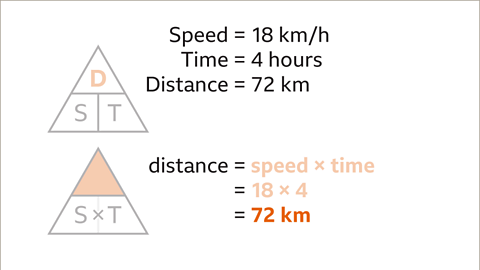
For the cyclist, the supplied relationship is
The speed is and the time is . Keeping those units beside the numbers shows why the result is a distance:
The “per hour” in the speed and the hours travelled work together to give kilometres. The image sets out the same calculation visually.
Use the unit to check the meaning
The unit depends on what you calculated, not merely on which units appear in the question. Distance might be reported in metres or kilometres; time in seconds or hours; average speed in metres per second or kilometres per hour.
Suppose a question instead supplies
and gives a distance of at a speed of . Substitution gives
You can check the answer without repeating the division: travelling at for covers . An answer of “” would not describe the quantity the question asked for.
This check works beyond travel calculations. If a formula subtracts one mass from another, its answer is a mass; if it divides a distance by a time, its answer is a speed. Read the formula and the question together to decide what unit belongs on the final line.
Make measurements compatible first
Sometimes the numbers cannot be substituted as written. Imagine a journey at lasting minutes. Multiplying by would treat the as hours, even though it is minutes. Since minutes is hour, minutes is hours. Now the time matches the “per hour” in the speed:
The same issue can arise without speed. Suppose a supplied formula for finding the mass of material in a container is
The filled container has a mass of , and the empty container has a mass of . You must express both masses in the same unit before subtracting. From the previous lesson, , so
Here the formula uses subtraction, not multiplication or division. The method is still the same: identify the unknown, match the units, substitute into the supplied formula, calculate, and label the answer. A formula triangle is not a general rule for every formula.
Make your working easy to check
In a science calculation, a short chain of working is usually more useful than an unexplained final number. For example:
Each line answers a different question: Which formula? Which values? What result? If the result seems wrong, you can locate the problem. You might have reversed the numbers in a division, missed a conversion, or written the unit of a given measurement instead of the unit of the unknown.
A useful final check is to ask whether the answer has a sensible size. In the 30-minute journey, the distance should be less than the travelled in a full hour at the same speed. The calculated passes that check.
Key takeaways
To calculate an unknown from a supplied formula, first identify what the unknown represents. Record the given values and units, convert any incompatible measurements, and substitute each value into its correct place. Show the calculation and finish with a unit that describes the answer, not just the measurements you started with.
Next, you will use measured results in a different way: plotting them on a line graph with labelled axes and suitable scales.