Hello! In our last lesson, we focused on the fundamental building blocks of mathematical arguments: propositions and the conditional statement (). You learned how to define these components and evaluate their truth, establishing the essential "nouns" and "grammar" of logic.
Today, we'll build on that foundation by learning our first "verb"—a rule that lets us take action and make a deduction. This lesson introduces Modus Ponens, the most fundamental rule of inference. You will see how this simple, intuitive rule provides a formal and verifiable way to move from a set of true statements to a new, guaranteed-true conclusion. This is the very first step in constructing the logical chains that form the heart of a proof.
From Promise to Deduction
In the previous lesson, we described the conditional statement as a promise. It says, "If P is true, I promise that Q is also true." But what happens when we know that the condition, P, has actually been met? Logic gives us a formal way to claim the reward of that promise.
This is the essence of Modus Ponens, a Latin phrase meaning "the way that affirms by affirming." It is a rule of inference that states:
If you have a conditional statement , and you also have the statement , you are allowed to conclude .
Let's watch a brief video segment from Dr. Trefor Bazett that introduces this concept with a clear, relatable example before formalizing it.
Logical Arguments - Modus Ponens & Modus Tollens
This video, "Logical Arguments - Modus Ponens & Modus Tollens," introduces the idea of a valid argument and then presents Modus Ponens.
Please watch the section from the beginning of the example. Notice how the argument is first presented with concrete statements and then abstracted into its logical form using the variables P and Q.
As the video shows, the structure of the argument is simple:
- Premise 1: (If P, then Q)
- Premise 2:
- Conclusion:
This structure is what makes the argument valid. It doesn't matter what P and Q represent; as long as the premises are true, the conclusion must follow.
What Guarantees the Conclusion?
Why can we be so certain that Modus Ponens always works? Your interest lies in the anatomy of a proof, and a key part of that anatomy is its soundness. A rule of inference is considered valid only if it is truth-preserving. This means that if you start with true premises, the rule must guarantee a true conclusion.
We can formally verify the validity of Modus Ponens using the truth tables we studied in the last lesson. Let's return to Dr. Bazett's video to see how this is done.
Logical Arguments - Modus Ponens & Modus Tollens
The video now uses a truth table to prove that the logical form of Modus Ponens is valid.
Watch the segment from the truth table analysis. The crucial step is identifying the single row where all premises—in this case, P \to Q and P—are true. Then, we check the conclusion in that specific row.
The truth table provides the formal justification. Let's review the logic:
- Our premises are the statements and .
- We are only interested in situations where we assume all our premises are true.
- Looking at the standard truth table, there is only one line where both and are simultaneously
True: the very first line. - In that specific line, what is the truth value of ? It is also
True.
Since in every possible scenario where our premises hold true, the conclusion also holds true, we have proven that Modus Ponens is a valid, truth-preserving rule.
The Formal Syntax of a Deductive Step
Now that we have an intuitive understanding and a formal justification for Modus Ponens, let's look at how it's used in practice. As you wanted to understand the formal syntax of proofs, this is where we see the mechanics in action. In formal logic proofs, each step must be explicitly stated and justified.
Rules of Inference and Logic Proofs
This resource from Millersville University introduces the column format for writing proofs and provides a clear definition and examples of Modus Ponens.
First, read the brief introductory section, "Rules of Inference and Logic Proofs". This sets the stage. Then, focus on the section titled "Modus Ponens." Pay close attention to the three-column format of the proof and how the rule is cited.
The reading shows the standard way to present a deductive step:
| Number | Statement | Justification |
|---|---|---|
| 1. | Premise | |
| 2. | Premise | |
| 3. | Modus Ponens (1, 2) |
This format is the basic syntax for building a proof. It transparently shows every piece of information used (the premises) and every logical move made (the rules of inference).
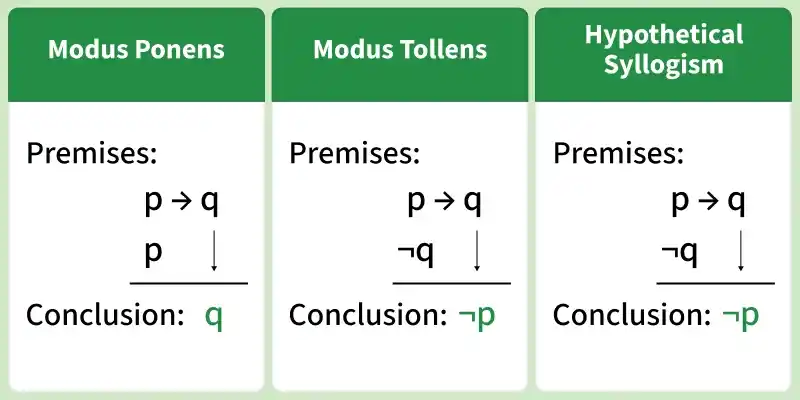
The structure of Modus Ponens is visually represented below. You have two premises, and , "above the line," which allow you to deduce the conclusion, , "below the line."
Applying the Rule with Precision
A crucial aspect of formal logic is that rules must be applied exactly. The "P" and "Q" in the Modus Ponens template are placeholders. They can stand for simple propositions or, more powerfully, for complex compound statements.
This short, direct video gives excellent examples of this.
Modus Ponens – How the Rule Works
This video, "Modus Ponens – How the Rule Works," excels at showing how the rule's structure remains the same even when the propositions are complex.
Watch the segment from the box and circle example. Notice how "P" can become "(not J and not K)" and "Q" can become "(A and not Z)". The logical structure is identical.
The Millersville text you read earlier also provided a great example of this:
Here, is the compound statement and is . The pattern is what matters.
This also highlights what you cannot do. The same resource correctly points out that the following is an invalid use of Modus Ponens:
- (Invalid!)
To apply the rule, you need the entire antecedent. In this case, the antecedent is . Having just is not sufficient to trigger the rule. This strictness is what gives proofs their certainty.
A Deeper Look: Inference as a Mechanical Process
Finally, let's touch upon a more abstract perspective that gets to the heart of your goal. You can think of a proof system as a machine for manipulating symbols according to a fixed set of rules. Modus Ponens is a central cog in this machine.
Fundamentals of Logic: Syntax, Semantics, and Proof – Rising Entropy
This article discusses the foundations of logic. It describes a proof system as a purely mechanical process.
Please read the final two paragraphs of the "Proof" section, starting from the discussion of proof systems. This frames Modus Ponens not just as a logical argument, but as a formal rule for generating new, valid strings of symbols from existing ones.
This perspective treats Modus Ponens as a function: modus_ponens(X, X → Y) = Y. It takes two strings as input and produces one as output. This "mechanical" view strips away the intuitive meaning and focuses purely on the syntactic manipulation, which is a core concept in formal logic and theoretical computer science.
Conclusion
In this lesson, we have armed ourselves with the first tool for building a proof. You've learned that:
- Modus Ponens is a fundamental rule of inference stating that from and , you can conclude .
- It is a valid rule because it is truth-preserving, a fact we formally verified with a truth table.
- The rule is applied through structural pattern-matching, where the propositions and can be complex statements. Precision is key.
- Formal proofs document each step, citing the premises and rules used, creating a verifiable chain of reasoning.
You now understand not just what a valid deductive step is, but also why it's valid and how to write it down formally.
In our next and final lesson, we will put everything together. We will take the components from lesson one and the rule of inference from this lesson to deconstruct a complete, simple direct proof, analyzing its structure from its initial assumptions to its final conclusion.