Hello. In the previous lesson, you distinguished overruling an earlier precedent from reversing the judgment in the case now on appeal. That distinction leads to the final question in this course: after the Supreme Court announces a decision, what has actually changed for the people in the case?
This lesson focuses on the Court’s disposition—what it does with the decision below—and the remedy, or relief the parties receive. You will see why a party can win a legal argument without yet winning money or an injunction, and why a case sent back on remand is not necessarily over.
An opinion explains; a disposition acts
Imagine a claimant who seeks repayment of a fee. A lower court dismisses the claim because it believes the filing deadline was 15 days. The claimant filed on day 20. The Supreme Court concludes that the correct deadline is 30 days.
That conclusion answers an important legal question, but it does not alone tell us whether the claimant receives a refund. The lower court never reached another disputed issue: whether the fee was unlawful in the first place. If the Supreme Court sends the case back, the claimant may now pursue the claim, while repayment remains undecided.
It helps to separate three layers of a ruling:
- Legal determination: The Court explains the rule it applies—for example, that the deadline is 30 days.
- Disposition: The Court states what happens to the judgment under review—for example, that it is affirmed, reversed, or vacated, sometimes with a remand.
- Remedy: The Court or a lower court specifies practical relief, if any—for example, repayment, an order to stop an action, or a declaration of the parties’ rights.
The majority opinion’s reasoning matters beyond the parties because its holding can bind courts in later cases. But precedential effect and relief in this case are different matters. A news report might accurately describe a broad legal holding while leaving out the narrower fact that the parties must return to a lower court before their dispute is resolved.
Read the disposition carefully
Start with Wex’s entry on reversal. It is brief, but its distinctions are useful: a reversal can cover all or only part of a judgment, and sending a case back does not automatically require a new trial.
reversal | Wex | US Law | LII / Legal Information Institute
Read Cornell Law School’s Legal Information Institute explanation to see what an appellate court may do after deciding that a lower court’s judgment was incorrect.
In the main paragraph of the “reversal” entry, read the explanation, beginning with “A reversal occurs” and stopping just before the example about newspaper vendors. Focus on the alternatives to a new trial and on the possibility of a partial reversal.
A reversal means that the appellate court has rejected the lower court’s judgment, in whole or in part. It might decide enough to direct a different judgment, or it might leave work for the lower court. Thus, “reversed” does not by itself mean “the party who appealed has received every form of relief requested.”
An affirmance leaves the judgment under review in place. Even then, the result and the reasoning are not identical: an appellate court may agree that the judgment should stand without adopting every reason the lower court gave for it.
A vacatur sets aside the ruling under review, stripping it of effect. Like a reversal, it changes the status of the decision below; unlike a complete account of the case’s outcome, the word alone does not tell us what the lower court must decide next. Read the instructions that accompany it. In particular, do not assume that every vacatur means the Supreme Court has decided which party is right on the merits.
A remand sends the case back to a lower court for further action. The destination may be a federal or state court, depending on the route by which the case reached the Supreme Court. The lower court’s job is governed by what the Supreme Court has decided and instructed it to do—not by the word “remanded” in isolation.
The following glossary entries put these terms alongside the related concept of a court order. Read them as a connected set rather than as four separate labels.
Glossary of Supreme Court terms | SCOTUSblog
Use SCOTUSblog’s glossary to connect the Court’s instructions with what happens when a case returns to a lower court.
Find the alphabetized entries “Order,” “Remand,” “Vacate,” and “GVR.” In “Order,” read the entry through its examples. In “Remand,” read from the definition through the instructions a lower court might receive. Read the complete short “Vacate” entry, including its practical effect. Finally, in “GVR,” read the entry through the merits distinction; notice that this kind of remand does not itself decide the underlying dispute.
A GVR—granting review, vacating the decision below, and remanding—is a useful warning against reading too much into a disposition. The Court may tell a lower court to reconsider a case in light of a recent decision without deciding the merits of that case itself. By contrast, a remand after a merits opinion may require the lower court to apply a legal rule the Supreme Court has just established. Both send the case back, but they leave different work to be done.
The visual summary below captures the basic idea that “reversed and remanded” and “vacated and remanded” both unsettle a ruling and send a matter back.
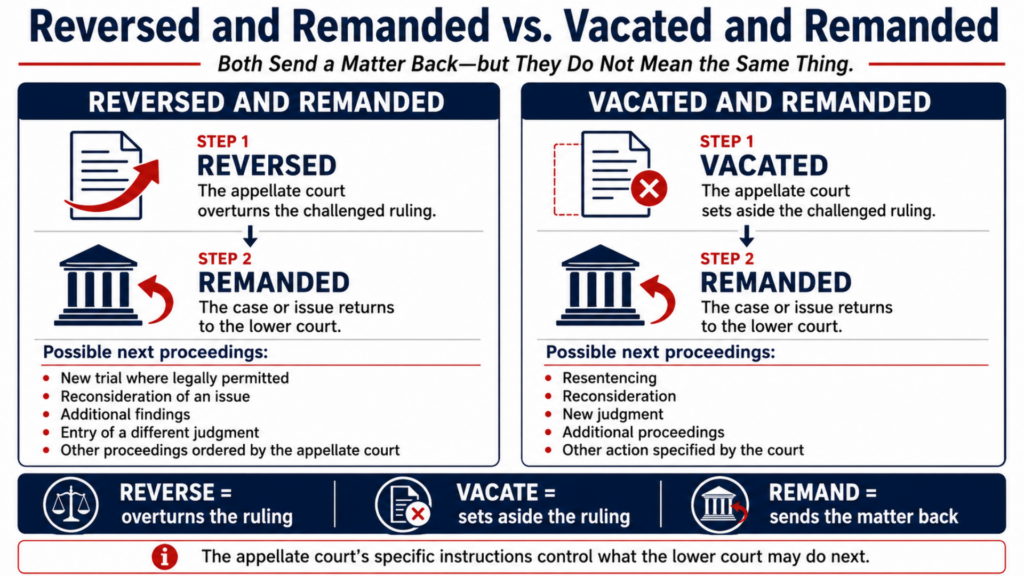
Treat the columns as a starting point, not a rule that predicts the next hearing. A reversal can require the lower court to set aside its earlier judgment, and a vacatur can occur in different circumstances. Neither phrase, standing alone, promises a new trial, repayment, or an ultimate win for the party who appealed.
Follow one dispute through different possible rulings
Return to the fee claim. The claimant filed on day 20, the lower court applied a 15-day deadline, and it dismissed the claim without deciding whether the fee was unlawful. Consider how different Supreme Court dispositions would change the parties’ positions.
“Affirmed.” The dismissal remains in place. The claimant does not obtain repayment through this claim. To understand why the judgment stands, however, you would still need the opinion: the Supreme Court might affirm on a ground other than the lower court’s deadline interpretation.
“Reversed and remanded for further proceedings consistent with this opinion.” Suppose the opinion holds that the deadline is 30 days. The lower court’s deadline-based dismissal cannot stand, and the claimant gets the opportunity for further proceedings under the correct rule. The Court has resolved the deadline issue, not the still-disputed legality of the fee. The lower court might consider that issue and any other issues left open.
“Vacated and remanded for reconsideration in light of a recent decision.” Suppose this is a GVR rather than an opinion deciding the deadline. The previous judgment is set aside, and the lower court must reconsider it in light of the identified decision. The Supreme Court has not itself held that this claimant’s filing was timely or that the fee must be repaid. The lower court may reach a new result after doing the requested analysis.
Now suppose the Supreme Court instead resolves every issue necessary to establish the claimant’s right to a specified repayment and directs the lower court to enter judgment accordingly. That instruction leaves much less open than “for further proceedings consistent with this opinion.” The disposition and directions—not merely the subject of the Court’s opinion—tell you how close the parties are to the requested relief.
Partial dispositions require the same care. If a court affirms in part, reverses in part, and remands, identify which part of the judgment survives, which part does not, and what the lower court has been directed to address. The words “the claimant won” or “the government won” may obscure that split result.
Match the remedy to the actual order
The same discipline applies beyond fee disputes. A court might determine that a government action is unlawful, but several kinds of relief could follow. An injunction orders someone to do or refrain from doing something. A declaratory judgment states the parties’ legal rights or obligations. Monetary relief requires payment when the law and the court’s judgment provide for it. A ruling that a law cannot constitutionally be applied in a particular case is not, by itself, an order paying every affected person or a physical removal of the law from the statute books.
To work out what changes for the parties, read a ruling in this order:
- Identify the judgment under review. What had the lower court actually ordered or dismissed?
- Find the disposition. Was that judgment affirmed, reversed, vacated, or changed only in part?
- Read the Court’s directions. On a remand, note which legal question is settled and which factual or legal issues remain open.
- Identify the relief actually ordered. Separate the right to continue litigating from a final order granting money, an injunction, or another remedy.
This also connects the last two lessons. Overruling tells you what happened to an earlier legal rule. Reversing or vacating tells you what happened to the judgment under review. Remanding tells you that further action belongs to a lower court. One opinion may affect precedent and the parties at the same time, but you need to read each effect separately.
Key takeaways
The Supreme Court’s legal reasoning does not, on its own, reveal the full practical result. Read the disposition to learn what happened to the lower court’s judgment, the remand instructions to learn what remains to be done, and the specified remedy to learn what relief the parties receive. Most importantly, being sent back to court is not the same as having finally won the underlying claim.
This completes the course’s path from how a case reaches the Supreme Court to what its ruling changes. When you encounter a headline about a major decision, you can now separate the rule announced for future cases from the order governing the parties in this one.