Hello! Welcome back to our course.
In our last lesson, we focused on identifying specific supporting details in a listening text. You learned how to use keywords, listen for paraphrasing, and avoid distractors to catch the essential facts and figures.
Today, we'll build on that by learning how to recognize signposting language. Think of these as the road signs a speaker uses to guide you through their talk. They tell you when they are starting, adding a point, giving an example, changing direction, or finishing. For your IELTS exam, this skill is a superpower, especially in the long academic lecture in Part 4. It helps you stay on track, predict what's coming next, and pinpoint where to listen for the answers.
1. What is Signposting Language?
In an academic talk, a speaker doesn't just list facts. They structure their ideas to create a clear argument. Signposting language is the collection of words and phrases they use to show you this structure.
To start, let's watch a short video that explains why this is so important in the context of the IELTS test.
Listening: Unit 6: Signpost Language
This video from IELTSx explains what signpost language is and gives two clear examples of how it's used to introduce a topic and transition to a new point.
Watch the entire video (it's short!). Pay close attention to the two main functions the speaker highlights: introducing the subject and moving to a new point.
As the video explains, understanding these "signs" helps you follow the speaker more easily and predict what's coming next, which is a huge advantage in a timed test.
2. Categories of Signpost Language
Signposts can be grouped by their function. Recognizing the function helps you understand the speaker's intention. For example, when you hear "however," you should be prepared for a contrasting idea.
This webpage provides an excellent summary of the main categories.
Signpost Language in IELTS Listening
Let's study a clear breakdown of the different types of signposts. This will give you a mental checklist to use when you listen.
Read the first part of the article, down to and including the table titled 'Core signpost categories you should recognize'. Focus on understanding the job that each category of words does (e.g., 'Sequencing', 'Contrast', 'Clarification').
Here is a visual summary of some of the most common signposting words, grouped by their function.
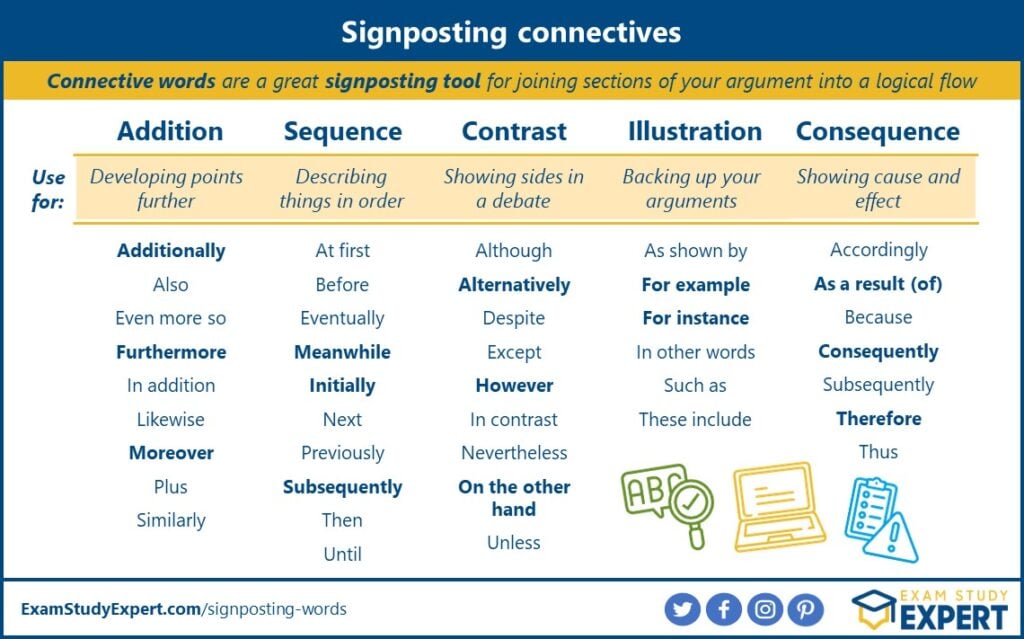
3. Hearing Signposts in Action
Now that you know the categories, let's practice hearing them in context. The following video uses short clips from various speakers to demonstrate how these words sound in natural speech. The speakers have Australian accents, which is great practice for the IELTS test.
Study English - Series 3, Episode 15: Listening for Signpost Words
This video from ABC Education will give you many examples of signpost words. We'll watch it in two parts to focus on different functions.
First, watch from 01:05 to 04:43 and again from 08:56 to 09:31. Listen for signposts that show: Explanation: not only because... but because Contrast/Alternatives: but, instead, even though Definitions: called, referred to as
Great. Now let's focus on a few more common and important functions.
Study English - Series 3, Episode 15: Listening for Signpost Words
Let's continue with the same video. This time, listen for words that signal causes, results, and additional points.
Watch from 05:49 to 08:56. Pay attention to how speakers use these signposts: Cause/Result: due to, therefore, so Adding information: in addition, as well as, not only... but also Examples: for example, for instance
4. Practice: Following a Talk with Signposts
Recognizing signposts is the first step. The next is using them to follow the questions in your test booklet. When you hear "Next...", you know the speaker is moving to the next point, and you should probably move to the next question.
Let's do a practice activity to connect signposts directly to test questions.
Signpost Language in IELTS Listening
The article we looked at earlier has a fantastic practice activity. It gives you a script and shows how the signposts guide you from one question to the next. It also has a special focus on the most 'dangerous' signposts: those that signal corrections.
Read the sections titled 'Structured listening script excerpt' and 'Mini-focus: contrast and correction'. First, read the 'Listening script excerpt' and try to find the signposts yourself. Then, look at the table 'Map signposts to question progression' to see how each signpost moves the listener forward. Finally, read the 'Mini-focus' section carefully. Phrases like 'Sorry, I mean...' are classic IELTS traps that test if you are listening for the final, correct piece of information.
This last point is crucial. In the previous lesson, we talked about "distractors." A correction signpost like sorry, I mean... or actually... is a very common way that test-makers introduce a distractor before giving the real answer.
Conclusion
Excellent work today! You've learned how to spot the verbal "road signs" that speakers use to structure their talks.
Key Takeaways:
- Signposting language guides the listener through a talk by signaling structure and transitions.
- Signposts have different functions, such as sequencing, adding information, contrasting, giving examples, and concluding.
- In the IELTS test, you can use signposts to follow the speaker and predict which question they are about to answer.
- Pay special attention to signposts for contrast (
however,but) and correction (sorry, I mean...) as the correct answer often follows them.
In our next lesson, we will move on to following spoken arguments and identifying speaker opinions. Now that you can identify the structure of a talk using signposts, you'll be ready to analyze the speaker's ideas and viewpoints within that structure.