Hello! Welcome back to your IELTS preparation course.
In the last lesson, you practiced writing a complete Task 2 essay from start to finish. This was a major step in building your writing skills. Now, it's time to learn how to think like an examiner.
Today's lesson focuses on a critical skill: assessing a Task 2 response using the official public band descriptors. Specifically, we will concentrate on two of the four marking criteria: Task Response and Lexical Resource. Understanding these will show you exactly what an examiner looks for to award a high score, helping you write more effectively towards your Band 7 goal.
1. The Four Keys to a High Score
Every IELTS Writing Task 2 essay is marked on four criteria. Each criterion is equally important, as your final band score is an average of the four.
The four criteria are:
- Task Response (TR): How well you answer the question.
- Coherence and Cohesion (CC): How well you organize and link your ideas.
- Lexical Resource (LR): Your use of vocabulary.
- Grammatical Range and Accuracy (GRA): Your use of grammar.
To begin, let's get a clear overview of how these four criteria work together.
The IELTS Writing Task 2 Marking Criteria EXPLAINED
This video from E2 IELTS provides a quick and clear introduction to the four marking criteria and explains how your final score is calculated.
Please watch from 00:36 to 02:13. Focus on understanding the names of the four criteria and how a score is awarded for each one.
To see these criteria in more detail, take a look at the official band descriptors. This table shows what is required for Bands 6, 7, 8, and 9.
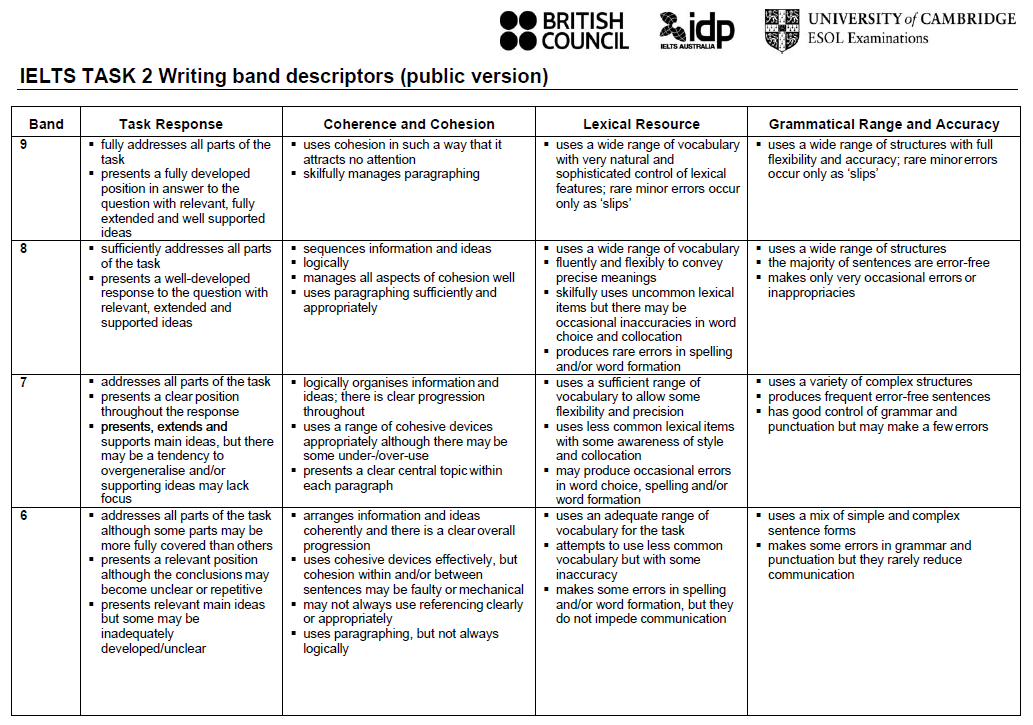
Today, we'll dive deep into the first and third criteria: Task Response and Lexical Resource.
2. Deep Dive: Task Response
Task Response is arguably the most important criterion because if you don't answer the question properly, nothing else matters as much. To get a high score, you must address all parts of the task, present a clear position, and support your ideas.
This next video explains Task Response brilliantly. It starts with a very simple example and then applies the principles to a real IELTS question.
Task Response/Task Achievement in IELTS Writing Task 2
The instructor from Complete Test Success, a former IELTS examiner, will walk you through what examiners look for in Task Response. You'll learn how to move from a low band to a high band score.
Watch from 02:59 to 13:16. Pay close attention to these key ideas: The difference between a Band 4 and Band 5 answer: giving a direct answer. How to get to Band 6: providing specific reasons. How to get to Bands 7, 8, and 9: adding relevant development (explanations and examples) to your reasons.
To reinforce what you've just learned, let's look at the specific requirements for a Band 7 in Task Response.
Requirements for IELTS Band 7 in Writing
This article from IELTS buddy breaks down the official Band 7 descriptors. It provides a clear, text-based explanation of what 'Task Response' means.
Read the sections titled 'Task Response' under 'IELTS Band 7 Descriptors' and the more detailed explanation under 'The Four Criteria in Detail'. Notice the emphasis on answering all parts of the question and having a clear, well-supported position.
Key Summary for Task Response (Band 7):
- Address all parts of the prompt: If the question asks you to "discuss both views and give your opinion," you must do all three things.
- Present a clear position: The examiner should never be confused about your opinion.
- Extend and support main ideas: Don't just list ideas. Explain them and provide examples.
3. Deep Dive: Lexical Resource (Vocabulary)
Lexical Resource assesses the range, accuracy, and flexibility of your vocabulary. To score well, you need to show that you can use a good range of words and phrases accurately and appropriately.
Let's return to the first video to see how vocabulary is assessed.
The IELTS Writing Task 2 Marking Criteria EXPLAINED
This short clip from the E2 IELTS video focuses specifically on Lexical Resource.
Watch from 09:16 to 10:18. Note the key differences between Band 5, 6, and 7. The main factor is the frequency of errors and how much they affect communication.
Now, let's read about the specific requirements for Band 7.
Requirements for IELTS Band 7 in Writing
Let's go back to the IELTS buddy article to see what is required for vocabulary at a Band 7 level.
Read the sections titled 'Lexical Resource'. Pay attention to the keywords: 'sufficient range', 'less common...items', 'awareness of style and collocation', and 'only a few errors'.
Key Summary for Lexical Resource (Band 7):
- Sufficient Range: You use a variety of words, not just repeating the same simple ones.
- Less Common Vocabulary: You can use some more advanced or topic-specific words (e.g., using "urbanization" or "sedentary lifestyle" when appropriate).
- Accuracy: You make only "occasional" errors in word choice, spelling, or word formation. The meaning must still be clear.
- Collocation: You can combine words that naturally go together (e.g., "heavy traffic," not "strong traffic").
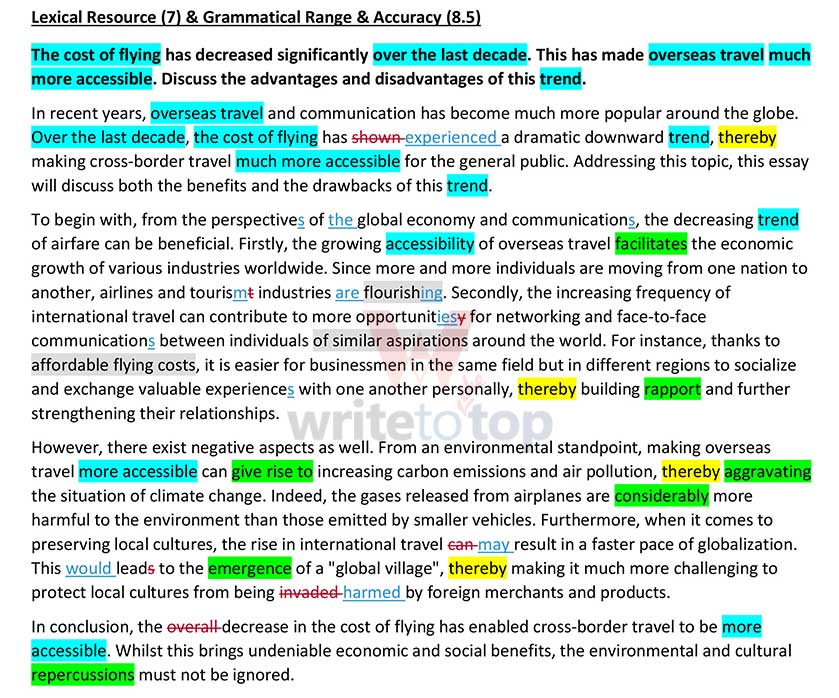
This image shows a sample essay with highlights for Lexical Resource. Notice the use of words like "advent," "accessibility," "detrimental," and "fosters."
4. Putting it into Practice: Assessing Official Samples
Now it's your turn to be the examiner. We are going to look at two official sample essays from ielts.org for the same question.
IELTS Academic Writing - Sample Tasks
This official IELTS document contains sample questions, candidate scripts, and examiner comments. We will analyze these comments to understand the band scores.
First, read the question in 'Academic Writing Sample Task – 2A' on page 6. Next, read the 'Examiner comment' for Sample Script A (Band 4) on page 18. Identify the comments related to Task Response and Lexical Resource. For example, 'the test taker’s position is difficult to identify' (Task Response) and 'The range of vocabulary is basic' (Lexical Resource). Finally, read the 'Examiner comment' for Sample Script C (Band 8.5) on page 22. Compare the comments here to the Band 4 script. Notice the praise for Task Response ('The topic is very well addressed') and Lexical Resource ('uses a wide and very natural range of vocabulary').
By comparing a low-scoring response with a high-scoring one, you can clearly see the huge impact that Task Response and Lexical Resource have on the final band score.
Conclusion
Great work today! You've taken a big step towards understanding the IELTS writing assessment. By learning to see your writing through an examiner's eyes, you can better identify areas for improvement in your own practice essays.
Key Takeaways:
- Your Task 2 essay is marked on four criteria: Task Response, Coherence & Cohesion, Lexical Resource, and Grammatical Range & Accuracy.
- Task Response is about directly and fully answering the question with a clear, well-supported position.
- Lexical Resource is about using a flexible and accurate range of vocabulary, including some less common words and correct collocations.
- Assessing your own writing against these criteria is a powerful way to prepare for the exam.
In our next lesson, we will move to a different part of the IELTS exam. We'll begin Module 10, "Speaking: Pronunciation and Fluency," starting with the learning outcome: Apply correct stress patterns to individual multi-syllable words.