Hello! Welcome back to our module on Academic Writing Foundations.
In our last lesson, we focused on building strong paragraphs with clear topic sentences and well-developed supporting details. We learned that a good paragraph is like a well-made sandwich: it has a clear structure and focuses on just one main idea.
Today, we're going to build on that skill. Now that we know how to construct the paragraphs, we need to learn how to connect them smoothly. Think of it this way: if paragraphs are the building blocks of your essay, cohesive devices are the mortar that holds them together. This lesson will teach you how to use cohesive devices (e.g., linking words, pronouns) to link your sentences and paragraphs logically.
Mastering this skill is absolutely essential for your IELTS goal. It directly impacts your score for "Coherence and Cohesion," which accounts for 25% of your total writing mark.
1. Understanding Cohesion and Coherence
First, let's clarify what these two important words mean. They are related, but not the same. A short video will explain this with a helpful analogy.
Coherence and Cohesion in Academic Writing
This clip from the EAPFoundation.com video 'Coherence and Cohesion in Academic Writing' uses a jigsaw puzzle analogy to explain the difference between cohesion and coherence.
Please watch from 00:24 to 01:18. Focus on understanding cohesion as the small connections (micro-level) and coherence as the overall picture (macro-level).
As the video explained:
- Cohesion refers to how your sentences are grammatically and lexically linked together.
- Coherence refers to how your ideas are logically organized and make sense as a whole.
Good cohesion leads to good coherence. Today, we'll focus on the tools that create cohesion.
2. The Main Tools for Cohesion
There are several types of cohesive devices we can use to make our writing flow. We will focus on the most important ones for your IELTS essays:
- Reference Words (like pronouns)
- Substitution (using synonyms or replacement phrases)
- Linking Words / Transition Signals
Let's explore the first two.
Reference Words and Substitution
One of the most common mistakes in writing is repeating the same words over and over. This makes the text boring and difficult to read. Reference words and substitution are two powerful techniques to avoid this.
Referencing and Substitution in IELTS Writing
The article 'Referencing and Substitution in IELTS Writing' from the official IELTS provider, IDP, explains these two concepts very clearly with simple examples.
Please read the sections titled 'So what exactly is referencing?' and 'What is substitution?'. Pay attention to how pronouns (this, they) and synonyms (teenagers/adolescents) are used to connect ideas without repetition.
Your Turn: Practice
Now, let's apply what you've just learned. The same article has a short practice exercise.
Referencing and Substitution in IELTS Writing
Let's try the practice activity from the same IDP article.
Read the paragraph under the 'Practice' heading. The underlined phrases are repetitive. Think about how you could replace them using referencing (e.g., 'them', 'this') or substitution (e.g., using a synonym like 'parents'). Write down your improved version of the paragraph. Then, compare your answer with the 'Model answer' provided below the exercise.
This exercise shows how a few small changes can make a paragraph much more cohesive and professional.
3. Linking Words (Transition Signals)
Linking words (also called transition signals or cohesive devices) are probably the most powerful tool for showing the relationship between your ideas. They act as signposts for the reader, telling them if you are adding information, contrasting ideas, or showing a result.
Here is a useful overview of different linking words organized by their function.
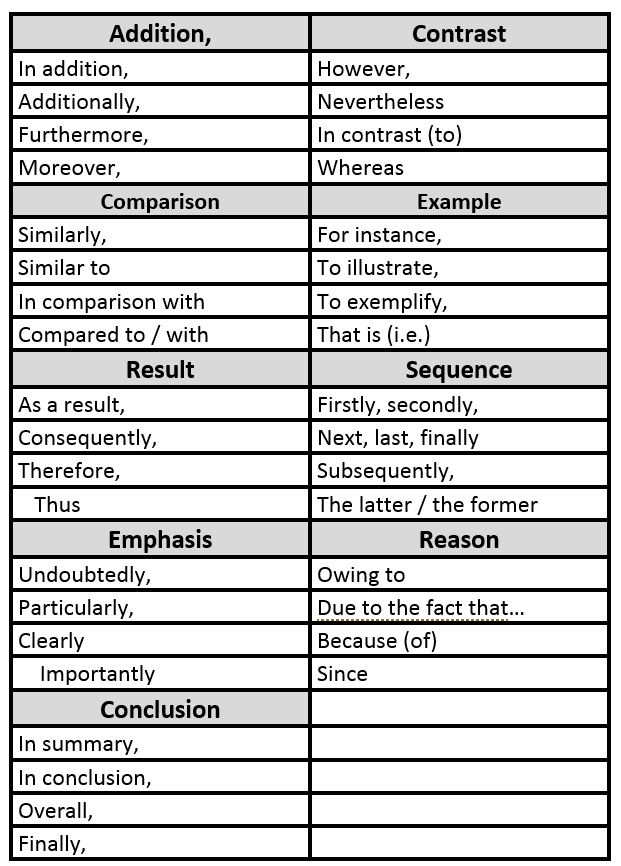
Using a range of these words correctly is key to a high IELTS score. Let's watch a detailed video guide that focuses on linking words for IELTS Writing Task 2.
BAND 9 IELTS Writing Task 2 LINKING WORDS
The video 'BAND 9 IELTS Writing Task 2 LINKING WORDS' by Fastrack IELTS is an excellent resource. It not only gives you better alternatives to simple words like 'but' and 'and', but also explains the correct grammar and punctuation to use with them.
This video is very detailed. Watch the following sections carefully: Showing Contrast (00:34 - 08:10): Pay close attention to the difference between words like 'although' and 'however', and how to use commas and semicolons correctly. Adding Information (07:56 - 12:07): Notice how you can use words like 'moreover' and 'in addition' to add a new point to your argument. Showing Result & Cause (11:51 - 16:51): This is very important. Focus on the difference in grammar between 'because' (which is followed by a subject + verb) and 'because of' (which is followed by a noun). This is a common area for mistakes.
As the video emphasized, correct punctuation is just as important as choosing the right word. For example, However, is often used at the start of a new sentence and is followed by a comma.
4. Common Mistakes to Avoid
It is possible to use too many linking words. This can make your writing sound unnatural and forced. The goal is to use them only when they are needed to make the connection between ideas clear.
IELTS Writing Task 2: Using Advanced Linking Words and Cohesive Devices Effectively
This article from IELTS Mumbai gives some clear advice on what to avoid and shows the difference cohesive devices can make.
Please read the sections 'Common Mistakes to Avoid' and 'Example of an Improved Paragraph'. Notice how the 'After' paragraph doesn't just add linking words; it uses better vocabulary and sentence structure to create a much smoother flow.
5. How Cohesion is Scored in IELTS
Finally, let's connect all of this directly to the IELTS band descriptors. Understanding what the examiners are looking for will help you focus your practice.
Coherence and Cohesion in Academic Writing
Let's return to the EAPFoundation.com video. This final section explains how the official IELTS criteria assess cohesion.
Watch from 09:58 to 12:43. Listen for key phrases in the band descriptors, such as 'uses a range of cohesive devices appropriately' (for Band 7) and 'may not always use referencing clearly or appropriately' (a feature of a lower score).
This shows that to get a Band 7 or higher, you must demonstrate control over a variety of these tools—not just linking words, but also referencing and substitution.
Conclusion
Excellent work today. You've learned how to weave your sentences and paragraphs together to create a text that is logical, smooth, and easy to read. This is a skill that will significantly improve the quality of your academic writing.
Key Takeaways:
- Cohesion is about connecting your writing at the sentence and paragraph level.
- Avoid repetition by using reference words (e.g.,
it,this,them) and substitution (e.g., synonyms). - Use linking words (
however,therefore,in addition) to signal the relationship between your ideas. - Use a variety of cohesive devices and use them accurately and naturally. Do not overuse them.
In our next lesson, we will continue to build on this by looking at another essential skill for avoiding repetition and showing lexical resource: how to paraphrase information accurately without changing its meaning.