Hello! Welcome to the first lesson in our new module, IELTS Speaking Test Strategies.
In our last lesson, we focused on the general skill of extending your answers by giving reasons, examples, and personal experiences, using frameworks like the AREA technique. This is a crucial foundation for fluency. Today, we will apply that skill specifically to the first part of the IELTS Speaking test.
Our learning outcome is to answer Part 1 questions with extended, relevant responses. Part 1 is a 4-5 minute "warm-up" where the examiner asks you questions about familiar topics like your home, family, work, or interests. While it may seem simple, performing well here is key to building confidence and making a strong first impression. Let's learn how to do it effectively.
1. The Golden Rules of Part 1
The biggest mistake candidates make in Part 1 is giving answers that are either too short (one sentence) or too long (a mini-speech). Your goal is to find the right balance: an extended but concise answer of about 2-4 sentences.
Let's start by reading about the key facts, common mistakes, and the fundamental principle for structuring your answers.
IELTS Speaking Part 1 – Questions & Sample Answers
The article 'IELTS Speaking Part 1 – Questions & Sample Answers' from IELTS Jacky provides an excellent overview. We'll focus on the basics of what to do and what to avoid.
Please read the sections titled 'Key facts about IELTS Speaking Part 1', 'Part 1 Mistakes to Avoid', and 'Developing your answers'. Pay close attention to the simple rule: Answer the question + Add an extra piece of information.
As you've just read, the core idea is simple: always add a little more detail to your direct answer. Now, let's explore a structured way to do this consistently.
2. The SEER Strategy: Your Go-To Framework
In our last lesson, you learned the AREA technique. A very similar and highly effective framework for Part 1 is the SEER strategy. It helps you build a well-rounded, extended answer every time.
SEER stands for:
- S - Short Answer: Give a direct, clear answer to the question.
- E - Extend: Add a reason or explanation (using words like because or so).
- E - Example: Provide a specific, personal example to illustrate your point.
- R - Reflect: Conclude with a brief feeling or opinion about it.
Let's see how this works in practice.
IELTS Speaking Part 1 Strategies: How to Extend Answers
This article from IELTS Speaking Lab breaks down the SEER strategy with clear examples.
Read the section 'Speaking Strategy #1: SEER'. Study the three examples provided (about 'major', 'hometown', and 'season'). Notice how each answer follows the S-E-E-R structure to create a complete, natural-sounding response.
The SEER strategy gives you a simple mental checklist. It ensures you don't just stop after the first sentence and provides the examiner with the vocabulary and grammar they need to assess you properly.
3. From Good to Great: Enhancing Your Answers
Having a good structure like SEER is the first step. The next step is to fill that structure with high-quality language. This includes using precise vocabulary, varied tenses, and descriptive words.
Let's watch a video that shows the difference between a simple answer and a high-scoring one.
Most Common IELTS Speaking Part 1 Questions and Answers
Keith from English Speaking Success will now demonstrate how to improve Part 1 answers. He provides a 'simple' answer and a 'better' one, explaining the exact techniques used to enhance it.
Please watch the following two sections: Topic: Where you live (00:58 - 03:30): Notice how he adds topic-specific vocabulary ('high-rise building', 'balcony'), adjectives ('spacious'), and adverbs ('really'). Topic: Routines (05:42 - 09:33): Pay close attention to how he combines the present simple and present perfect tenses ('I am an early bird. I've always been an early riser'). This is a very powerful way to show grammatical range.
As you saw, small changes can make a big difference. Using a word like "spacious" instead of "lots of space," or adding a tense like the present perfect, immediately elevates the quality of your response.
4. The A123 Strategy: For 'Preference' and 'Frequency' Questions
Some questions, like "Do you prefer X or Y?" or "How often do you...?", can be tricky to answer with a simple "yes" or "no." For these, the A123 strategy is perfect.
A123 stands for:
- A - Answer: Start with a phrase like "Well, it depends..." or "To be honest, it varies..."
- 1 - Option 1: Describe one situation or context.
- 2 - Option 2: Describe a contrasting situation or context.
- 3 - Conclude: Provide a quick summary.
This strategy allows you to show off more complex thinking and grammar by comparing two scenarios.
IELTS Speaking Part 1 Strategies: How to Extend Answers
Let's return to the IELTS Speaking Lab article to learn about the A123 strategy.
Read the section 'Speaking Strategy #2: A123'. Focus on how the examples for internet use and book preference use phrases like 'During the week...' vs 'However, on weekends...' to build a sophisticated answer.
5. Your Turn: Practice Time
Now it's time to put these strategies into practice. Below is an image with 50 real IELTS Speaking Part 1 questions.
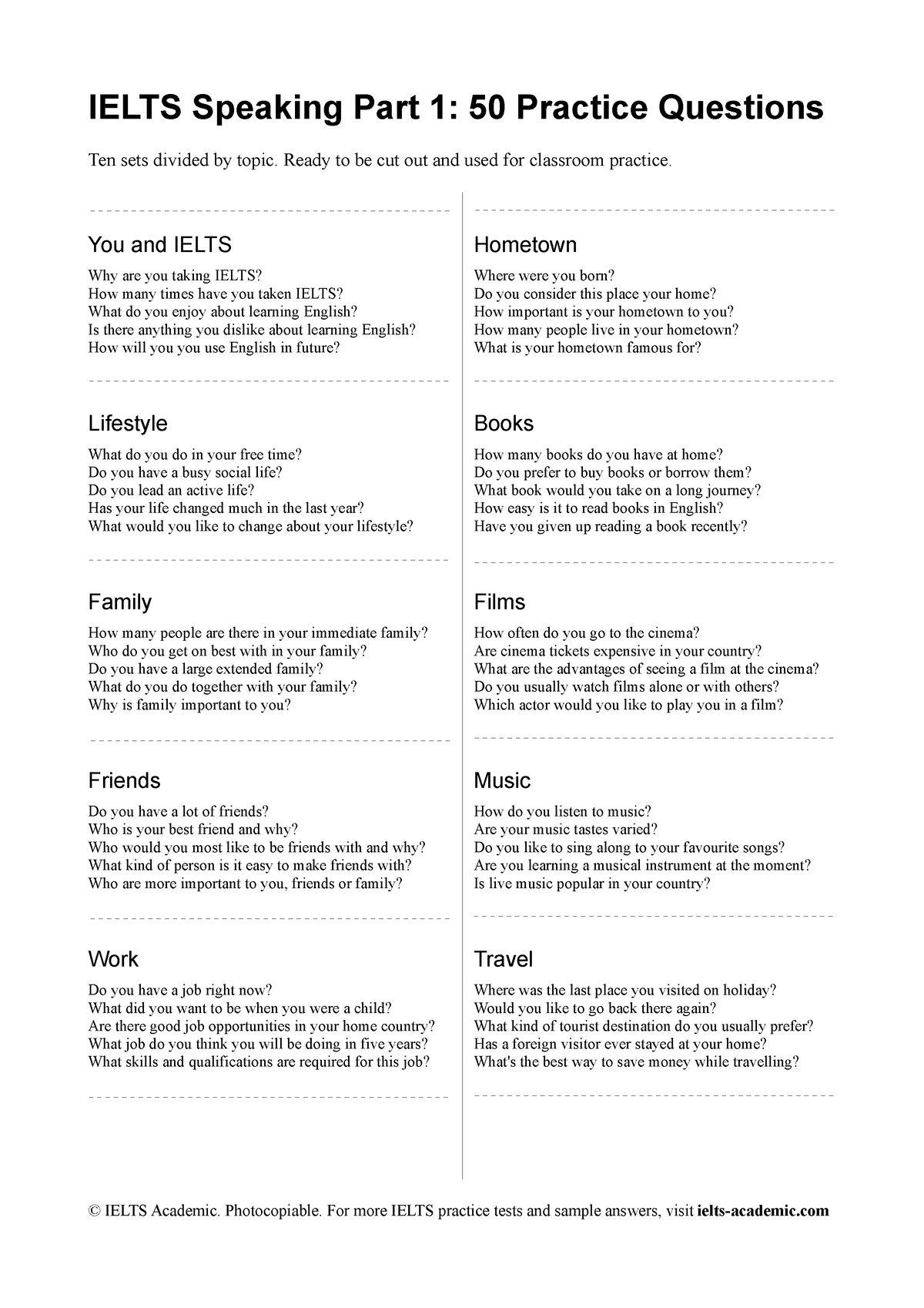
Your Task:
- Choose a SEER Question: Look at the image and select one question that is good for the SEER strategy. For example, a question from the "Hometown" or "Friends" topic.
- Choose an A123 Question: Select one question that is good for the A123 strategy. A question with "prefer" or "how often" would be ideal, for example, from the "Films" or "Books" topics.
- Plan Your Answers: For each question, quickly write down a few bullet points for your answer using the steps of the relevant strategy (S-E-E-R or A-1-2-3).
- Record Yourself: Use your phone to record your answers. Don't read from your notes. Try to speak naturally, aiming for a fluent response of 2-4 sentences for each question. Listen back and see if you successfully extended your answer.
This exercise will help you get comfortable using these structures so they become automatic during the real test.
Conclusion
Well done! Today you've learned the essential strategies for mastering IELTS Speaking Part 1. By moving beyond simple, one-sentence answers and using structured frameworks, you are demonstrating the fluency and complexity needed for a Band 7 score.
Key Takeaways:
- The Goal: Aim for relevant, extended answers of 2-4 sentences.
- The SEER Strategy: Use Short Answer, Extend, Example, Reflect for general questions about your life, opinions, and habits.
- The A123 Strategy: Use Answer ("It depends"), Option 1, Option 2, Conclude (3) for preference and frequency questions.
- Enhance your answers with topic-specific vocabulary, varied grammar (like the present perfect), and descriptive words.
In our next lesson, we will move on to the next section of the exam. Our focus will be to use the 1-minute preparation time for Part 2 effectively. You'll learn how to quickly brainstorm ideas and structure your two-minute talk.