Hello! Welcome to our next lesson in the IELTS Academic Reading module.
In our last lesson, we focused on answering True/False/Not Given questions. We learned the importance of reading carefully to distinguish between a statement that contradicts the text (False/No) and one that simply isn't mentioned (Not Given). This skill of understanding the precise meaning of sentences will be a great foundation for today's topic.
Today, we will focus on another very common—and sometimes tricky—IELTS question type. Our learning outcome is to complete matching headings tasks by analyzing paragraph structure. You'll learn how to identify the main idea of a paragraph and match it to the correct heading, a crucial skill for improving your reading score.
1. Understanding the 'Matching Headings' Task
First, let's look at what this task involves. You will see a reading passage divided into paragraphs (or sections) and a separate box with a list of headings. Your job is to choose the heading that best summarizes the main idea of each paragraph.
To get a clear picture of the task format and why it can be challenging, please watch the first part of this video.
IELTS Reading Matching Headings | Best Tips + Practice Tasks
This clip from Fastrack IELTS will show you what a 'Matching Headings' question looks like and explain its basic rules, such as having more headings than paragraphs.
Please watch from 00:33 to 01:24. Notice how the headings are listed with Roman numerals (i, ii, iii, etc.) and that there are always extra headings that you won't use.
As the video explains, this task tests your ability to understand the overall meaning or purpose of a paragraph, not just one or two details within it. Here is an example of what the task looks like in an exam paper:
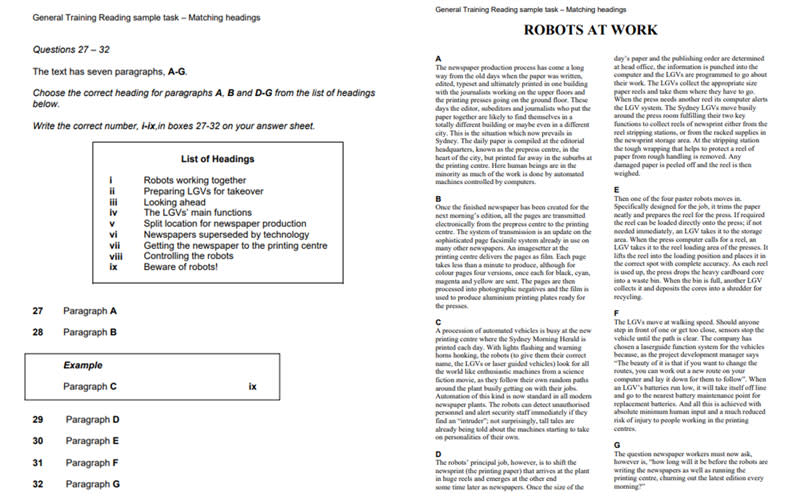
The main difficulties students face are:
- Similar Headings: Two or more headings might seem very close in meaning.
- Distractors: A heading might refer to a small detail or a single sentence in the paragraph, but not the main idea.
- Time Pressure: Reading every paragraph in full detail can take too much time.
2. The Core Skill: Finding the Main Idea
To succeed in this task, you must learn to distinguish between a paragraph's main idea and its supporting details. The correct heading will always reflect the main idea.
A common piece of advice is to read the first and last sentences of a paragraph to find its main idea. This is often true because paragraphs frequently begin with a topic sentence that introduces the main point.
This image shows an example of identifying a topic sentence.

However, be careful! The main idea is not always in the first sentence. It might be in the second sentence, or even at the end. The first and last sentences are a good starting point, but you must skim the rest of the paragraph to confirm its overall focus.
The following video clip explains this distinction between the main idea and minor details very well.
IELTS Reading Matching Headings - BEST Tips and Practice Test
This segment from IELTS with Juva gives a clear example of how a paragraph might mention something (like 'movies') that is only a minor detail, not the main point.
Please watch from 03:57 to 06:07. Focus on how the presenter analyzes the paragraph about 'Benjamin' to show that 'movies' are just part of a list and not the paragraph's main focus.
3. A Step-by-Step Strategy
Now let's combine these skills into a reliable strategy. Having a clear process will help you stay focused and manage your time effectively.
For a comprehensive written guide, please review the strategy outlined in the following article.
IELTS Reading Matching Headings
This article from IELTS Advantage provides a clear, step-by-step strategy and excellent tips for tackling 'Matching Headings' questions.
Please read the sections titled 'Tips and Solutions' and 'Strategy'. Pay special attention to Tip #1 (doing this question first) and Tip #10 (not looking at the headings first is one possible strategy, but many people prefer to read the headings first to know what to look for). Try both approaches in your practice to see what works best for you.
Based on that, here is a summary of an effective strategy:
- Read the headings first. Underline keywords in each one and try to understand the precise meaning. Think about the differences between headings that seem similar.
- Read the first paragraph quickly. Skim it to get the general meaning. Don't focus on details.
- Choose the best heading. Go back to your list and find the heading that best summarises the paragraph's main idea.
- Cross out the heading you have used. This helps you narrow down the options.
- If you are unsure, write down two possible headings next to the paragraph and move on. The correct answer may become clearer after you have matched other paragraphs.
- Repeat this process for the remaining paragraphs.
- Go back to any questions you were unsure about at the end. With fewer headings to choose from, the correct answer is often easier to find.
4. Avoiding Common Traps
Even with a good strategy, there are two common traps you must avoid.
- Trap 1: Reading only the first and last sentences. As we discussed, this is a risky shortcut. It might work sometimes, but often the true main idea is developed in the body of the paragraph.
- Trap 2: Matching keywords. The IELTS test is designed to test your understanding of meaning, not your ability to match words. The correct heading will use synonyms and paraphrasing to express the paragraph's main idea. If a heading uses the exact same keywords as the paragraph, it is often a distractor.
This next video clip explains these two traps very clearly.
IELTS Reading Matching Headings | Best Tips + Practice Tasks
Let's return to the Fastrack IELTS video. This part explicitly warns against the most common mistakes students make.
Please watch from 04:15 to 05:15. The presenter gives a crucial piece of advice: if you see matching keywords, the option is probably wrong.
5. Guided Practice
Let's see this strategy in action. The presenter in the video will now walk you through a few examples. As you watch, pay attention to how she justifies her answers by referring to the main idea of the paragraph, not just specific words.
IELTS Reading Matching Headings | Best Tips + Practice Tasks
In this final clip from Fastrack IELTS, you will see a demonstration of how to apply the strategy to real IELTS questions.
Please watch from 05:15 to 08:01. For each question, try to pause the video and decide on your own answer first, then listen to the explanation. Notice how the answers often depend on understanding paraphrased ideas, like 'a proposal to take control away from the driver'.
Conclusion
Excellent work today! You have learned a complete strategy for one of the most challenging question types in the IELTS Reading test. By focusing on the main idea and avoiding common traps, you can approach these questions with much more confidence.
Key Takeaways:
- Your goal is to find the heading that summarizes the main idea of the entire paragraph.
- Reading the first and last sentences is a good starting point, but you must skim the whole paragraph to confirm its main purpose.
- Beware of headings that use the exact same keywords as the text; they are often distractors. Look for synonyms and paraphrasing.
- Use a systematic approach: read headings, skim paragraphs, match, cross out, and return to difficult questions at the end.
In our next lesson, we will continue building your IELTS Reading skills by tackling multiple choice questions. The ability to skim for general meaning and then scan for specific information will be very useful.