Hello! Welcome to the next lesson in our IELTS journey.
In our last session, we learned how to describe process diagrams using sequencing language and the passive voice. These skills are excellent building blocks for today's topic.
Today, we are focusing on another common visual in IELTS Writing Task 1: maps and plans. You will often see two maps of the same place at different points in time and be asked to describe the changes.
Our learning outcome for this lesson is to describe a map or plan using appropriate spatial language. This means learning the specific words and phrases you need to say where things are and where changes have happened. This is a fundamental skill for scoring well on this task type.
1. Understanding Map Descriptions
Map tasks require you to be a good observer. Your goal is to report the main changes that have occurred between the two maps. This usually involves:
- Things that have been added (e.g., new buildings, roads).
- Things that have been removed (e.g., forests, old houses).
- Things that have been changed (e.g., a factory converted into apartments).
To do this effectively, you must be able to describe locations precisely.
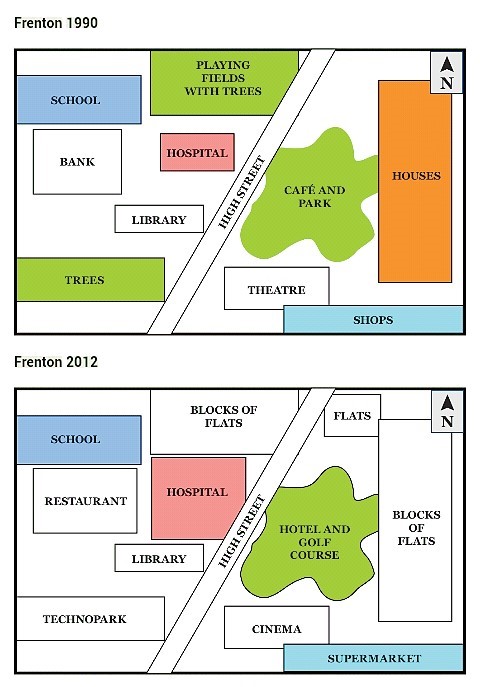
Look at the image below. It shows two maps of a town called Frenton in 1990 and 2012. You can see many changes, such as new buildings and the removal of green spaces. To describe these, you need to be able to say where they are on the map.
2. The Language of Location: Compass Points
The most precise way to describe a location is by using compass points. If a map includes a compass symbol (showing North), you should use this language.
The main compass points are:
- North
- South
- East
- West
You can also combine them for more specific locations:
- Northeast
- Northwest
- Southeast
- Southwest
Let's watch a video that explains how to use this vocabulary in sentences. It also introduces some useful verbs for describing location.
IELTS Writing Task 1 Map Vocabulary
This video from IELTS Liz provides a clear and simple introduction to using compass points and essential location verbs.
Please watch from 00:46 to 03:19. Pay close attention to the compass points (north, south, east, west) and the different verbs used to describe location, like 'is located', 'is situated', and 'lies'.
As the video explained, we often use the passive voice (e.g., is located, is situated), which you will remember from our last lesson on process diagrams.
Here are some example sentences:
- The school is located in the north of the town.
- A new hospital was built to the east of the river.
- The industrial area in the southwest was demolished.
To see more examples of this language in action, please have a look at the following guide.
IELTS Writing Task 1 Maps Lesson
To reinforce your understanding, this short reading from an IELTS Advantage guide provides more excellent examples.
Find the heading 'How to Describe Locations'. Read this section to see more sentences using compass directions like 'to the north of' and 'in the southwest of'. Also, notice the list of useful prepositions of place like 'next to', 'on', and 'beside'.
3. Language for Relative Position
What if the map doesn't have a compass? In that case, you describe the location of objects in relation to each other or to the map itself.
Here are some essential phrases:
- at the top / at the bottom
- on the left / on the right
- in the centre
- next to / beside
- opposite
- between
- in front of / behind
The next video explains how and when to use these phrases.
Band 9 Vocabulary for IELTS Academic Writing Task 1: MAPS
This video from Fastrack IELTS explains how to describe locations when a compass is not provided.
Watch from 15:43 to 16:47. Focus on the list of phrases used when there are no cardinal points, such as 'at the top of the map', 'on the left', 'next to', and 'in front of'.
Using these phrases will allow you to describe any map, with or without a compass. For example:
- A new road was built at the top of the map.
- The reception building is located between the two accommodation areas.
4. Describing Changes Over Time
The main purpose of a map task is to describe changes. To do this, you need to combine location language (where) with verbs of change (what happened).
Here are some of the most common verbs used to describe changes, often in the passive voice:
| Type of Change | Verbs | Example Sentence |
|---|---|---|
| Addition | built, constructed, added, opened, erected | A new cinema was constructed in the northeast. |
| Removal | demolished, removed, cut down, knocked down | The old houses on the left were demolished. |
| Transformation | converted into, replaced by, redeveloped, modernized | The factory was converted into apartments. |
| Expansion | extended, expanded, enlarged | The car park was extended to the south. |
| Relocation | relocated to, moved to | The library was relocated to the city centre. |
This next video segment will give you an excellent range of vocabulary for describing these kinds of changes.
Band 9 Vocabulary for IELTS Academic Writing Task 1: MAPS
Now, let's learn some powerful verbs to describe the changes you see on a map. This part of the Fastrack IELTS video provides excellent vocabulary for this.
Please watch from 04:12 to 06:23. Pay attention to the groups of verbs used for different types of changes: 'no longer there' (demolish, remove), 'to add' (build, construct), and 'change in size' (extend, expand). Notice they are often used in the passive voice (e.g., 'the houses were demolished').
5. Practice Time
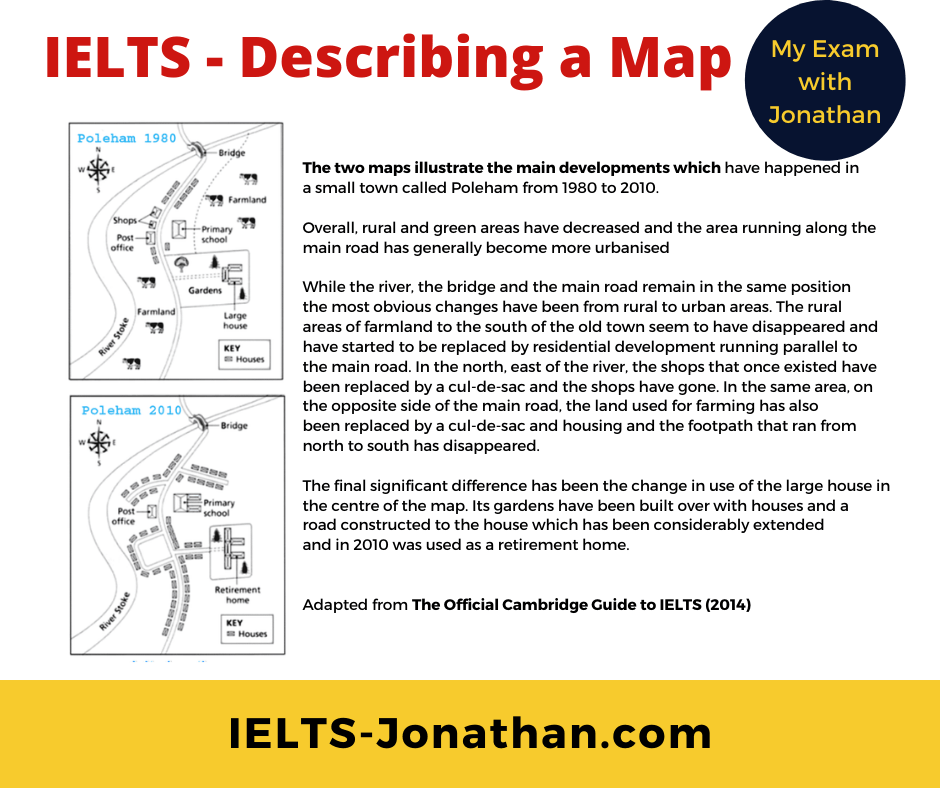
Let's put all this together. Look at the two maps of Poleham town below.
Your Task:
Write 3-4 sentences describing the changes that happened in Poleham between 1980 and 2010. Focus on using spatial language and verbs of change.
Instructions:
- Describe the change to the farmland in the north.
- Describe what happened to the shops in the centre.
- Describe the changes around the large house in the southeast.
- Try to use a different verb of change (e.g.,
replaced,converted,extended) in each sentence.
Take about 10 minutes for this task.
Model Answer:
Here are some example sentences you could have written:
In the north of the town, the farmland was replaced by a sports field. The row of shops that was located in the centre of the town was demolished, and a new cul-de-sac with houses was built in its place. In the southeast, the large house was converted into a retirement home, and the building was extended to include more rooms.
Analysis:
- Spatial Language:
in the north,in the centre,in the southeast. - Verbs of Change:
was replaced by,was demolished,was converted into,was extended. - Clarity: The sentences clearly state what changed and where the change happened.
Conclusion
Great work today! You have learned the essential vocabulary and sentence structures for one of the most common IELTS Writing Task 1 questions.
Key Takeaways:
- To describe locations accurately, use compass points (north, south, east, west) when available.
- If there is no compass, use relative positions (at the top/bottom, on the left/right, next to, etc.).
- Combine spatial language with verbs of change to describe developments over time.
- Remember to use the passive voice (e.g.,
was built,were demolished) because the action is more important than who did it.
In our next lesson, you will learn how to bring all the elements of a Task 1 response together. We will practice writing a complete Task 1 map description of at least 150 words, focusing on the overall structure, including the introduction and overview paragraph.